

ADHD does not stay the same over a lifetime, and it does not look the same in everyone. For years, the picture of ADHD was a hyperactive boy who could not sit still. That image left a lot of people out, especially girls and women, whose ADHD often hides in plain sight and gets missed for decades.
This guide follows ADHD across the stages of life, with a focus on the people it most often overlooks: girls, women, mothers, and older adults. It also covers something the old picture never captured, the real strengths that come with an ADHD brain, and how to put them to work.
This article is for general education only. It is not a substitute for medical advice. If you think you may have ADHD at any age, it is never too late to talk to a licensed provider for an evaluation.
Why ADHD Looks Different Across Life Stages
ADHD is something you are born with, but how it shows up shifts as life changes. Hyperactivity in childhood often turns into inner restlessness and disorganization in adulthood. Hormones, life demands, and the loss or gain of structure all change how strong the symptoms feel. And in girls and women especially, the signs are quieter, so ADHD frequently goes unnoticed until a later crossroads forces the question.
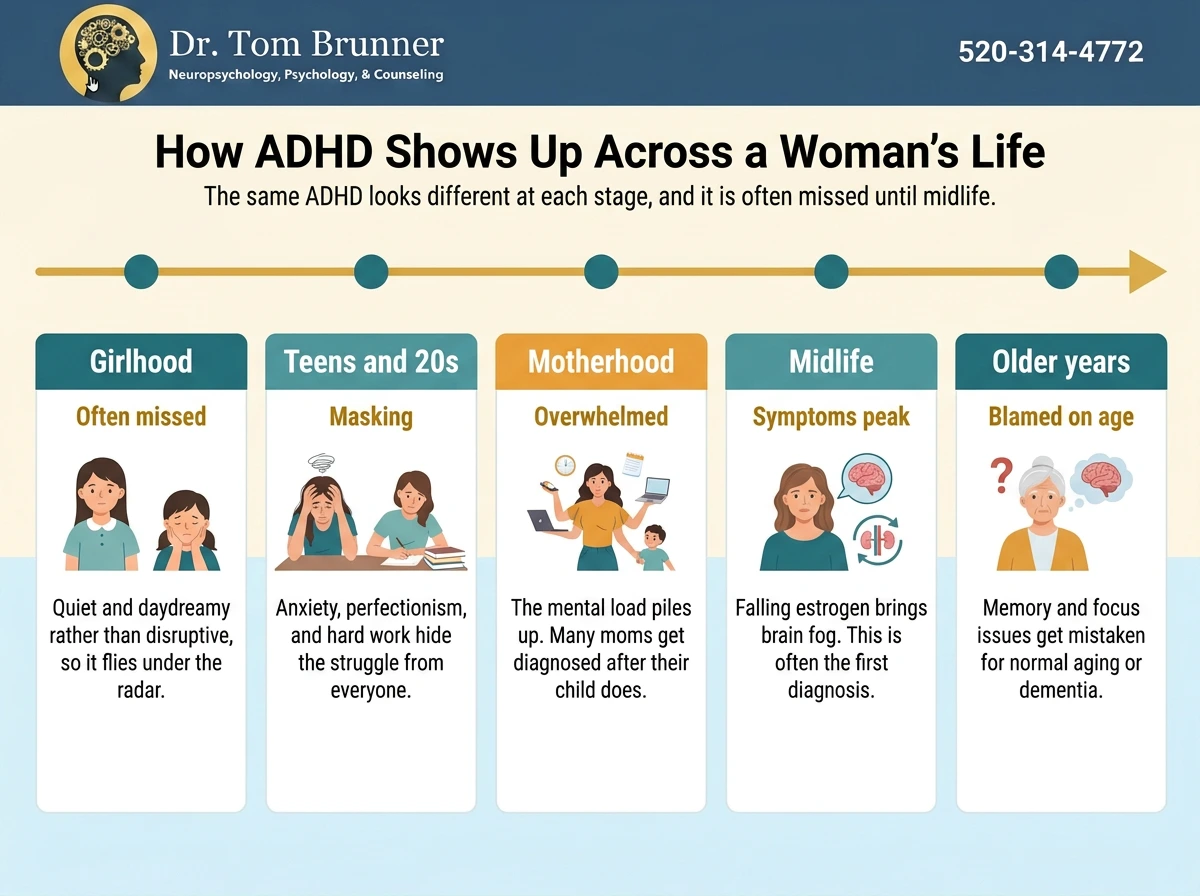
Keep this through-line in mind as you read: the same underlying ADHD can look like a daydreamy child, an anxious high-achiever, an overwhelmed parent, and a forgetful older adult. It was there the whole time. It just wore different clothes.
ADHD in Girls: Why It Gets Missed
Girls with ADHD are diagnosed far less often than boys, and it is not because they have it less. It is because their symptoms look different. Boys more often show the obvious, disruptive kind, running around, blurting out, unable to sit still. Girls more often have the inattentive kind: daydreaming, losing track of assignments, seeming to drift off. That does not disrupt a classroom, so it does not get flagged.
Girls also tend to work hard to cover their struggles, through perfectionism, people-pleasing, and quiet anxiety. On the outside, a girl with ADHD may look like she is doing fine, or just a little scattered. Inside, she may be exhausted from the effort of keeping up. Because nobody sees the struggle, she often grows up believing she is simply lazy or not smart enough, when the real issue had a name all along.
ADHD in Women
The pattern that starts in girlhood continues into adulthood. According to the Attention Deficit Disorder Association, ADHD in women is widely underdiagnosed, in part because women present with more inattentive, internal symptoms and become skilled at masking them. Many women are not diagnosed until their 30s, 40s, or later, often after their own child is diagnosed and they recognize themselves in the description.
Undiagnosed ADHD takes a toll. Women may struggle with overwhelm, disorganization, and emotional sensitivity, and blame themselves for it. ADHD in women also frequently comes with anxiety or depression, and it can overlap with autism, which is similarly underdiagnosed in women. The relief many women describe at finally getting diagnosed is enormous, because the struggle finally makes sense.
A late diagnosis does more than explain the past. It opens the door to real help: medication, therapy, coaching, and practical strategies that many women never knew were available to them. Just as important, it reframes a lifetime of moments a woman may have read as personal failures. The messy desk, the missed deadlines, the sense of running twice as hard to stay in place, all of it starts to look like a manageable condition rather than proof that she was not trying hard enough.
Hormones and ADHD
One piece unique to women is the role of hormones. Estrogen helps regulate dopamine, the brain chemical closely tied to ADHD, so when estrogen rises and falls, ADHD symptoms often rise and fall with it. The ADDA and a growing body of research describe how this plays out across the reproductive years.
| Life phase | What happens to estrogen | Common effect on ADHD |
|---|---|---|
| Monthly cycle | Estrogen dips before your period | Focus and mood often dip too, premenstrually |
| Pregnancy | Estrogen rises | Some women feel steadier, others still struggle |
| Postpartum | Estrogen drops sharply | Symptoms can flare alongside exhaustion |
| Perimenopause and menopause | Estrogen declines for good | Brain fog, memory, and focus often worsen |
Menopause does not cause ADHD, which begins in childhood. But falling estrogen can intensify existing symptoms, and many women are diagnosed for the first time during this transition.
This is why so many women reach perimenopause and suddenly feel like they are falling apart. The brain fog and forgetfulness they blame on menopause may be ADHD that hormones have turned up to full volume. It is worth raising with a provider, because both can be treated.
ADHD in Mothers
Motherhood asks for exactly the skills ADHD makes hardest: planning, remembering, staying organized, and juggling many things at once. The invisible mental load of running a household, the appointments, permission slips, meals, and schedules, lands heavily on a brain that already struggles to keep track. Many mothers with ADHD feel like they are constantly dropping balls and letting their family down.
Add the guilt, and it gets heavier. A mom with ADHD may compare herself to other parents who seem to manage effortlessly and conclude that something is wrong with her. It helps enormously to reframe the picture: the challenge is not a character flaw, it is a brain wired differently trying to do one of the most demanding jobs there is. Practical systems, shared responsibilities, treatment, and self-compassion all lighten the load. And ADHD moms bring real gifts to parenting too, creativity, playfulness, and deep empathy for a child who thinks the way they do.
ADHD in Seniors and Older Adults
ADHD does not vanish with age, but in older adults it is almost invisible in the medical system. Research suggests ADHD is significantly underdiagnosed in seniors, with far more people showing symptoms than ever getting a diagnosis. Many grew up in an era when ADHD was barely recognized, so they never had a chance to be evaluated.
There is an important complication here. In older adults, ADHD symptoms like forgetfulness, trouble concentrating, and disorganization can look a lot like mild cognitive impairment or early dementia, and doctors often assume the latter. The distinction matters, because the treatments are completely different. Worth knowing: there is no evidence that ADHD causes dementia. They are separate conditions that can be confused. If an older adult has struggled with attention and organization their whole life, and not just recently, ADHD deserves to be on the table.
Retirement can also unmask ADHD. The structure of a job often propped up someone’s focus for decades, and when that scaffolding disappears, the symptoms come forward. The encouraging news is that it is never too late. Older adults diagnosed for the first time can respond very well to treatment and finally understand a lifetime of struggle.
Picture a woman in her late sixties who was always the scattered one, forever losing her keys and starting projects she never finished, but who held it together with the routine of work and raising a family. After retirement, with that structure gone, the forgetfulness gets worse, and her family worries it is early dementia. A thorough evaluation finds something else: ADHD that was there all along, finally stepping into view. With treatment, she does better, and decades of self-doubt lift. Stories like this are more common than most people realize.
Careers and ADHD: Finding Work That Fits
A common search is for the best jobs for women with ADHD, or for anyone with ADHD. The honest answer is that there is no single perfect job, but there are kinds of work that fit the ADHD brain better than others. ADHD tends to thrive on interest, variety, movement, and autonomy, and to wilt in rigid, repetitive, low-stimulation roles.
Fields that often suit ADHD strengths include creative work, entrepreneurship, sales, marketing, emergency and crisis response, hands-on trades, and any fast-paced, people-facing role that rewards quick thinking. What matters most is not the job title but the fit: enough stimulation to stay engaged, enough flexibility to work with your rhythms, and enough meaning to spark hyperfocus. Many people with ADHD also do well working for themselves, where they can build their own structure around their strengths.
Leveraging ADHD Strengths
For all its challenges, ADHD comes with genuine strengths, and this is not just feel-good talk. A large 2026 research review and organizations like CHADD point to real, repeatedly observed advantages that often travel with the ADHD brain.

The key phrase is when channeled well. These strengths are the flip side of the challenges: the creativity that comes with a wandering mind, the hyperfocus that is the twin of distractibility, the drive that is restless energy pointed at something exciting. Left unmanaged, they can tip into disorganization, burnout, or impulsive choices. With the right structure and support, they become real advantages. The goal is not to erase ADHD traits, but to build a life that lets the best of them shine.
Frequently Asked Questions
What are the symptoms of ADHD in girls?
Girls more often have the inattentive kind: daydreaming, losing things, trouble following through, and seeming to drift off. They may also mask their struggles with perfectionism and quiet anxiety. Because these signs are not disruptive, they are easily missed.
Is it ADHD or menopause?
It can be both. Falling estrogen in perimenopause can worsen ADHD symptoms and also cause brain fog on its own, so they overlap. A key clue is history: if the attention and organization struggles go back to childhood, ADHD is likely part of the picture. A provider can help sort it out.
Can you be diagnosed with ADHD as a senior?
Yes. It is never too late. Older adults are often diagnosed for the first time, sometimes after symptoms were mistaken for normal aging or dementia. Treatment can still help a great deal at any age.
What are the best jobs for women with ADHD?
There is no single best job, but roles with variety, autonomy, and stimulation tend to fit well, such as creative work, entrepreneurship, sales, and fast-paced or people-facing jobs. The right fit matters more than the specific title.
Is ADHD really more common in men?
Boys are diagnosed more often than girls, but that gap largely reflects underdiagnosis in girls and women, not a true difference in how common ADHD is. As awareness grows, more women are being correctly identified across all ages.
Sources
The information in this article was drawn from the following authoritative sources. Each link goes to the original publication.
Attention Deficit Disorder Association (ADDA): ADHD in Women. Overview of how ADHD presents and is underdiagnosed in women.
ADDA: ADHD and Perimenopause and Menopause. How falling estrogen affects dopamine and ADHD symptoms in midlife.
CHADD: Understanding ADHD from a Strengths-Based Perspective. Research on the strengths that often accompany ADHD.
Centers for Disease Control and Prevention (CDC): About ADHD. General facts on ADHD symptoms and diagnosis across ages.
National Institute of Mental Health (NIMH): ADHD. Federal research summary on ADHD across the lifespan.
The Bottom Line
ADHD travels with a person their whole life, changing shape at each stage. It hides in daydreamy girls, masks itself in high-achieving women, overwhelms busy mothers, and disguises itself as aging in seniors. Along the way, it is missed far too often, especially in women, which means many people spend years struggling without knowing why.
If any of these stages sounds like you or someone you love, the most important message is that it is never too late to get answers. A diagnosis at 15, 45, or 75 can be life-changing, because it turns a lifetime of self-blame into understanding and a plan.
And ADHD is not only a list of challenges. It brings creativity, energy, resilience, and heart. Understood and supported, those strengths are not the exception to ADHD. They are part of the whole picture, at every age.