

Search “ADHD diet” and you will find bold promises: cut this food to cure symptoms, add that supplement to sharpen focus, follow this plan to transform your child. It would be wonderful if it were that simple. The honest truth is more modest, and more useful. Food does not cause or cure ADHD, but good nutrition can support the ADHD brain in real, if smaller, ways.
This guide separates the hype from the evidence. It covers what to actually put on your plate, which “trigger foods” matter (and for whom), the truth about sugar and supplements, and how to eat well when ADHD makes that genuinely harder.
This article is general information, not medical or nutrition advice. Diet is not a treatment or cure for ADHD. Do not change your or your child’s diet, stop any treatment, or start supplements without guidance from a doctor or registered dietitian. This is about nourishing your body, not restricting it or fearing food.
Can Diet Treat or Cure ADHD? The Honest Answer
No. ADHD is a neurodevelopmental condition rooted in brain wiring and genetics, and no food or diet can cure it. As the Child Mind Institute puts it plainly, nutritious meals help the brain function, but there is no solid evidence that any specific food reliably changes core ADHD symptoms. Anyone promising a dietary cure is overselling.
So why talk about food at all? Because nutrition sets the stage. Stable energy, steady blood sugar, and a well-nourished brain make it easier to focus, regulate mood, and get through the day, for anyone, and especially for someone already working hard to self-regulate. Think of good nutrition as a supporting player alongside real treatment, not a replacement for it. Here is how the common beliefs stack up against the evidence.
| Common belief | What the evidence says |
|---|---|
| Sugar makes ADHD worse | Controlled studies do not support sugar causing hyperactivity, though blood-sugar crashes affect anyone’s mood |
| The right diet can cure ADHD | No. Good nutrition supports the brain, but it is not a treatment or a cure |
| Everyone with ADHD should cut dyes, gluten, or dairy | Only a sensitive minority benefits; there is no need to cut foods you do not react to |
| Supplements can fix ADHD | They mainly help if you are genuinely deficient; omega-3 shows a small effect at best |
| There is one official ADHD diet | No single proven diet exists; balanced, whole-food eating is the low-risk bet |
Summarized from ADHD nutrition research and clinical guidance. Individual responses vary; work with a professional.
Foods That Support Focus and Energy
There is no magic ADHD superfood, but the same balanced eating that supports any brain helps here too. The emphasis is on steady, slow-burning fuel rather than quick spikes and crashes.
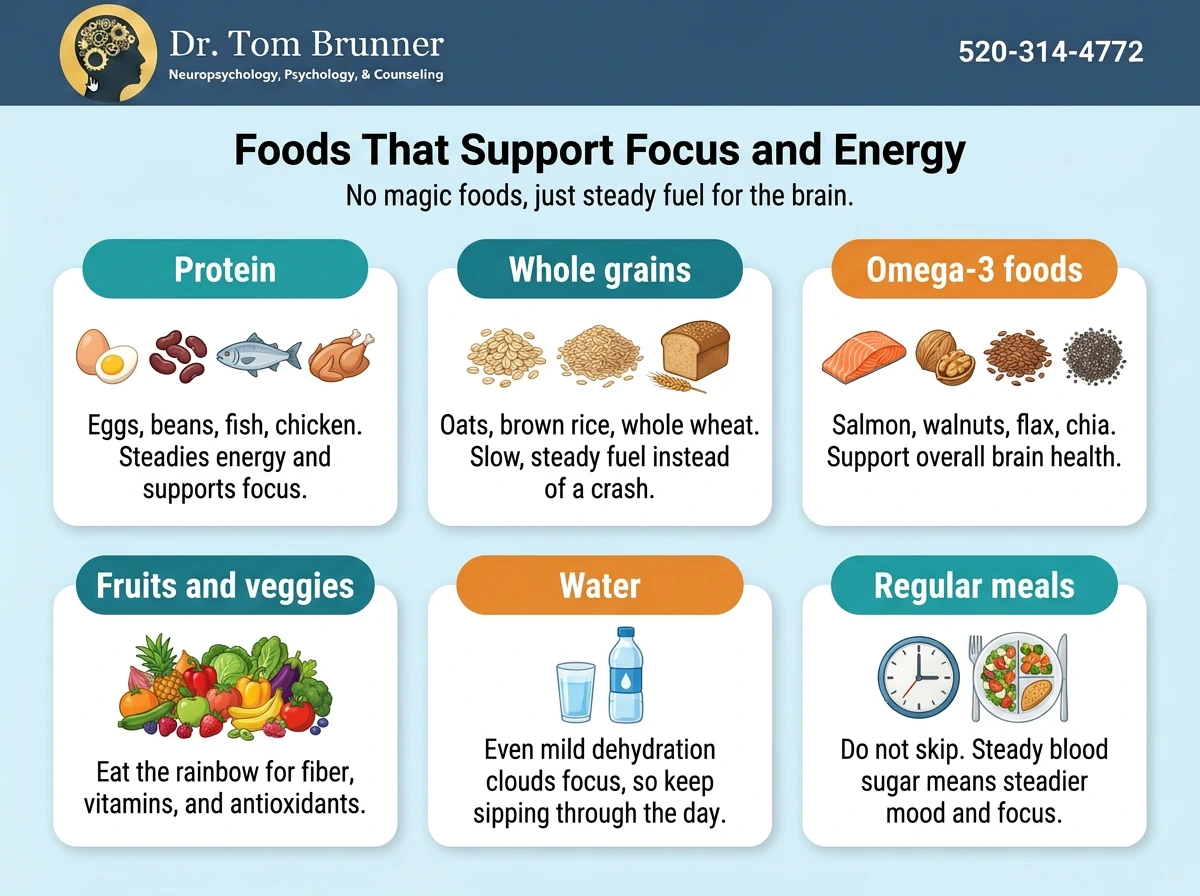
Protein is a standout, because it steadies blood sugar and supplies the building blocks for brain chemicals involved in focus. A protein-rich breakfast is especially helpful. Pair that with complex carbohydrates like oats and whole grains for slow-release energy, healthy fats including omega-3-rich foods like salmon and walnuts, and plenty of colorful fruits and vegetables. Add regular meals and good hydration, and you have covered the fundamentals that matter most.
It is worth noting that overall diet quality seems to matter more than any single food. Research has linked eating patterns rich in whole foods, produce, lean protein, and healthy fats with better focus and mood, and patterns heavy in ultra-processed foods with more symptoms in some people. This is not about perfection or a rigid menu. It is about the general shape of what you eat most days. Small, consistent upgrades, swapping a sugary drink for water, adding a vegetable, choosing whole-grain bread, add up more than any dramatic overhaul you cannot maintain.
Foods and Additives to Be Mindful Of
The flip side gets a lot of attention, often more than the evidence warrants. Here is a measured take, starting with the biggest myth.
The sugar myth
The belief that sugar makes kids hyper is one of the most stubborn in parenting, but well-designed studies, including ones published in the New England Journal of Medicine, found that even high-sugar diets did not measurably change children’s behavior or thinking. The hyperactivity parents notice at birthday parties is more likely the excitement and chaos than the cake. That said, a diet loaded with sugar still means blood-sugar spikes and crashes that can leave anyone irritable and foggy, and it crowds out more nourishing foods, so keeping added sugar moderate is sensible for general health.
Artificial dyes and additives
Here the picture is more nuanced. Some research has found that artificial food dyes and certain preservatives produce small but real increases in ADHD-type symptoms in a subset of sensitive children. The key word is subset: most children are not noticeably affected, but some clearly are. Because cutting back on ultra-processed foods packed with artificial colors and additives is low-risk and healthy anyway, it is a reasonable thing to try, especially if you notice a consistent pattern in a particular child.
What About Supplements?
Supplements are where marketing gets loudest and evidence gets quietest. The honest summary: most do little for ADHD unless you are correcting an actual deficiency.
Omega-3 fatty acids are the most-studied, and the most promising, but even they show only a small to modest effect, mainly on inattention. Children with ADHD do tend to have lower omega-3 levels, so getting more through fish or a supplement may help a little; it is not a game-changer, and major guidelines stop short of recommending it as a treatment. For minerals like iron, zinc, and magnesium, plus vitamin D, the rule is simpler: supplementing helps if a blood test shows you are low, and does little if you are not. More is not better, and some can be harmful in excess, so test before you treat and involve a doctor.
A word of caution about the supplement aisle: products marketed as ADHD “brain boosters” or focus formulas are largely unregulated, rarely tested in rigorous trials, and can be expensive. Some even interact with medications. Impulsive spending on the latest promising powder is a familiar ADHD trap, so treat supplements the way you would any health decision: with a healthy dose of skepticism and a conversation with your provider first.
Dairy, Food Sensitivities, and Special Diets
Many people wonder about specific triggers like dairy or gluten. If a particular food genuinely worsens how you or your child feels, that individual sensitivity is worth taking seriously and exploring, ideally by removing it and reintroducing it under professional guidance to see if the pattern is real. But dairy and gluten are not general causes of ADHD, and there is no reason to cut them without a clear, personal reason.
Strict elimination diets, like the few-foods or Feingold approaches, can help a small minority of children, but they are demanding, hard to sustain, and risk leaving out important nutrients. They should only be done with a dietitian’s supervision, never as a DIY cure. The ketogenic diet, popular elsewhere, has very little evidence for ADHD specifically. In short, special diets are a last resort for particular cases, not a starting point.
Eating Well With an ADHD Brain
Here is the part diet guides usually skip: ADHD makes eating well genuinely harder, and not because of willpower. Stimulant medication can suppress appetite, so meals get skipped during the day and hunger comes roaring back at night. Executive-function struggles make planning, shopping, and cooking feel like mountains. And impulsivity or boredom can drive grazing and takeout. Working with these realities beats fighting them.
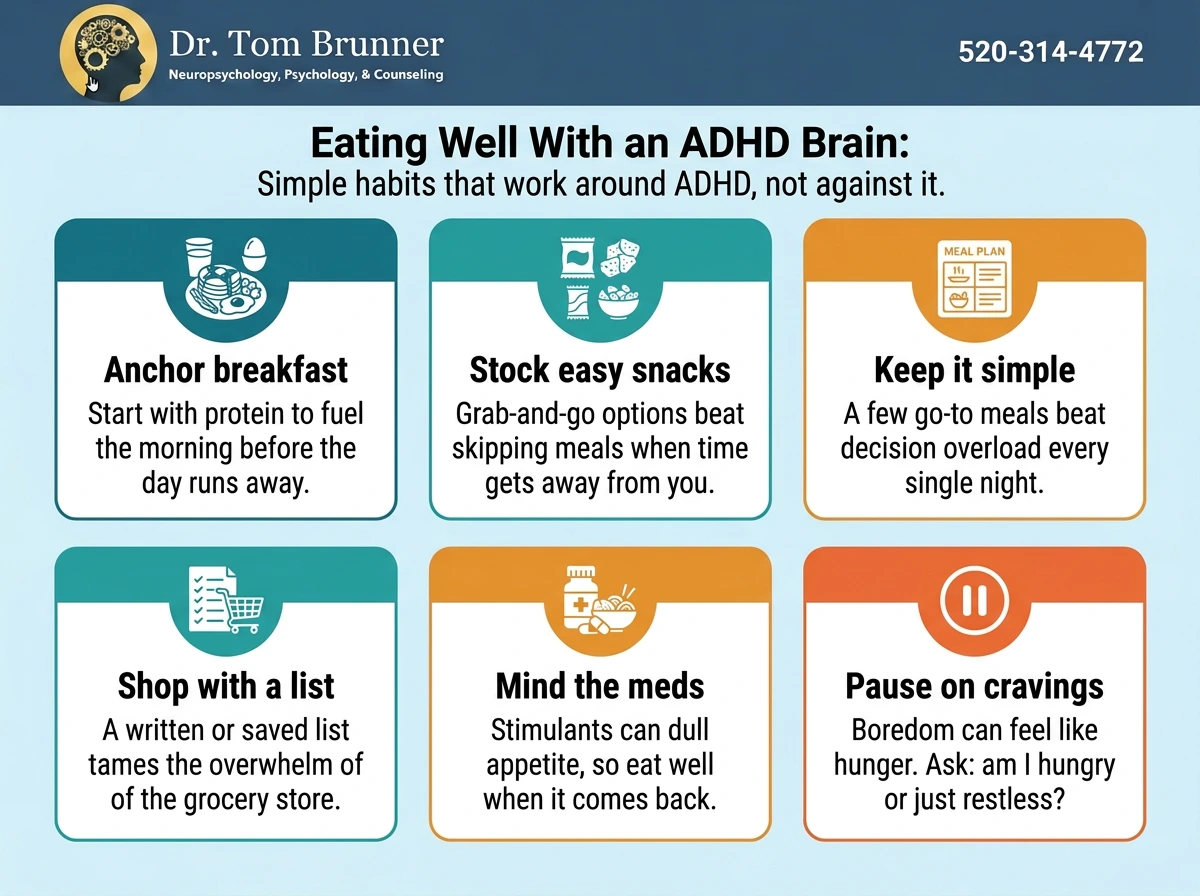
A few small systems go a long way: anchor your morning with a protein-rich breakfast, keep easy grab-and-go snacks on hand so a busy day does not become a skipped meal, lean on a short rotation of simple go-to meals, and shop from a saved list to tame the grocery store. And when a craving hits, pause to ask whether you are actually hungry or just bored or restless. The goal is not a perfect diet. It is steady, sustainable nourishment that supports the rest of your ADHD management.
Frequently Asked Questions
What foods should people with ADHD avoid?
There is no universal list. It is sensible to limit ultra-processed foods high in added sugar and artificial dyes, mostly for general health, and a sensitive minority may react to certain additives. Beyond that, avoid a specific food only if you notice it consistently affects you.
Does sugar make ADHD worse?
Controlled studies do not support the idea that sugar causes hyperactivity. However, sugar-heavy meals cause blood-sugar swings that can leave anyone irritable and unfocused, so moderation is still wise.
Do omega-3 supplements help ADHD?
They may help a little, mainly with attention, but the effect is small and they are not a substitute for treatment. Talk to your doctor before starting, and know that eating omega-3-rich foods is a good option too.
Can changing my diet replace ADHD medication?
No. Diet can support your overall functioning, but it does not replace evidence-based treatment like medication or therapy. Never stop a prescribed treatment in favor of a diet without talking to your prescriber.
Is there an ADHD grocery list?
The best “ADHD grocery list” is simply a balanced one: lean proteins, whole grains, fruits and vegetables, healthy fats and omega-3 foods, and easy, grab-and-go snacks. Building your list around those staples covers the essentials.
Sources
The information in this article was drawn from the following authoritative sources. Each link goes to the original publication.
Child Mind Institute: What We Know About ADHD and Food. Evidence-based overview of diet, sugar, and ADHD.
ADDitude: Nutrition and the ADHD Brain. Practical guidance on protein, carbs, fats, and the sugar question.
Healthline: Nutrition and ADHD. Reviews the research on nutrients, additives, and ADHD symptoms.
Children and Adults with Attention-Deficit/Hyperactivity Disorder (CHADD). National nonprofit with evidence-based ADHD resources.
The Bottom Line
No diet will cure ADHD, and no single food is to blame for it. What nutrition can do is quieter but real: steady your energy and mood, support your brain, and remove a few obstacles to focusing well. That comes from the basics, protein, whole grains, produce, healthy fats, regular meals, and water, not from a rigid or expensive plan.
Be skeptical of dramatic claims and food fear. A sensitive minority may react to certain additives, some people benefit from correcting a real deficiency, and everyone does better with balanced meals. Beyond that, the details matter far less than consistency.
Most of all, keep nutrition in its proper place: a helpful support, working alongside the treatments that actually move the needle on ADHD. Nourish yourself well, stay kind to yourself about it, and let food be one steady piece of a bigger plan.