


People usually picture a neuropsychological evaluation as a long test, the way a school exam is a long test. Sit down, answer questions, get a number back. That picture explains why the process can feel confusing when it starts with an hour of conversation about your childhood, or why the clinician wants to speak with your spouse, or why the results take weeks.
A neuropsychological evaluation is better understood as an investigation. Four main streams of evidence are gathered: your history, your existing records, your performance on standardized tests, and how you function according to someone who knows you well. Each stream can be misleading on its own. The clinician’s job is to see whether they tell the same story, and to reconcile the differences when they tell different stories. The test scores are one stream among four, and the written report, not the scores, is what will clarify what the neuropsychologists ultimate opinion is.
This article explains what a neuropsychological evaluation involves, the four phases it moves through, what gets measured, what the report contains, and who it is for. It is general education about the process as a whole rather than a description of any one practice’s methods.
Neuropsychological Evaluation, Defined
A neuropsychological evaluation is a structured assessment of how well a person’s brain is supporting thinking and behavior, conducted by a psychologist with specialty training in brain-behavior relationships. It combines interview, records review, standardized testing, and collateral information, and concludes with a written report containing findings and recommendations.
Identifying patterns among the brain-behavior relationship is at the core of neuropsychology as a field, and there are specific scientific methods that allow neuropsychology to reveal hidden patterns affecting daily functioning.
A few terms are used interchangeably and mean essentially the same thing:
- Neuropsychological evaluation and neuropsychological assessment. The same process. The term “evaluation” and “assessment” are synonymous.
- Neuropsychological exam. Also synonymous with the terms “evaluation” and “assessment”, although the term “exam” can make people expect something physical. But unlike physicians, neuropsychological evaluation often involves nothing physical because you are answering questions verbally instead of being poked or prodded by a medical professional.
- Neuropsychological testing. Strictly speaking, only the testing portion. In everyday use people say “testing” to mean the whole evaluation. Worth clarifying when you receive a quote, since some practices price testing separately from the report.
What it is not: a screening for emotional issues, an IQ test to assess giftedness, a brain scan, or a therapy session. It is also not pass or fail. Many tasks are built so that almost nobody completes them perfectly, and hitting the ceiling of a task before the questions run out is expected.
Why It Is an Investigation and Not a Test
A single test score is a thin piece of evidence. It reflects how one person performed on one task, on one day, at a certain time of day, under a particular set of conditions. Fatigue, pain, anxiety, poor sleep, a medication change, hearing loss, or simply a bad morning can move a score downward. Sometimes dramatically. Likewise, prior experience taking the same test, high motivation, a lucky guess, stimulant substances like caffeine, medication or familiarity with a similar task can drive scores upward.
The evaluation is designed to account for the ups and downs a person exhibits. Rather than trusting any one measure, it gathers independent evidence and looks for convergence among data points.
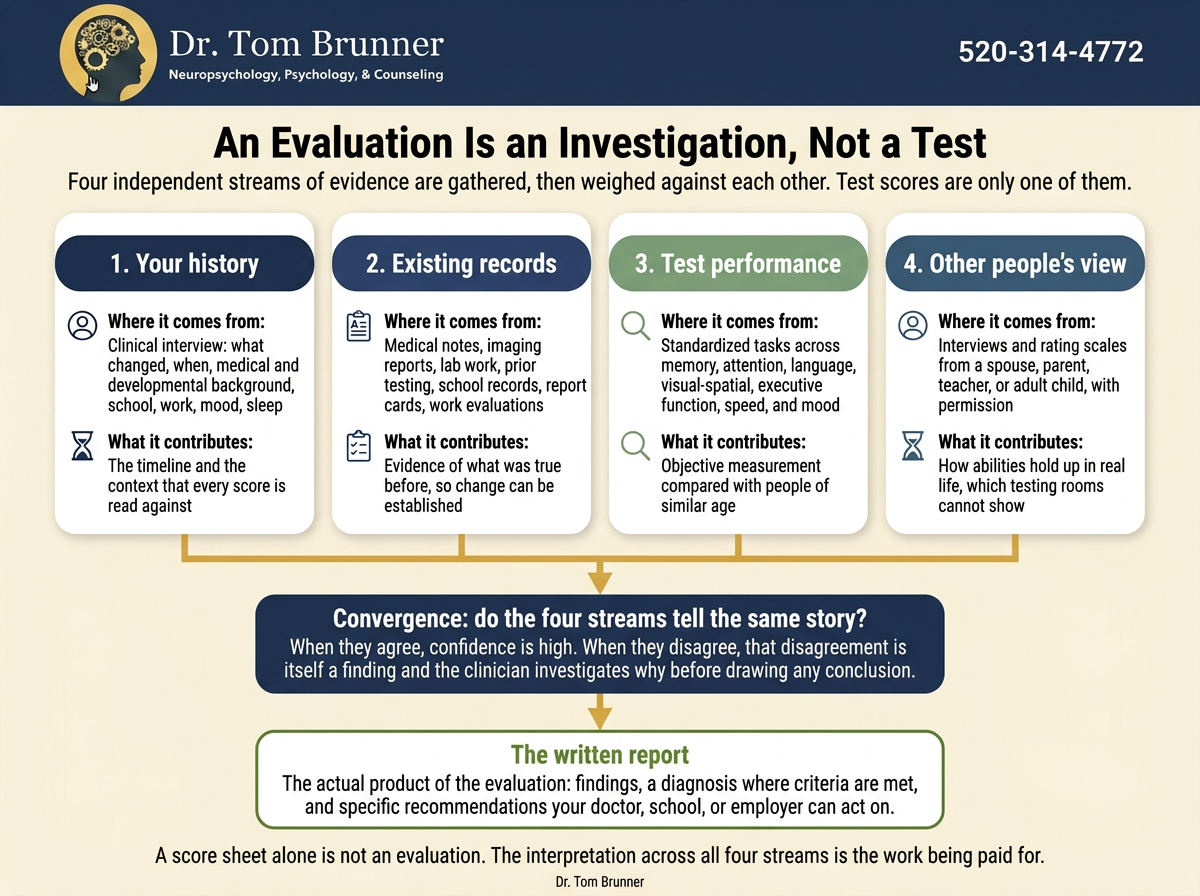
The ultimate goal of the neuropsychologist is to use the scientific method to identify patterns impairing functioning. Identifying how different types of data facilitate discovery of patterns. When history, records, testing, and collateral report all point the same direction, confidence is higher. When they conflict, the conflict is itself a finding worth investigating.
Here are some common scenarios you should be aware of in order to better understand what goes on behind the scenes in the mind of a neuropsychologist:
- Testing scores suggest impairment, but daily life looks intact. Possible explanations for this scenario include medication effects, test anxiety, poor effort, fatigue or a mismatch between the language of the test (E.g., English) and the person’s first language background (e.g., Spanish). Or a person’s abilities might truly be weak but they compensate well in life by masking their impairment. For example, a person with memory issues might be very good at making lists constantly which can make them look like their memories much better in real life. But then when they have to take a memory test with the neuropsychologist they are not allowed to make a list. Like a detective, the clinician must study and deeply investigate any contradictory data. No information is treated as trustworthy immediately. The neuropsychologist has to be in the role of a scrupulous detective who trusts none of the data until all of the data is looked at together.
- Testing looks normal, but the family is certain something changed. This happens with highly educated people whose current “normal” scores actually represent a real decline from a much higher baseline. For example, an engineer or a PhD scientist may have a background of having a gifted mind and so when they only obtain an average score, it doesn’t stand out necessarily, unless one pays close attention to the high level of intellectual functioning this individual previously operated with. This is a common reason a dementia evaluation goes further than a brief screen.
- The person reports no problems, but everyone around them does. Reduced awareness of one’s own difficulties is itself a clinical finding, common after certain injuries and in some dementias. Remember, a defining feature of each individual human is people tend to be defensive and whether there are aware of it or not tend to try and hide any deficiencies.That is just how humans are wired, and this makes sense given humans have had to survive across hundreds of thousands of years where their primary role was to defend themselves against all the creatures around them.
This is why collateral information matters so much, and why an evaluation that skips it is weaker. It is also why the tests included in a battery are chosen rather than fixed. The clinician must sculpt the battery of measures they end up utilizing to address not only obvious questions but hidden issues that can crop up over time. The best neuropsychologists often change the plan of testing after they get initial results.
How the Clinician Reasons Through It
Before testing begins, the neuropsychological clinician will often form competing explanations for the referral question and then identifies types of evidence that would clarify which of the explanations is more accurate and compelling. The illustration below works through a common example.
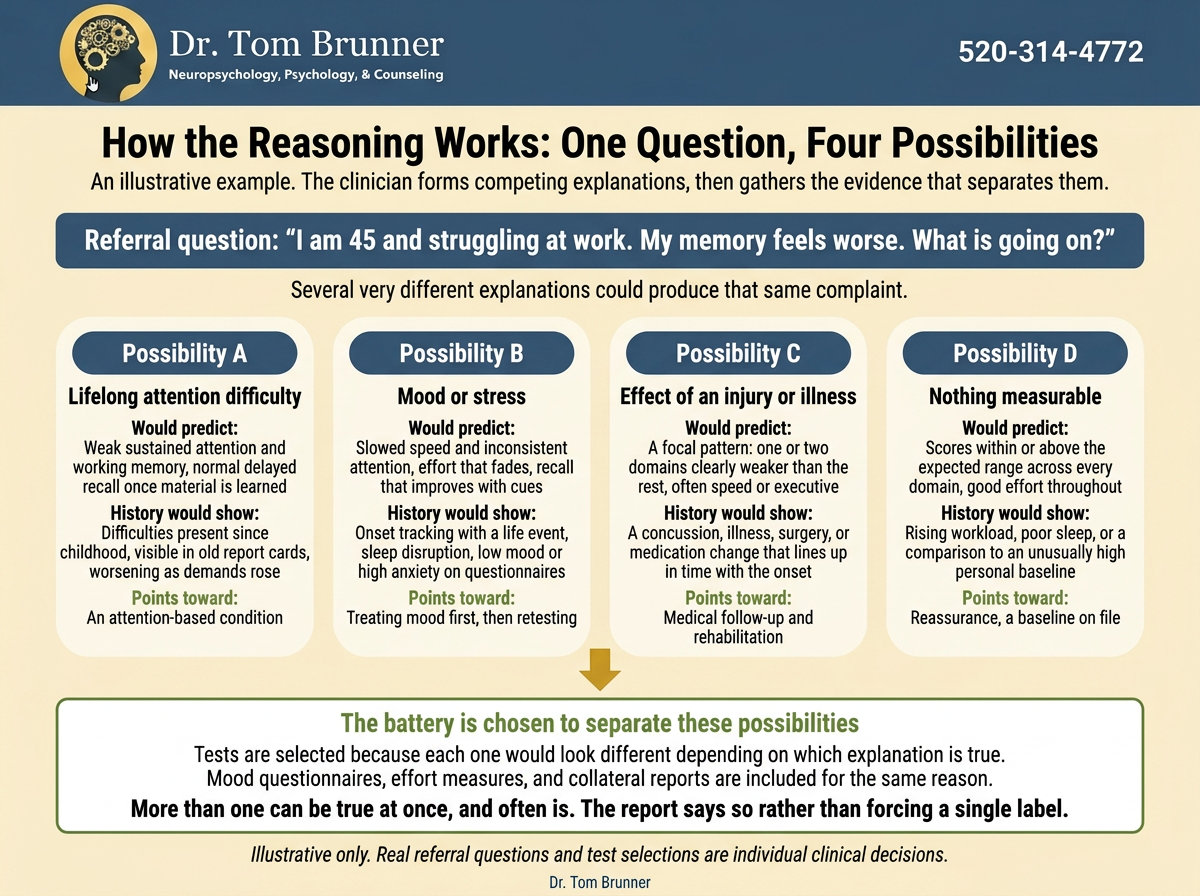
Two features of this diagram are worth emphasizing. First, “nothing measurable” is a real and common outcome, not a failure of the evaluation that makes it a waste of money. Documenting that abilities are intact has genuine value: it redirects attention to sleep, workload, or mood, and it leaves a baseline on file if concerns return later.
Second, more than one explanation is often true at the same time. A person can have a lifelong attention difficulty and a current depression and a recent concussion. A good report says so and ranks the contributors rather than forcing a single tidy label. The best kind of neuropsychological report in the summary report section will describe the evolution of symptoms so that the original layer of symptoms is described first, and then subsequent layers of symptoms and impairments are described after that.
The Four Phases of an Evaluation
Practices differ in scheduling, but nearly every evaluation moves through the same four phases.
| Phase | What happens | Typical time | Who is involved |
|---|---|---|---|
| 1. Intake and history | A detailed interview about what changed and when, plus medical, developmental, educational, work, mood, sleep, and medication history. Records are requested and reviewed. | 1 to 2 hours, plus review time | You, the neuropsychologist, often a family member |
| 2. Testing | Standardized tasks across all relevant domains, given in blocks with breaks. Mood questionnaires and effort measures are included. | 2 to 12 hours, sometimes split across days | You, the neuropsychologist or a trained technician under the neuropsychologist’s supervision |
| 3. Scoring and interpretation | Raw performance scores are converted to normed scores; the pattern is read across domains and weighed against history, records, and collateral report. | 2 to 4 hours, done after you leave | The neuropsychologist |
| 4. Feedback and report | Results are explained in plain language in a meeting, and a written report is delivered to you and, with your permission, to referring providers. | 1-2 hour meeting; report typically 2 to 6 weeks | You, the neuropsychologist, family if you wish |
Typical ranges in U.S. private practice. Hospital clinics, forensic evaluations, and pediatric cases vary.
Notice that roughly half of the professional time happens when you are not in the room. That is the part people are surprised to be billed for, and it is covered in the article on what drives evaluation pricing. Whether an insurer will pay depends on documented medical necessity, which the insurance and coverage article explains in more detail.even if the neuropsychologist cannot accept the co-pay, remember that most often they can provide you with a super bill that you can submit to the insurance company after the testing is completed.
It is also critical you remember that the more experienced a neuropsychologist becomes, the less likely it might be that they can accept insurance.Insurance companies offer very low pay rates and season psychologists become very busy and are often in great demand.
What Gets Measured
The domains sampled depend on the referral question, but a full evaluation touches most of the following:
- Attention and working memory. Focusing, sustaining focus, and holding information briefly in mind.
- Learning and memory. Taking in new information and recalling it after a delay, with and without cues.
- Language. Naming, comprehension, fluency, and word retrieval.
- Visual-spatial skills. Copying, construction, and spatial judgment.
- Executive function. Planning, flexibility, inhibition, and problem solving.
- Processing speed. How quickly straightforward mental work gets done.
- Motor and sensory function. Fine motor speed and coordination, sometimes basic sensation.
- Mood, personality, and behavior. Questionnaires and interview of client and collaterals who know them best, because emotional state shapes cognitive performance.
- Effort and validity. Short validity scales confirming that results reflect genuine ability versus are skewed by odd response styles, faking symptoms or lack of intentional answers due to indifference or an oppositional attitude.
The array of conditions these types of measures help identify or rule out are described in the overview of neuropsychological disorders.
Assessment of academic achievement is added when school performance or need for accommodations is part of the referral question. General intellectual ability is often included as a reference point. For the specific instruments and how a battery is assembled, see how a test battery is put together; the short version is that each test is chosen to help identify patterns while also clarifying which explanation seems to be the most accurate explanation of why an individual is facing challenges.
What You Actually Receive
The deliverable is a written report, usually 6 to 30 pages. But it is not uncommon for a neuropsychological report to extend well beyond 30 pages. For example, if an individual is applying for Social Security disability income, .report might need to include review of up to a thousand pages of records. Record review is a critical part of a solid neuropsychological evaluation.
The structure of a neuropsychological report follows a standard shape: reason for referral, background and history, tests administered, behavioral observations, results by domain, summary and impressions, diagnoses where criteria are met, and recommendations.
The recommendations section is the part that changes lives, and it is worth reading first. Well-written recommendations are specific: which accommodations a student needs and why, whether an adult can safely return to a particular job, what a rehabilitation program should target, what a physician should consider evaluating next, when to repeat testing.
The problem with a lot of neuropsychological reports is there’s a lot of testing done leading to a lot of psychobabble, but the summary does not pull together all of the findings. So the client is left wondering what the findings mean and what they actually need to do going forward. This is why it’s good to ask for a sample report from a neuropsychologist before you choose who you want to work with.
You also attend a feedback meeting. This can be done in person or remotely. Ask questions there, including the uncomfortable ones. A good clinician will tell you plainly what the results do and do not explain. A great neuropsychologist will be honest about what questions have not been answered but will outline a plan for what kind of information needs to be collected to definitively answer any lingering questions.
Making sense of the scores is easier once someone has walked you through percentiles and what “average” vs “well below average” actually means. Remember, it is reasonable to ask for a second conversation after you have read the report.
Great neuropsychology does not just use words to describe what is going on, but often will include a visual drawing or dynamic mind map so you have a crisp clear understanding of the dynamics affecting your daily functioning.

Who Gets a Neuropsychological Evaluation?
To answer this question we first have to start with whether you were referred by a professional. Effort professional refers you they often should get the report. But remember a neuropsychological report is a medical record that is your private property. You decide what should be done with that report. However, if you submit a neuropsychological evaluation billed to insurance, remember the insurance company will commonly ask for the report. That is a reason why some people do not choose to use their insurance to pay for the neuropsychological evaluation.
Referrals come from neurologists, primary care providers, psychiatrists, pediatricians, schools, attorneys, and often from patients and families directly. The common thread is a question that cannot be settled in a regular office visit.
- A change in thinking or memory that needs to be precisely measured rather than casually estimated.
- A child or adult struggling to learn or keep pace with peers despite clear effort, where the reason is not obvious.
- Recovery from an injury or illness affecting the brain, where the effect on mental functioning needs documenting.
- A treatment decision such as epilepsy surgery, deep brain stimulation, or a medication with cognitive effects, that requires a before-and-after assessment of functioning so you know the actual impact the intervention had.
- A question of capacity, safety, or accommodation for school, work, disability, or legal purposes.
Evaluations are adapted to the person. Evaluations for children and adolescents use age-normed measures and rely heavily on parent and teacher input. Older adults are tested in shorter blocks with attention to physical or sensory limitations. The list of changes that commonly prompt a referral may help you decide whether your situation requires a neuropsychological evaluation. If you are in southern Arizona and want to talk it through first, a exploratory phone call is most often free. Remember, many psychologists have an interjurisdictional license allowing them to serve people who do not live near them. In that case they can provide psychological services by video and this also usually begins with a phone conversation about whether testing is the right step at all.
Before You Schedule
A few questions protect you from mismatched expectations:
- What question will this evaluation answer? Say out loud what decision you need to make so the clinician understands what kind of results they need to produce to ensure you can make the decision regarding the dilemma you are facing. The clinician should be able to confirm whether testing can address it.
- Does the fee include the report and feedback meeting? It usually does; confirm rather than assume.
- How long until I receive the report? Two to six weeks is typical. If you have a school or legal deadline, say so before scheduling.
- Who will administer the tests, and who interprets them? Offices vary in terms of whether the neuropsychologist themselves or a technician (often called a psychometrist) will administer the actual measures. Regardless, the neuropsychologist should do the interpretation, report, and feedback.
- Should I bring anyone? For memory, developmental, or behavior questions, a family member who can describe daily functioning adds a critical evidence stream. Even if you don’t bring someone remember you can tell the neuropsychologist that you definitely want certain people to be interviewed. This only enhances the eventual credibility of the evaluation.
Practical preparation is simple: sleep well, eat well, bring your glasses and hearing aids, bring your medication list, and do not study for the tests. Trying to find the tests online is analogous to cheating and this will only artificially inflate your scores and waste your time and money. My article on preparing for the testing day covers timing, breaks, and what to expect physically. If a full evaluation sounds like more than your situation calls for, a shorter screening option may be the better starting point.
Frequently Asked Questions About Neuropsychological Evaluations
What is a neuropsychological evaluation?
A structured assessment of how well the brain is supporting a wide variety of emotional, thinking or behavioral activities, combining a detailed interview, records review, standardized cognitive testing, and input from someone who knows the person well, which concludes with a written report of findings and recommendations that are discussed during a feedback meeting.
What is involved in a neuropsychological evaluation?
Four phases: an intake interview and records review, several hours or more of standardized testing, scoring and interpretation done after you leave, and a feedback meeting with a written report were you can discuss your questions with the neuropsychologist.
What is included in a neuropsychological exam?
Commonly what is included are measures of attention, learning and memory, language, visual-spatial skills, executive function, processing speed, motor function, and mood, plus effort measures that confirm the results are valid. Academic achievement and intellectual ability are added when relevant.
How long does a neuropsychological evaluation take?
Testing usually runs two to eight hours depending on the question, sometimes split across sessions, with an additional interview and a later feedback meeting. The full process from first appointment to report typically spans several weeks.
Is a neuropsychological evaluation the same as neuropsychological testing?
Testing is the portion where standardized tasks are administered. The evaluation is the whole process, including interview, record review, interpretation, and report. People often use the words “testing”, “evaluation” and “assessment” interchangeably.
Do I need a referral?
Many practices accept self-referrals, but insurance often requires a physician referral to establish medical necessity. Check with both the practice and your plan.
Can I fail a neuropsychological evaluation?
No. There is no passing score. Some tasks are designed so almost no one finishes them. The goal is a profile of strengths and weaknesses, not a grade.
What if the results show nothing is wrong?
That is a useful result. It rules out a measurable cognitive disorder, redirects attention to factors like sleep, stress, or mood, and creates a documented baseline for comparison if concerns return.
The Bottom Line
A neuropsychological evaluation is an investigation built from four streams of evidence: your history, your records, your test performance, and how you function in the eyes of someone who knows you. It moves through intake, testing, interpretation, and feedback, and it ends in a written report whose recommendations are the real product. Test scores matter, but only as one input weighed against the rest of the data.
If you are considering one, the most useful preparation is to write down the question(s) you want answered and the decision you are facing right now. Bring that to the first conversation. A clinician can tell you whether an evaluation will answer it, whether a shorter assessment would do, or whether someone else should see you first.
Several hours of testing is a real commitment, and waiting weeks for a report can be hard when you want an answer now. What you get in return is not a number but an explanation, written down, that you and other people will act on so your life can improve. A neuropsychological evaluation can be a life-changing event. For most families a neuropsychological evaluation allows you to stop worrying and gives you a clear roadmap for what you need to do so your life can become much more pleasurable.