

A generation ago, most people knew ADHD only as the label for the kid who could not sit still. Today it shows up everywhere: in hit movies, in the memoirs of Olympic champions, in song titles, and in a flood of relatable videos online. Pop culture has become one of the biggest forces shaping how the world understands ADHD, for better and sometimes for worse.
This guide looks at how ADHD appears across movies, television, music, and social media, which celebrities have spoken openly about living with it, the symbols the community rallies around, and where to find trustworthy information once the show is over.
Pop culture can raise awareness, but it is not a source of medical advice. If you think you or your child may have ADHD, talk to a licensed healthcare provider, and see the trusted resources listed near the end of this article.
Why ADHD in Pop Culture Matters
Representation shapes reality. When a beloved character or a famous athlete has ADHD, it tells millions of people that the condition is real, common, and nothing to hide. That visibility chips away at old stereotypes, the idea that ADHD is just laziness or bad behavior, and it can nudge someone who has struggled quietly for years to finally seek help.
The flip side is that pop culture can also spread myths. A lazy joke or an inaccurate storyline can reinforce the very stereotypes it should be breaking. That is why it helps to know which portrayals ring true, which are played for laughs, and where to go for the real facts.
There is also a bigger shift underneath all of this. More and more, ADHD is being framed as a form of neurodiversity, a natural variation in how brains work, rather than simply a disorder to be fixed. Pop culture has helped carry that idea into the mainstream. When a character or a celebrity treats ADHD as one part of who they are, strengths and struggles together, it gives the audience permission to do the same.
ADHD in Movies and TV
Straightforward films about ADHD are still rare, but the condition and its traits show up more and more on screen. A few stand out.
Percy Jackson: ADHD as a superpower
The Percy Jackson stories, first as bestselling novels, then a 2010 film, and a 2023 streaming series, are the most famous positive portrayal. Percy has both ADHD and dyslexia, and the story reframes them as signs that he is a demigod. His restless energy becomes battle-ready reflexes, and his trouble reading English exists because his brain is wired for Ancient Greek. Author Rick Riordan created Percy partly for his own son, and countless kids with ADHD have felt seen by the character ever since.
South Park: a sharp satire
On the comedy end, the South Park episode “Timmy 2000” from the year 2000 pokes fun at ADD diagnosis and Ritalin. In it, students fake the condition to get out of homework and are quickly medicated. It is a satire aimed at over-diagnosis and over-medication, not a serious or accurate look at ADHD, and its humor is very much of its era. It is worth knowing about mostly because people still search for it.
Beyond these, many popular characters read as having ADHD even when it is never named, the impulsive, distractible, big-hearted friend who cannot sit still. Documentaries in recent years have also started to explore adult ADHD directly. The trend is clear: ADHD is becoming a normal part of the stories we tell.
Why does an accurate portrayal matter so much? Because for a kid who has always felt like the problem child, seeing a hero who shares their wiring can be the first time ADHD looks like something other than a flaw. Percy Jackson works precisely because it does not pity the character or reduce him to his diagnosis. It hands him a quest and lets his differences become part of how he wins.
Celebrities Who Have Opened Up About ADHD
Some of the most accomplished people in the world have ADHD and have chosen to talk about it. Their openness does real good, because it shows that ADHD and success are not opposites. Here are a few who have shared their experience publicly.
| Name | Known for | What they have shared |
|---|---|---|
| Simone Biles | Gymnastics | Confirmed in 2016 that she has ADHD and has taken medication since childhood, saying it is nothing to be ashamed of. |
| Michael Phelps | Swimming | Diagnosed at age 9. Has written about how swimming gave his restless energy a focused outlet. |
| Justin Timberlake | Music, acting | Has said he lives with both ADHD and OCD. |
| Paris Hilton | Business, media | Opens her memoir discussing how ADHD has shaped her life and work. |
| Mark Ruffalo | Acting | Diagnosed with ADHD, dyslexia, and depression in his youth. Speaks about learning to manage it. |
| Howie Mandel | Comedy, TV | Lives with ADHD and OCD, and says his symptoms found their way into his comedy and career. |
| Adam Levine | Music | Has spoken about carrying ADHD into adulthood and taken part in awareness efforts. |
| Barry Keoghan | Acting | Diagnosed in his late twenties, and credits treatment for helping him manage symptoms. |
Based on public statements and interviews. Details reflect what each person has chosen to share.
A common thread runs through many of these stories. People often describe their ADHD as double-edged: the same restless, fast-moving mind that made school hard also fuels creativity, hyperfocus, and relentless drive in the right setting. Athletes talk about channeling their energy into training. Artists point to the flood of ideas that never stops. It is not that ADHD is a gift instead of a challenge. It is that, with support, the traits can cut both ways.
It is also worth noticing how many of these public voices are women, several of whom were diagnosed as adults. ADHD in girls is often missed, because it can look like daydreaming or anxiety rather than the classic hyperactive boy stereotype. When high-profile women speak up, they help close that gap and prompt others to ask questions they might have carried silently for years.
ADHD in Music and Online Culture
Music has picked up the theme too. Kendrick Lamar named a track on his 2017 album ADHD, using the term less as a clinical description and more as a metaphor for a restless, overstimulated generation. It is a good example of how the label has entered everyday language. If you are looking for the actual lyrics, licensed sites like the artist’s official pages or streaming services are the place to find them.
Social media may be where ADHD culture is loudest right now. Hashtags like #ADHD have billions of views, and creators share relatable clips about time blindness, losing their keys, and the chaos of an ADHD brain. ADHD jokes and memes are everywhere, and for many people they are a genuine relief, a way to laugh at shared struggles and feel less alone.
There is a catch worth naming. Online content is not a diagnosis. Some of it is accurate and validating, and some of it oversimplifies or turns normal quirks into supposed symptoms. Enjoy the memes, take the medical claims with a grain of salt, and check anything serious against the trusted sources below.
ADHD Awareness: Symbols, Colors, and October
The ADHD community has its own symbols, and they show up especially in the fall. Here is what they mean.
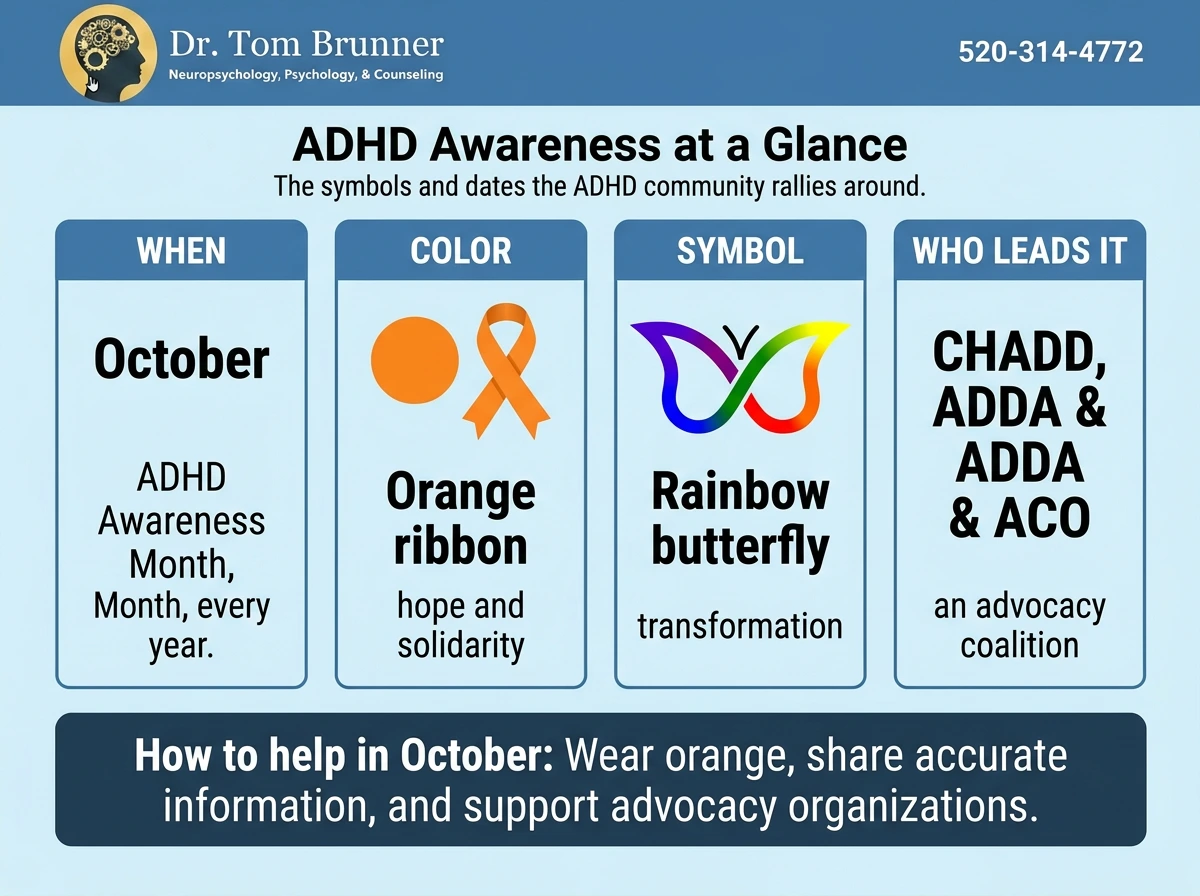
October is ADHD Awareness Month, which began in 2004 and is now coordinated by a coalition of advocacy groups. The awareness color is orange, and the orange ribbon stands for hope, energy, and solidarity with the ADHD community, much like the pink ribbon does for breast cancer. Many people also use a rainbow butterfly as a symbol of neurodiversity and the fast, shifting nature of the ADHD mind. Each October, groups like CHADD and ADDA run campaigns to share facts and reduce stigma. Wearing orange and sharing accurate information are two simple ways to take part.
Trusted Online Resources for ADHD
When you want facts instead of hot takes, these reputable, non-commercial sources are the best places to start. Each one is run by a respected medical body or nonprofit.
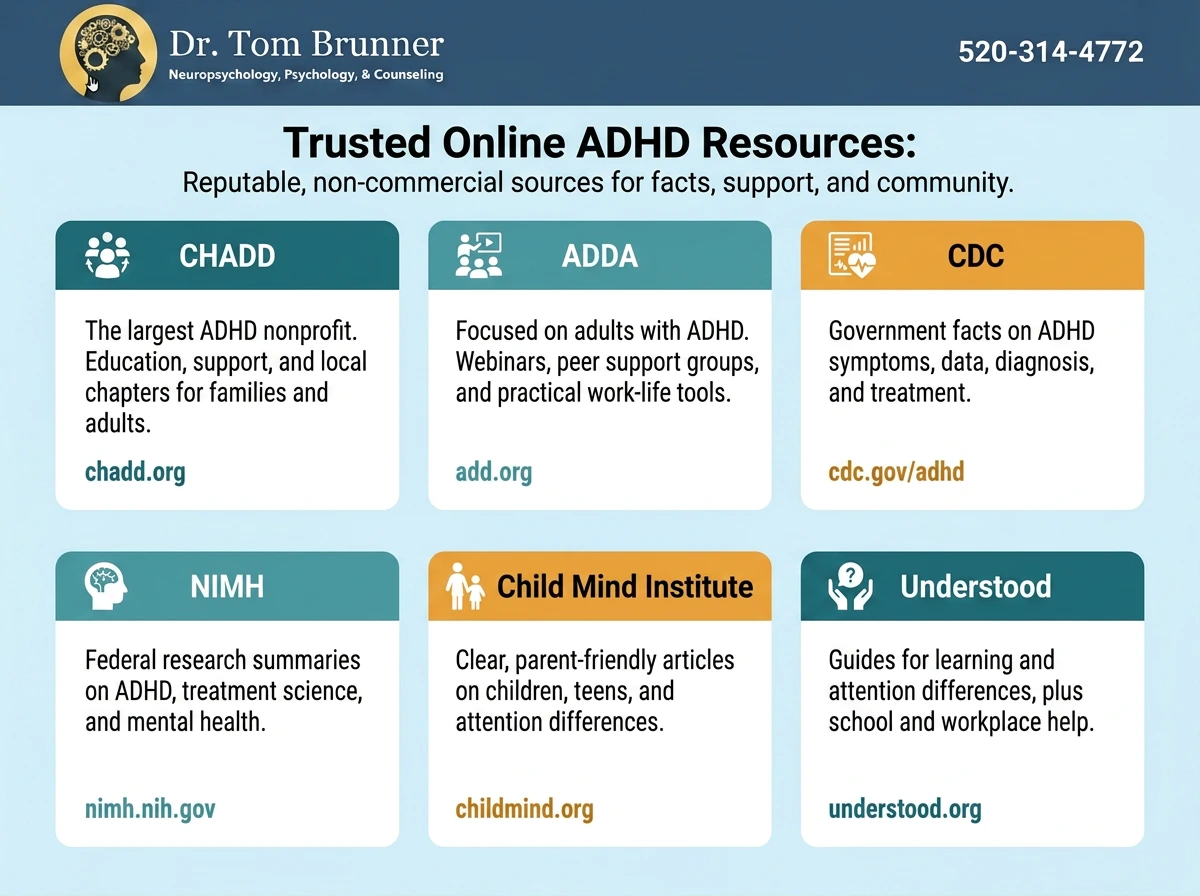
- CHADD. The largest ADHD nonprofit, with education, support, and local chapters for families and adults.
- ADDA. The Attention Deficit Disorder Association, focused on adults with ADHD, with webinars and peer support.
- CDC. Government facts on ADHD symptoms, data, diagnosis, and treatment.
- NIMH. The National Institute of Mental Health, with research summaries on ADHD and mental health.
- Child Mind Institute. Clear, parent-friendly articles on children, teens, and attention differences.
- Understood. Practical guides for learning and attention differences, including school and workplace support.
Frequently Asked Questions
What movies feature a character with ADHD?
The clearest example is Percy Jackson, whose ADHD and dyslexia are central to the story and framed as strengths. Many other characters show ADHD-like traits without naming the condition, and a growing number of documentaries explore adult ADHD directly.
Is there a song called ADHD?
Yes. Kendrick Lamar released a track titled ADHD on his 2017 album. He uses the term as a metaphor for a restless, overstimulated generation rather than as a clinical description. You can find the lyrics on licensed music sites.
What is the ADHD awareness color and symbol?
The awareness color is orange, shown as an orange ribbon that stands for hope and solidarity. Many people also use a rainbow butterfly to represent neurodiversity. ADHD Awareness Month is every October.
Which celebrities have ADHD?
Many have spoken openly about it, including Simone Biles, Michael Phelps, Justin Timberlake, Paris Hilton, Mark Ruffalo, Howie Mandel, Adam Levine, and Barry Keoghan. Their openness helps reduce stigma.
Are ADHD memes and TikToks accurate?
Sometimes. Many are relatable and validating, but social media is not a diagnosis. Some content oversimplifies or mislabels ordinary habits as symptoms. Enjoy it, but check serious questions against trusted medical sources.
Sources
The information in this article was drawn from the following authoritative and reputable sources. Each link goes to the organization’s website.
Children and Adults with Attention-Deficit/Hyperactivity Disorder (CHADD). National nonprofit and a lead organizer of ADHD Awareness Month.
Attention Deficit Disorder Association (ADDA). Nonprofit focused on adults with ADHD, and an ADHD Awareness Month partner.
Centers for Disease Control and Prevention (CDC): About ADHD. Government overview of ADHD facts and treatment.
National Institute of Mental Health (NIMH): ADHD. Federal research summaries on ADHD.
Child Mind Institute. Nonprofit with parent-friendly articles on children and mental health.
Understood. Nonprofit resource for learning and attention differences.
The Bottom Line
ADHD has stepped into the cultural spotlight. It powers a hero’s journey in Percy Jackson, gets skewered in old satire, lends its name to a Kendrick Lamar track, and fills millions of relatable videos online. Meanwhile, champions like Simone Biles and Michael Phelps have shown the world that ADHD and greatness can go hand in hand.
This visibility matters. Every honest portrayal and public disclosure makes it a little easier for the next person to understand their own mind and ask for help. The orange ribbon in October is a reminder of that shared story.
Just remember where pop culture ends and real support begins. Movies and memes can spark the conversation, but the trusted resources above, and a licensed professional, are where the real answers live.