


Neurology, neuropsychology, and neuropsychiatry all have “neuro” in the name, all deal with the brain, and all get recommended to people who have noticed something changing. That is where the similarities end. They ask different questions, use different tools, and one of them cannot write a medication prescription.
The practical difference between neurology and neuropsychology comes down to this: a neurologist looks for what is physically wrong with the nervous system, a neuropsychologist measures how well the brain is working in thinking and daily life, and a neuropsychiatrist sorts out whether changes in mood or behavior are coming from a brain condition. Which one you should see first depends on the symptom you noticed, not on which name sounds most serious.
This article compares the three specialties side by side, walks through common scenarios and who handles them first, and explains how the referral order flips as answers come in. It is general education. For a specific concern, the right starting point is often your primary care provider, and anything sudden or severe belongs in an emergency room.
The Short Answer: Three Specialists, Three Questions
Each specialty is built around a different question. Once you know the question, the rest of the differences follow.
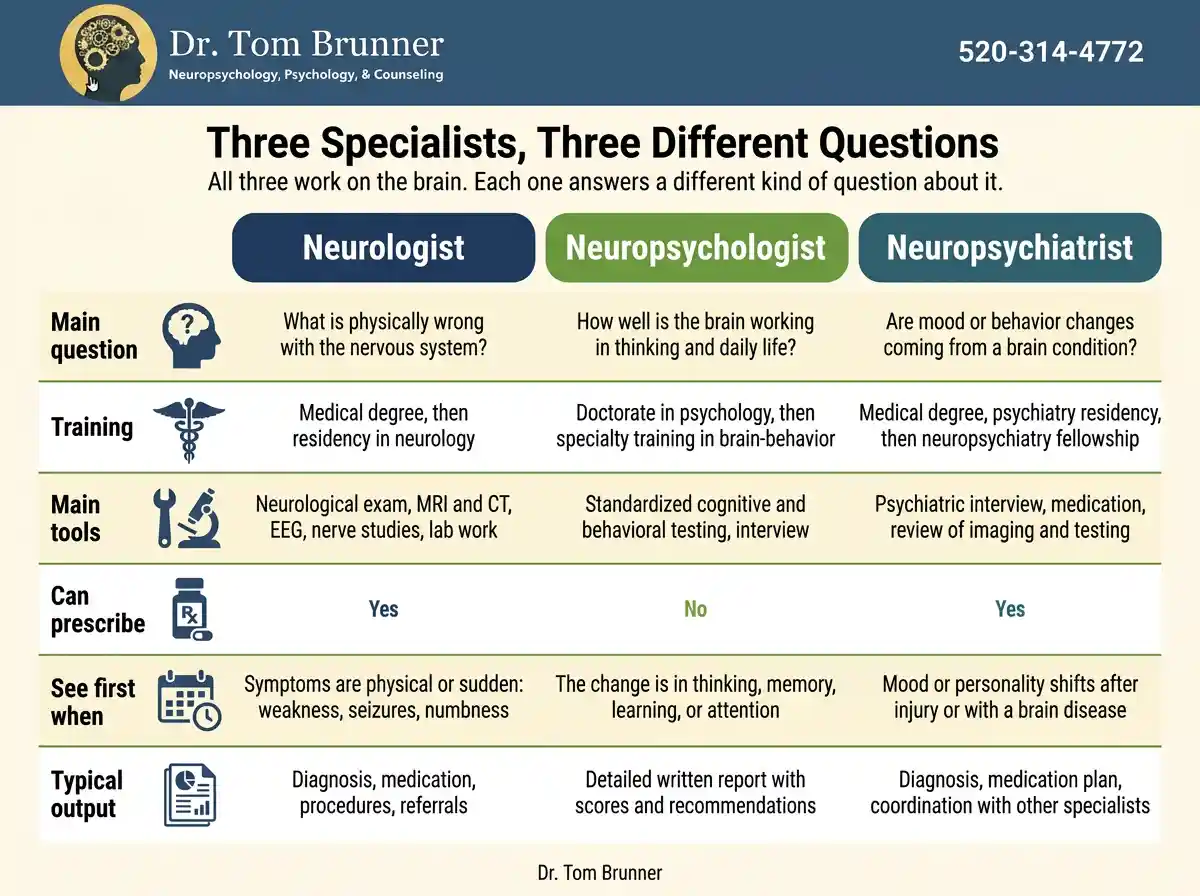
General distinctions in U.S. practice. Individual clinicians may hold additional credentials or roles.
What a Neurologist Does
A neurologist is a physician who diagnoses and treats disorders of the brain, spinal cord, nerves, and muscles. The neurologist’s exam is hands-on: reflexes, strength, sensation, eye movements, coordination, gait. When the exam raises a question, the neurologist orders the tools that see inside: MRI or CT to look at structure, EEG to record electrical activity, nerve conduction studies, and blood work.
Neurologists treat epilepsy, stroke, Parkinson’s disease, multiple sclerosis, migraine, neuropathy, and many dementias. They prescribe medication and perform or refer for procedures. When a condition also affects thinking, a neurologist frequently sends the patient for testing, which is how many people first hear the word neuropsychology.
A common handoff from neurology to neuropsychology is common after a stroke, where the scan shows where the neurological damage is and neuropsychological testing shows what that stroke did to a persons functioning.
Another example is regarding epilepsy care, where testing before epilepsy surgery measure pre-surgery language and memory functions that surgery could affect.
Because a referral for neuropsychological assessment often arrives without warning, it is worth knowing in advance what an evaluation is likely to cost.
What a Neuropsychologist Does
A neuropsychologist is a psychologist with a doctorate and specialty training in how the brain produces thinking and behavior. Neuropsychologists do not perform physical exams, order imaging, or prescribe.
Their instrument is the standardized test, and clinical neuropsychology as a specialty exists to measure what no scan can: memory over time, sustained attention, language, problem solving, and processing speed, compared with people of similar age and background.
The neuropsychologist’s output is a written report. It answers questions like whether memory has actually declined, whether a student’s struggles fit a learning disability, how much a head injury changed thinking, and what supports or treatments the results point toward.
The tests a neuropsychologist chooses are assembled for the referral question, which is why two evaluations can look quite different. If you are unsure who actually performs the testing in a given office, ask; a licensed psychologist should be interpreting the results even when a technician administers some tasks.
What a Neuropsychiatrist Does (and Where Behavioral Neurology Fits)
Neuropsychiatry vs. neuropsychology is the comparison people find hardest, because the names differ by only a few letters. The difference is large.
A neuropsychiatrist is a physician, trained first in psychiatry, who specializes in psychiatric symptoms that arise from neurological disease or injury: depression after a stroke, personality change after a brain injury, psychosis in epilepsy, agitation in dementia, mood and behavior changes in Huntington’s or Parkinson’s disease.
Because neuropsychiatrists are physicians, they prescribe and manage medication. Because they are trained in the brain, they read imaging and neuropsychological reports fluently and use both to decide whether a symptom is primarily psychiatric, primarily neurological, or both.
Behavioral neurology
Behavioral neurology is the mirror image: a neurologist who specializes in the thinking and behavior effects of brain disease. In the United States the two subspecialties have converged, and behavioral neurology and neuropsychiatry training often are merged and offer one certification.
In practice, a patient referred to either will find a physician focused on the same territory, the place where brain disease and behavior meet. Neuropsychology sits alongside both, providing the measurements of functioning
Who You See First Depends on the Symptom
People often start by asking which specialist is best. The more useful question is what changed. Describe the change in plain words, and the starting point usually becomes obvious.
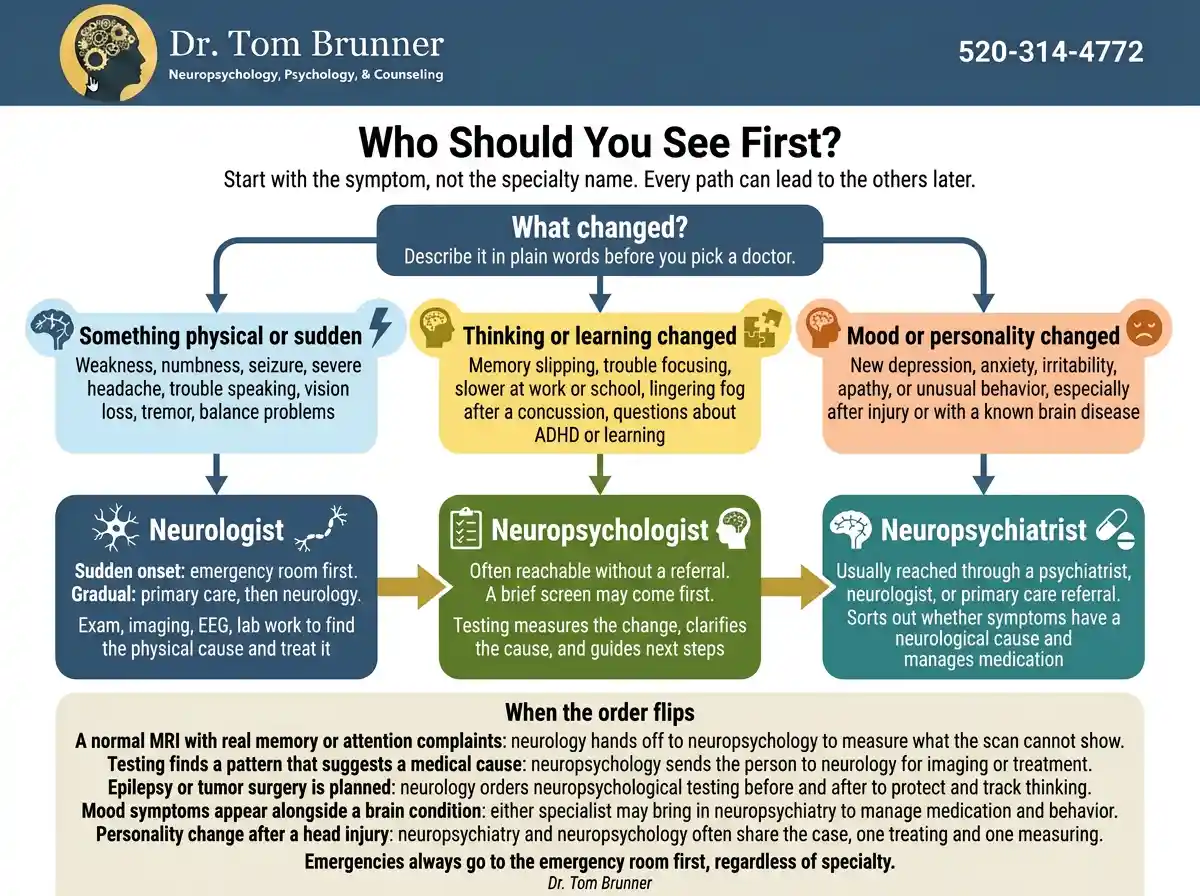
| What you noticed | Usually see first | Why |
|---|---|---|
| Sudden weakness, numbness, slurred speech, severe headache, seizure | Emergency room, then neurology | These can signal stroke or another emergency. Time matters. |
| Gradual memory slipping, repeating questions, getting lost | Primary care, then neuropsychology and neurology together | Testing measures the change; neurology rules out treatable medical causes. |
| Fog, slowed thinking, or trouble focusing weeks after a concussion | Neuropsychology | Scans are usually normal. Testing documents the effect and guides return to work or school. |
| Child or adult struggling with attention, reading, or school despite effort | Neuropsychology (or a psychologist who does testing) | There is no scan finding for ADHD or learning disabilities. Diagnosis rests on history and measured performance. |
| New irritability, apathy, or personality change after a head injury or with a brain disease | Neuropsychiatry, often with neuropsychology | Medication and behavioral treatment come from the physician; testing measures the cognitive side. |
| Depression or anxiety with trouble concentrating, no neurological history | Psychiatrist or psychologist first | Mood often clouds thinking. If cognitive problems persist after mood improves, testing follows. |
| Known epilepsy, tumor, or Parkinson’s disease and surgery is being considered | Neurology, which orders neuropsychological testing | Baseline and follow-up testing protect and track functions that treatment could affect. |
Typical pathways, not rules. Local access, insurance, and the referring provider’s judgment shape the actual order.
Many people can reach a neuropsychologist directly. If you are in southern Arizona, a neuropsychologist in Tucson AZ who specializes in neuropsychological assessment can tell you in a brief conversation whether testing fits your situation or whether a neurologist should see you first. That kind of triage is part of the job, and a good clinician will send you elsewhere when that is the right answer.
How the Three Specialties Work Together
In real cases the three rarely work in isolation. A dementia workup is the clearest example. The neurologist rules out reversible causes with lab work and imaging. The neuropsychology side of a dementia workup establishes whether memory and thinking have measurably declined, in what pattern, and how much daily function is affected. If agitation, depression, or sleep disruption become the main problem, neuropsychiatry manages medication. Each answers the question it is built for, and the family gets a complete picture.
Brain injury follows the same shape. Neurology handles the acute medical care. Brain injury neuropsychology measures what changed once the person is stable and tracks recovery over months. If mood or personality shift in ways that strain the household, neuropsychiatry joins. The referral loop can run in any direction, and it should. When a neuropsychologist’s testing reveals a pattern that looks medical, the right next step is a neurologist, not another test.
Neuropsychology vs. Neurology: Common Points of Confusion
Is a neuropsychologist a doctor?
Yes in the academic sense (a doctorate in psychology) and no in the medical sense. A neuropsychologist is not a physician, does not attend medical school, and does not prescribe. The title “Dr.” is accurate; the expectation of a prescription pad is not.
Can a neuropsychologist diagnose?
Yes, within scope. Neuropsychologists diagnose conditions defined by cognitive and behavioral criteria, such as ADHD, learning disorders, and mild or major neurocognitive disorder. They do not diagnose the underlying medical disease; a neuropsychological report may say the pattern is consistent with a particular cause, and the physician confirms it.
Can a neurologist do neuropsychological testing?
Neurologists perform brief cognitive screens in the office, and some order computerized measures. A full neuropsychological evaluation requires training most neurologists do not have, which is why they refer out to a neuropsychologist for it.
Which one is better?
Neither. They answer different questions. Asking which is better is like asking whether a blood test or an X-ray is better. Each field has its own job, and confusion usually comes from the shared vocabulary rather than any real overlap in what they do.
If you are trying to decide whether any of this applies to you, a good first step is to review the neuropsychological signs or symptoms that typically prompt an evaluation. When depression and neuropsychology overlap, as they often do, the order of care matters: treating the mood first sometimes clears the cognitive complaint entirely.
Frequently Asked Questions About Neuropsychology, Neurology, and Neuropsychiatry
What is the difference between neurology and neuropsychology?
Neurology is a medical specialty that diagnoses and treats physical disorders of the nervous system using exams, imaging, and medication. Neuropsychology is a psychology specialty that measures how well the brain is working through standardized testing and produces a report to guide diagnosis and care.
What is the difference between neuropsychiatry and neuropsychology?
A neuropsychiatrist is a physician who treats psychiatric symptoms caused by brain disease or injury and can prescribe medication. A neuropsychologist is a psychologist who measures cognitive and behavioral function through testing and does not prescribe.
Do I need to see a neurologist before a neuropsychologist?
Not always. Many neuropsychologists accept self-referrals for concerns about memory, attention, or learning. If your symptoms include anything physical or sudden, see a physician first. Insurance plans may require a referral for coverage.
What is behavioral neurology?
A neurology subspecialty focused on how brain disease affects thinking and behavior. It overlaps heavily with neuropsychiatry, and the two are now often trained and certified together in the United States.
Who should I see for memory loss?
Start with your primary care provider, who can run a brief screen and check for reversible causes. From there, neuropsychology measures the change and neurology evaluates the medical side. Sudden memory loss or confusion is an emergency.
Can a neuropsychologist prescribe medication?
No. Neuropsychologists are not physicians. Medication decisions come from a neurologist, psychiatrist, neuropsychiatrist, or primary care provider, often informed by the neuropsychologist’s report.
Is neuropsychological testing part of a neurology visit?
A brief cognitive screen may be. A full evaluation is a separate, multi-hour process performed by a neuropsychologist, usually on referral from the neurologist.
The Bottom Line
Neurology finds what is physically wrong and treats it. Neuropsychology measures how the brain is actually working and explains what that means for daily life. Neuropsychiatry treats mood and behavior changes that come from brain conditions and manages the medication. The three overlap in territory but not in tools, and each refers to the others constantly.
The practical next step is to write down what changed, when, and how it affects the day, then match that description to the table above. Physical or sudden goes to medicine first. Thinking and learning goes to neuropsychological testing. Mood and personality with a brain condition goes to neuropsychiatry. When in doubt, primary care can route you.
Choosing a specialty is not a test you can fail. Every one of these professionals knows how to send you to the right door when you have knocked on the wrong one’s door. What matters is that you start.