

If you have ADHD, you have probably wondered whether it counts as a disability, and what that word even means for you. Does it entitle you to help at school or work? Could it get you benefits? Could it stop you from serving in the military? These are real, practical questions, and the answers matter for your daily life.
The short version is that ADHD can be a legally protected disability, and that protection can open doors to real support. But the details depend on your situation. This guide walks through your rights under the ADA and other laws, the accommodations you can ask for at school and work, whether ADHD qualifies for disability benefits, and the current rules about joining the military.
This article explains general legal protections and is not legal advice. Your rights and eligibility depend on your specific situation. For advice about your case, talk to an attorney, and for benefits, contact the Social Security Administration.
Is ADHD a Disability? The Short Answer
Yes, ADHD can be a disability under U.S. law. The Americans with Disabilities Act (ADA) protects people whose ADHD substantially limits a major life activity, such as concentrating, thinking, learning, or working. That protection is not automatic. It depends on how much ADHD affects your daily functioning. For many people, it clearly qualifies, and that opens the door to accommodations and protection from discrimination.
Here is a quick reference to the questions people ask most. The sections below explain each one in detail.
One helpful piece of history: in 2008, Congress passed the ADA Amendments Act, which deliberately widened who counts as having a disability. Before that, courts often read the ADA narrowly. The update made clear that conditions like ADHD should be covered when they substantially limit a major life activity, and that the bar for “substantially limits” is not meant to be demanding. In practice, that makes it easier for people with ADHD to claim the law’s protection.
| Common question | The honest answer |
|---|---|
| Is ADHD covered by the ADA? | Yes, if it substantially limits a major life activity like concentrating. |
| Can I get workplace accommodations? | Yes. Request them, then work through the interactive process with your employer. |
| Can I get school accommodations? | Yes, through a 504 plan or an IEP. |
| Can adults get disability benefits? | Rarely on ADHD alone. Only severe, well-documented cases that prevent working qualify. |
| Can children get SSI? | Sometimes, in severe cases. Most claims are denied. |
| Can I join the military? | Often yes, with conditions. Rules vary by branch (see below). |
A quick reference only. Each answer depends on your specific circumstances and documentation.
Is ADHD a Mental Illness or a Learning Disability?
These labels confuse a lot of people, so let us sort them out. ADHD is officially a neurodevelopmental disorder, meaning it is tied to how the brain develops and works. It is not a mental illness in the way that term is usually used, though it is often grouped under the broader umbrella of mental health, and it can raise the risk of conditions like anxiety and depression.
ADHD is also not a learning disability. A learning disability affects a specific academic skill, like reading (dyslexia) or math (dyscalculia). ADHD affects attention and self-control across the board. The two are separate, though they often occur together. Why does the label matter here? Because the legal protections do not care much about which box ADHD fits in. What matters is whether it substantially limits a major life activity. If it does, you are protected, whatever you call it.
The Laws That Protect You
Three main federal laws protect people with ADHD, and they cover different parts of life. Knowing which one applies helps you ask for the right kind of support.
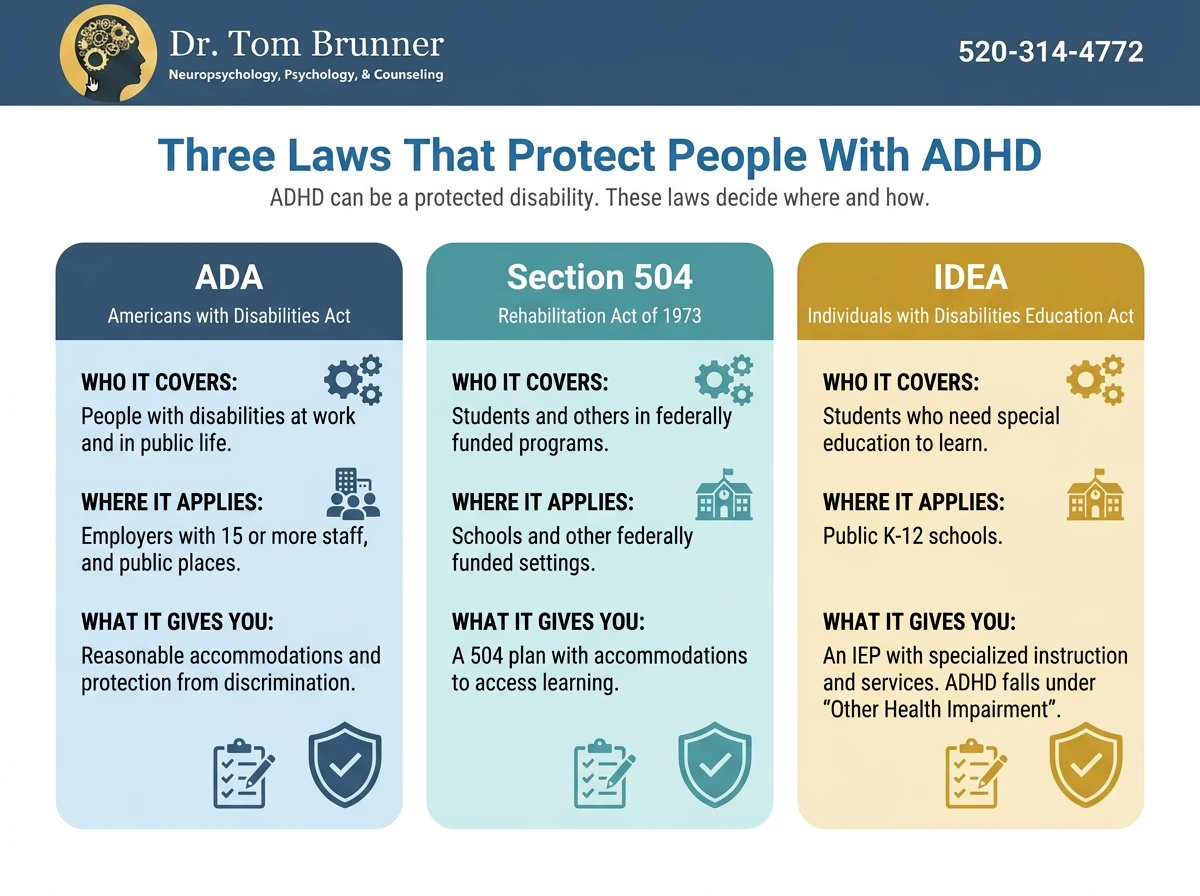
In plain terms: the ADA covers you at work and in public life, Section 504 of the Rehabilitation Act covers accommodations in schools and federally funded programs, and IDEA covers special education for students who need it. Students with ADHD often qualify under IDEA through a category called Other Health Impairment. You do not need to memorize the details. You just need to know that the protection exists and where to ask for it.
ADHD Accommodations at School
Students with ADHD have a right to support at school through one of two plans. A 504 plan provides accommodations that remove barriers, like extra time or a quieter space. An IEP, which comes from IDEA, is more involved and provides specialized instruction and services for students who need them to learn. A school counselor or special education coordinator can help you figure out which fits your child.
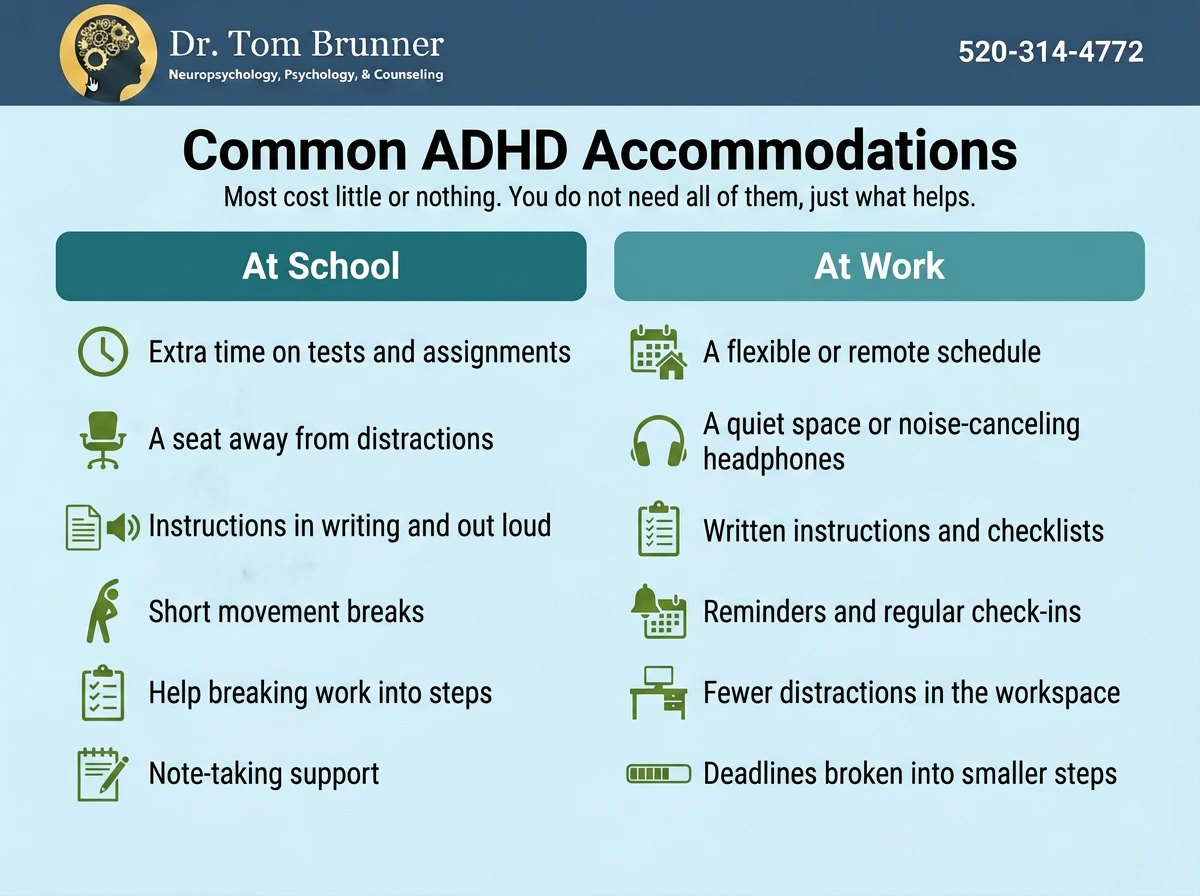
Common classroom accommodations are simple and effective: extra time on tests, a seat away from distractions, instructions given in writing as well as out loud, short movement breaks, and help breaking big assignments into smaller steps.
College works a little differently. The IEP and 504 systems end after high school, but the ADA and Section 504 still apply. Nearly every college has a disability services office that arranges accommodations for students with documentation, such as extended time on exams or a distraction-reduced testing room. The catch is that you have to seek it out yourself. Unlike K-12, no one will come to you, so register with that office early if you want support.
ADHD Accommodations at Work
At work, the ADA requires employers with 15 or more employees to provide reasonable accommodations, unless doing so would cause the business real difficulty (called undue hardship). A reasonable accommodation is any change to the job or workspace that lets you do your job well. Importantly, most cost little or nothing. According to the Job Accommodation Network, a large share of accommodations cost the employer nothing at all.
How to Request Accommodations
Getting accommodations at work follows a straightforward path, even though it can feel intimidating. Here are the basic steps:
1. Disclose and ask. The employer only has to accommodate a disability it knows about. You do not have to share your whole medical history, just that you have a condition and need a specific change.
2. Start the interactive process. This is a back-and-forth conversation where you and your employer figure out an accommodation that works. It is meant to be collaborative, not a fight.
3. Provide reasonable documentation if asked. Your employer may request a note confirming you have a condition that needs accommodation, but only what is necessary.
4. Try it and adjust. The employer can choose among options that work, and either of you can revisit the plan if it is not helping.
A note on rights: your employer cannot fire you or treat you unfairly simply because you have ADHD or asked for an accommodation. If that happens, the U.S. Equal Employment Opportunity Commission handles ADA complaints.
Does ADHD Qualify for Disability Benefits?
This is where expectations often meet a hard reality. ADHD can qualify for Social Security disability benefits, but rarely does on its own. The Social Security Administration evaluates ADHD as a neurodevelopmental disorder, and to qualify you must show severe, well-documented limitations, not just a diagnosis.
There are two programs. SSDI is for adults with a work history, and SSI is a needs-based program for people with low income and for children. For adults, you have to show that ADHD prevents you from holding down substantial work, which is a high bar. For children, families can apply for SSI, but the symptoms must cause marked and severe limitations, and most claims are denied. If you pursue benefits, thorough documentation from doctors, teachers, and employers is everything, and many people work with a disability advocate or attorney.
What does the Social Security Administration actually look for? Beyond documented symptoms, it weighs how much ADHD limits core areas of functioning: understanding and remembering information, interacting with others, concentrating and keeping pace, and managing yourself day to day. Generally, you need an extreme limitation in one of these areas, or marked (serious) limitations in two. That is why a diagnosis is only the starting point. The evidence has to paint a clear picture of real-world impairment.
Can You Join the Military With ADHD?
Having ADHD in your past does not automatically disqualify you. The rules recently loosened. Under the Department of Defense’s Medical Accession Records Pilot (MARP), introduced in late 2024, an applicant with a history of ADHD may be able to enlist without a special waiver if they meet two main conditions: they have been off all ADHD medication for at least 12 months, and they did not use school or work accommodations (like a 504 plan or IEP) after age 14.
If you do not meet those conditions, a medical waiver is still possible, but it is a case-by-case process, and the rules vary by branch. The Coast Guard tends to be the strictest, and roles like aviation have their own standards. Two things are always true: be completely honest about your history, because lying is a federal offense, and check the current rules with a recruiter, since policies keep evolving. For a fuller overview, CHADD keeps a helpful guide on ADHD and the military.
CHADD’s guide to ADHD and the military is a good place to start if this applies to you.
Frequently Asked Questions
Is ADHD a mental illness?
ADHD is classified as a neurodevelopmental disorder, not a mental illness in the usual sense. It is often grouped under mental health, and it can raise the risk of anxiety and depression, but it is its own separate condition.
Is ADHD a learning disability?
No. ADHD affects attention and self-control, while a learning disability affects a specific skill like reading or math. They are different, though they often occur together. Both can qualify a student for school support.
Do I have to tell my employer I have ADHD?
Not unless you want accommodations. Employers only have to accommodate a disability they know about, so to get support you do need to disclose that you have a condition and need a specific change. You do not have to share your full medical history, and your employer cannot discriminate against you for asking.
Can ADHD get you disability benefits?
Sometimes, but it is difficult. ADHD alone rarely qualifies for Social Security benefits. Only severe, well-documented cases that prevent an adult from working, or cause marked limitations in a child, tend to be approved.
Can dogs have ADHD?
Dogs can show ADHD-like traits, such as high energy, impulsivity, and trouble focusing, and researchers have studied these behaviors. But ADHD is a human diagnosis, and there is no formal canine version. If your dog seems unusually hyperactive, a veterinarian can help rule out other causes and suggest training or care.
Sources
The information in this article was drawn from the following authoritative sources. Each link goes to the original publication.
U.S. Equal Employment Opportunity Commission (EEOC): Reasonable Accommodation. Federal guidance on ADA accommodations and the interactive process.
Job Accommodation Network (JAN): ADHD. Free federal resource with detailed workplace accommodation ideas for ADHD.
ADA National Network. Plain-language information on rights and accommodations under the ADA.
Social Security Administration. Official source on SSDI and SSI disability benefits and eligibility.
CHADD: ADHD and the Military. Overview of military enlistment rules for people with a history of ADHD.
The Bottom Line
Yes, ADHD can be a disability, and that word is not something to fear. It is a key that unlocks real protection: accommodations at school and work, a shield against discrimination, and in some cases benefits or a path into the military. The one constant is that support depends on documentation and on how much ADHD affects your life, not on the label alone.
If ADHD is making school or work harder than it should be, the practical next step is to ask for accommodations, through a 504 plan or IEP at school, or the interactive process at work. Most accommodations are simple and cost little, and you have a legal right to request them.
Knowing your rights changes the whole picture. ADHD does not have to hold you back from the classroom, the workplace, or the life you want. The protections exist precisely so that it does not have to.