


If a doctor mentioned clinical neuropsychology to you, you may have pictured a brain scan or a blood test. It is neither.
Clinical neuropsychology is the branch of psychology that studies how the health of the brain shows up in the way a person thinks, remembers, and behaves, and then measures those abilities directly with standardized tests.
That difference matters more than most people realize. A medical imaging brain scan can look completely normal even though a person struggles to follow a conversation or finish their workday.
A medical brain imaging scan can also show a change that never affects daily life functioning at all. Clinical neuropsychology exists to answer the question imaging cannot: how well is this particular brain actually working, and what does that mean for school, work, and home?
This article explains what clinical neuropsychology is, what a clinical neuropsychologist does, and when seeing one makes sense. The information here is general and educational. Whether an evaluation is the right step for you or your child depends on details only a licensed professional reviewing your situation can weigh.
Clinical Neuropsychology, Defined in Plain Terms
Clinical neuropsychology is a specialty within psychology. It takes what science knows about the link between the brain and behavior and applies it to one person at a time.
The broad field of neuropsychology includes laboratory research, theory, and in the trenches clinical work. The clinical branch is the part that sits down with real people, tests them, and uses the results to guide diagnosis and care.
It is one of several branches of the field of neuropsychology. Other neuropsychological areas focus on research, on children’s development, or on questions raised in court. Clinical neuropsychology is the branch most patients and families will meet when they go into an office to get a functional question answered
If you want the shortest clinical neuropsychology definition that still holds up: it is the science of measuring thinking and behavior to understand brain health, applied to an individual.
The two ideas the whole field rests on
- Different brain systems support different abilities. Memory, attention, language, and planning rely on different brain networks. When one network is injured or develops differently, the matching functional behavioral ability tends to change in a recognizable way.
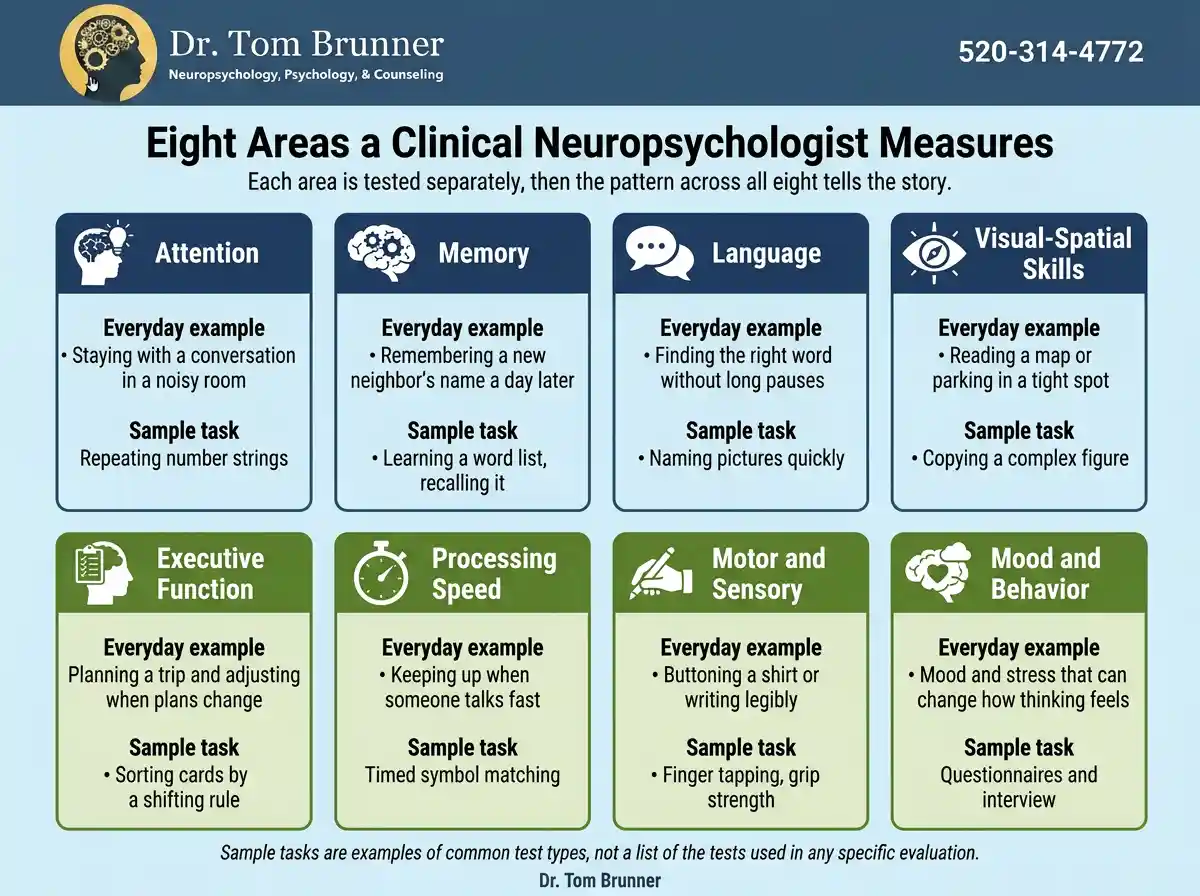
- Those abilities can be measured. Standardized tests, given the same way every time, let a clinician compare one person’s performance with hundreds or thousands of people of similar age and background. That comparison turns a vague worry (“my memory seems worse”) into an objectively measurable pattern where an individuals performance is compared to typical performance for their age group.
Put those two ideas together and you have the core of the discipline: measure the abilities, read the pattern, and connect the pattern back to what may be happening in the brain and in the person’s life.
Why a Brain Scan Can’t Show What Testing Shows
MRI and CT scans take photographs of brain structures. They are excellent at finding tumors, bleeds, strokes, and shrinkage in brain tissue. They tell a doctor where something is. What they cannot tell anyone is how well a person remembers a grocery list, keeps track of a conversation, or plans a week.
Neuropsychological testing measures function. It watches how the brain is able to do its behavioral work and records how well the work gets done. That is why the two tools so often disagree, and why the disagreement is useful rather than confusing.
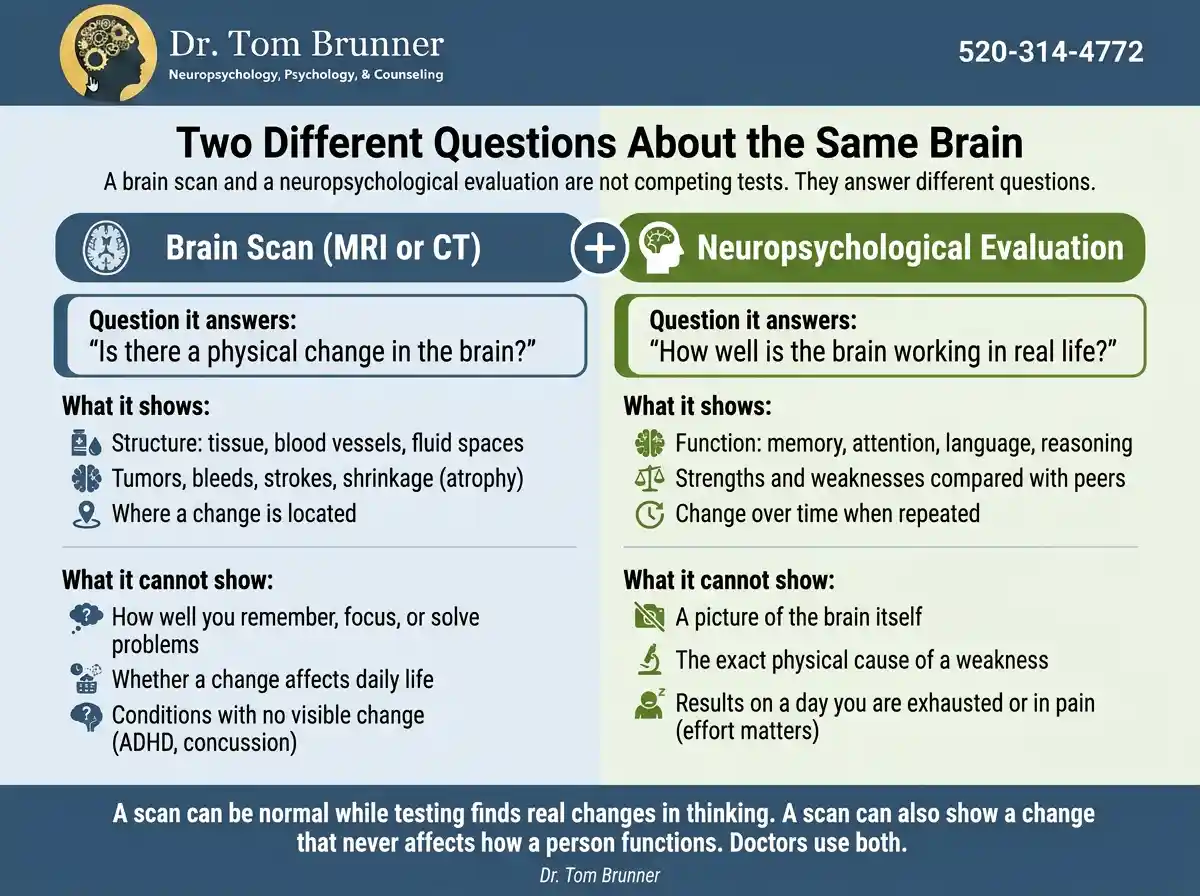
Four common situations show the gap clearly:
- Concussion. Some people with a concussion have a normal brain scan. But many people still show slowed processing speed or trouble with attention on testing in the weeks afterward. The scan is not wrong. It is answering the question of if the brain looks different, not if a person can do the same things.
- Early memory changes. Thinking can begin to change before any brain shrinkage is visible on brain imaging. Testing can document a real functional and behavioral decline, or rule one out, while a scan might still read as unremarkable for age.
- ADHD and learning differences. There is no scan that will tell you if you have an “ADHD brain” or “dyslexia brain”. there is no specific type of brain structure and determine if you will have either of these types of problems. Rather, the diagnosis rests on history and measured performance. Testing is the only objective process available to diagnose these diagnostic conditions.
- Stroke. Here a brain scan can show exactly where the damage is. Testing shows which abilities were affected, which were spared, and where rehabilitation should start. Both are needed.
| What the tool looks at | Brain scan (MRI or CT) | Neuropsychological evaluation |
|---|---|---|
| Main question | Is there a physical change, and where? | How well is the brain working in daily life? |
| Best at finding | Tumors, bleeding, stroke, tissue loss | Weaknesses in memory, attention, language, reasoning, and speed |
| Tends to miss | Function, effort, and conditions with no visible change | The exact physical cause of a weakness |
| Who typically orders it | Neurologists, emergency doctors, primary care | Neurologists, pediatricians, psychiatrists, schools, courts, or the patient directly |
| How results read | Radiology report describing images | Scores compared with peers, plus a written interpretation and recommendations |
Table reflects general clinical practice. Ordering patterns vary by setting and insurer.
They work best together
None of this makes brain imaging less important. When a scan and an evaluation are read side by side, the scan explains what changed and the evaluation explains what that change means for the person. A neurologist may order both. A clinical neuropsychologist will often ask to see the imaging report before finalizing an interpretation.
What a Clinical Neuropsychologist Actually Does
A clinical neuropsychologist is a psychologist with a doctoral degree (a PhD or PsyD) with additional supervised training in brain-behavior relationships.
They are not medical doctors, so they do not prescribe medication or order imaging. If you are unsure which kind of professional performs this testing, the short answer is a licensed psychologist with this specialty training, sometimes working alongside a technician who helps administer the tests.
Day to day, the job breaks into five kinds of work:
- Clarify a diagnosis. Is this memory complaint normal aging, depression, medication side effects, or the start of a neurological condition? Testing narrows the field in a way symptoms alone cannot.
- Map strengths and weaknesses. A good evaluation does not just find problems. It shows what still works well, because that is what treatment and accommodations get built on.
- Track changes over time. Repeating an evaluation months or years later shows whether abilities are stable, improving after treatment, or declining. This is one of the most valuable things the field offers.
- Guide treatment and accommodations. Results translate into concrete recommendations: how a student should be supported at school, whether an adult can safely return to a demanding job, what a rehabilitation team should target first.
- Answer questions for other professionals. Neurologists, surgeons, pediatricians, and schools all send patients for answers they cannot get on their own. Some clinicians also perform brain evaluations in legal cases, and others specialize in evaluations for children and teens.
When Would You See a Clinical Neuropsychologist?
Most people are referred by another professional, but many families find their way to the specialty on their own after noticing changes that worry them.
The common threads are a change in how someone thinks or functions, a question that a regular office visit cannot settle, or there may be need for documentation of an impairment to get accommodations in school or at work.
- A change in memory or thinking. Forgetting conversations, repeating questions, getting lost in familiar places, or struggling with tasks that used to be routine.
- After a head injury. A concussion or more serious brain injury where symptoms linger past the expected recovery window, or where a return to work, school, or sports needs to be planned carefully.
- Attention, learning, or school concerns. A child or adult who works hard but cannot keep pace, or whose teachers and parents see different things and need an objective picture.
- Before or after medical treatment. Epilepsy surgery, tumor treatment, deep brain stimulation, and some cancer treatments can affect thinking. Testing before and after documents the effect.
- Mood or behavior change alongside cognitive complaints. When depression, anxiety, or a personality change arrives with trouble concentrating or remembering, testing helps separate the causes.
- Documentation and decisions. Disability claims, workplace or academic accommodations, capacity questions, and legal matters often require a formal evaluation.
If you live in southern Arizona, a Tucson neuropsychologist can talk through whether an evaluation fits your situation before you commit to a full assessment. A brief phone conversation is often enough to know whether testing is the right next step or whether a different professional should see you first.
When you probably do not need one
- A sudden, severe change. Sudden confusion, a severe headache, weakness on one side, or trouble speaking are emergencies. Go to an emergency room. Testing comes later, if at all.
- The main concern is emotional, not cognitive. If the question is mostly about mood, stress, or relationships, a psychologist or therapist is usually the right first stop. They can refer for testing if thinking becomes a concern.
- A brief screen already answered the question. Primary care doctors use short cognitive screens. When a screen is clearly normal and there is no functional change, a full evaluation may not add much yet.
Clinical Neuropsychology vs. Clinical Psychology vs. Neurology
The names overlap enough to confuse anyone. The simplest way to separate them is by the main tool each one uses and the question each one is best at answering. The short version is below.
| Clinical neuropsychologist | Clinical psychologist | Neurologist | |
|---|---|---|---|
| Training | Doctorate in psychology plus specialty training in brain-behavior relationships | Doctorate in psychology focused on mental health assessment and therapy | Medical degree plus residency in nervous system disorders |
| Main tool | Standardized cognitive testing | Interview, psychological testing, psychotherapy | Neurological exam, imaging, lab tests, EEG |
| Best question | How is this brain functioning, and why? | What is this person feeling and how can they cope better? | What is physically wrong with the nervous system? |
| Can prescribe | No | No (with rare exceptions in a few states) | Yes |
| Typical output | Detailed written report with scores and recommendations | Diagnosis, treatment plan, ongoing sessions | Diagnosis, medication, procedures, referrals |
General distinctions. Individual clinicians may hold more than one role or credential.
In practice these professionals refer to one another constantly. A neurologist who finds nothing on a scan but believes the patient may send them for testing. A therapist who notices a client cannot hold onto material between sessions may do the same. The system works when each specialty answers the question it is built for.
What Happens in a Clinical Neuropsychological Evaluation
A full evaluation is more involved than a single appointment, and it helps to know the shape of it before you begin. What follows is a brief overview of the shape it usually takes.
- Intake and history. A conversation about what prompted the referral, medical and developmental history, schooling, work, mood, sleep, and medications. Records from other providers are reviewed. Family members are often interviewed with permission.
- Testing. A mix of paper-and-pencil tasks, verbal questions, and sometimes computer-based measures, usually over several hours in one or more sessions. Breaks are built in. Effort and fatigue are tracked because they affect scores.
- Scoring and interpretation. Raw performance is converted to standardized scores and compared with people of similar age, education, and background. The clinician then looks at the pattern across all areas, not any single number.
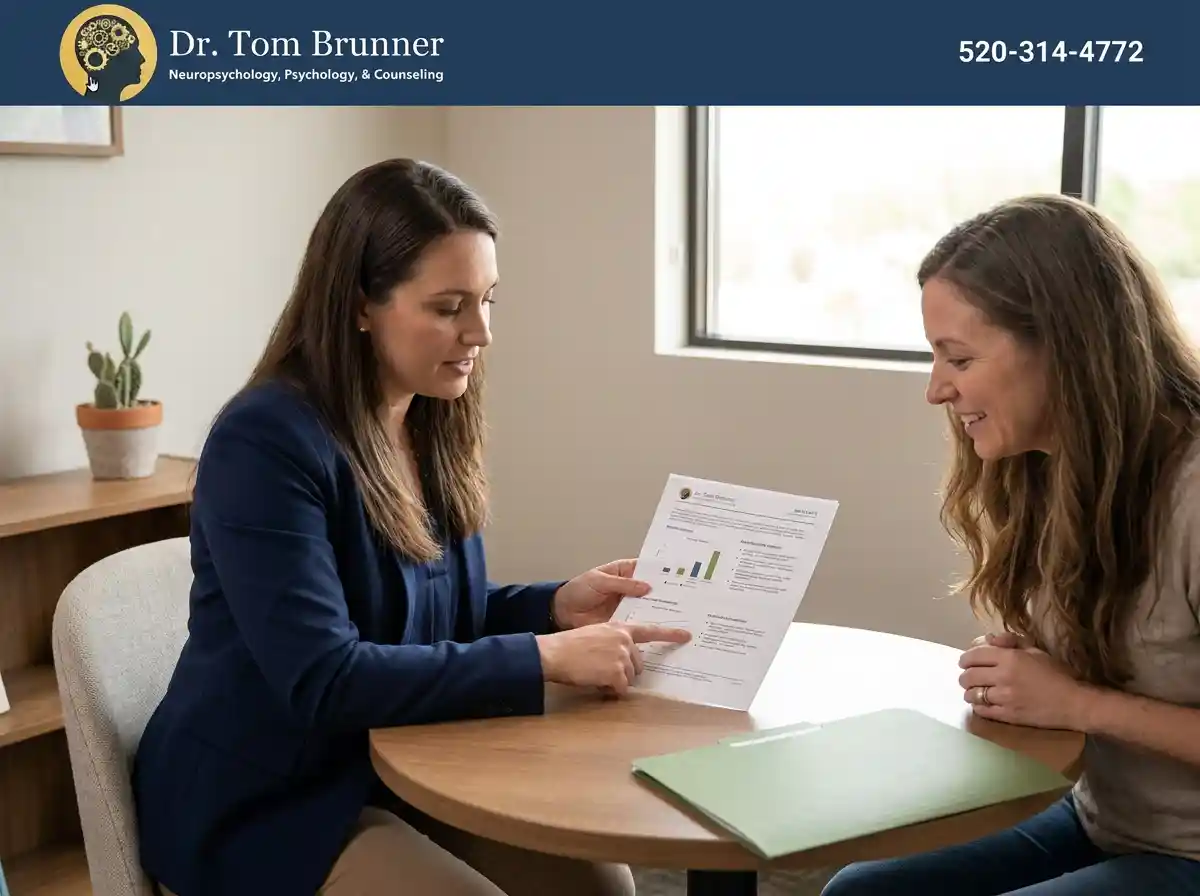
- Feedback and report. Results are explained in a feedback meeting in plain language, followed by a written report with findings and specific recommendations for you, your doctor, or your child’s school.
There are two practical notes to keep in mind. First, effort matters: a person who is exhausted, in pain, or heavily medicated on testing day will not produce a fair picture, so clinicians ask about these things and may reschedule. Second, testing is not a pass-or-fail exam. Many tasks are designed so that almost no one finishes them perfectly. The goal is a profile, not a grade.
Frequently Asked Questions About Clinical Neuropsychology
What is clinical neuropsychology in simple terms?
It is the part of psychology that measures how well a person’s brain is working by testing memory, attention, language, problem solving, and related skills, then uses that information to help with diagnosis and treatment planning.
Is a clinical neuropsychologist a medical doctor?
No. A clinical neuropsychologist holds a doctorate in psychology (PhD or PsyD) with specialized training, not a medical degree. They do not prescribe medication or order scans. They frequently work alongside neurologists and other physicians who do.
Does clinical neuropsychology use brain scans?
Not directly. Clinical neuropsychologists read imaging reports and consider them when interpreting test results, but the evaluation itself is built on standardized cognitive and behavioral testing rather than pictures of the brain.
What conditions does clinical neuropsychology help evaluate?
Common referral reasons include memory disorders and dementia, concussion and brain injury, ADHD, learning disabilities, autism, epilepsy, stroke, multiple sclerosis, Parkinson’s disease, and cases where mood disorders and cognitive complaints overlap. The evaluation clarifies how a condition is affecting thinking. It does not replace medical diagnosis of the condition itself.
How is clinical neuropsychology different from neuropsychology in general?
Neuropsychology is the whole field, including laboratory research and theory about how the brain produces behavior. Clinical neuropsychology is the applied branch that works with patients. When a doctor refers you for testing, you are being sent to the clinical branch.
What are common clinical neuropsychology research topics?
Active areas include detecting the earliest signs of dementia, understanding recovery after concussion, improving how test norms account for culture and education, using computerized testing responsibly, and connecting test scores to how people function in daily life. That research is what keeps the tests and interpretations current.
Do I need a referral to see a clinical neuropsychologist?
Often no. Many practices accept self-referrals, and a brief consultation can determine whether testing is appropriate. Insurance plans, however, may require a physician’s referral for coverage, so it is worth checking your plan before scheduling.
The Bottom Line
Clinical neuropsychology measures what a scan cannot: how well the brain is actually working in a real person’s life.
It rests on two simple ideas, that different brain systems support different abilities and that those abilities can be measured against similarly aged peers. From that foundation it clarifies diagnoses, maps strengths and weaknesses, tracks change, and turns results into practical recommendations.
If you or a family member has noticed a change in memory, attention, learning, or daily functioning, the practical next step is a conversation, not a commitment. Write down what you have noticed, when it started, and how it affects the day.
Bring that list to your primary care doctor or directly to a clinical neuropsychologist, who can tell you whether a full evaluation is likely to help.
Worrying about your own mind, or a child’s, is a heavy thing to carry without answers. An evaluation does not promise a particular outcome, but it does replace guessing with information. For most families, that alone is worth a great deal.