


Families often arrive at neuropsychological testing for dementia with one question: is it Alzheimer’s?
Neuropsychological testing can help answer that anxiety-provoking question. But neuropsychological testing can do more than help answer a “yes” or “no” question such as “Does someone have Alzheimer’s?” Neuropsychological testing can clarify how a person’s ability to think has actually changed, and if so, what new patterns are now operating.
Blood tests that can help detect Alzheimer’s disease pathology are now FDA-cleared and available through ordinary labs. This is a major step forward. But just because there is a significant result on this kind of laboratory test does not mean a person is actively impaired by dementia. As is true with many diseases, a person can test positive for a disease like Alzheimer’s but not show symptoms or have observable impairments.
What neuropsychological testing can do, that laboratory tests cannot do, is 1) precisely measure an individual’s ability to think, and then 2) compare their thinking ability against what is expected for their age and background. This is the unique and valuable contribution that neuropsychological testing can make; it can clarify whether a person is functionally impaired by their dementia, as well as clarify how severe their impairment is. This in turn can clarify how far along the dementia process is. This helps professionals and family members create a tactical treatment plan.
This article explains what neuropsychological testing for dementia measures, how the pattern of results points toward different causes, where testing fits alongside imaging and biomarkers, and what it cannot do. It is general education. A diagnosis of dementia requires a clinician who has examined the person, reviewed the medical picture, and interpreted the results in that context.
What Neuropsychological Testing for Dementia Actually Measures
A neuropsychological evaluation for dementia is a structured process: an interview with the person and usually a family member, a review of medical records and imaging, several hours of standardized tests, and a written report with interpretation. The tests typically sample every major area of thinking, because dementia is defined by decline across daily function, not by a single failing ability.
That structure follows directly from how the field approaches brain and behavior, and dementia is one of the conditions the term “neuropsychological disorder” covers.
Here are the core domains, and why each matters when you are asking a dementia related question:
- Learning and memory. Can the person take in new information, hold it over a delay, and recall or recognize it later? The shape of the memory failure is one of the most informative findings evaluation produces.
- Attention and processing speed. How quickly and reliably can the person handle simple mental work.
- Receptive and Expressive Language. Naming, comprehension, and word retrieval. Some dementias begin with language and leave memory intact for years. This can occur with primary progressive aphasia (PPA).
- Visual-spatial skills. Copying figures, judging space, recognizing 3D objects. Early weakness here raises certain possibilities over others.
- Executive function. Planning, flexible thinking, judgment. This can sometimes be the first area to slip in frontotemporal and vascular conditions.
- Mood and behavior. Depression and anxiety are screened in every dementia evaluation, because untreated mood or anxiety problems can imitate cognitive decline.
- Effort and validity. Neuropsychological measures can help confirm real cognitive deterioration versus results driven by momentary fatigue, distraction, or a bad day that causes a person to put in much less effort which dampens their scores.
Remember, neuropsychological scores are compared with people of the same age and, where possible, similar educational level. That comparison is what turns “Dad seems forgetful” into a measurable statement. What matters in the end is the pattern across domains rather than any single number.
What the Testing Can Tell You, and What It Cannot
The honest case for neuropsychological testing in dementia rests on four things it does well and three things it does not do.
What it can do
- Confirm whether thinking has actually declined. Worry, stress, and normal aging all can produce momentary deterioration. Neuropsychological testing separates a subjective concern from a measured change. A surprising share of people referred for memory concerns test within the normal range for their age.
- Distinguish mild cognitive impairment from dementia. Mild cognitive impairment means measurable decline with daily function largely intact whereas dementia is often correlated to decline interfering with independence. What is really going on is revealed by testing plus a careful account of daily life. This matters because treatments, planning, and prognosis differ depending on what is going on.
- Points toward a cause through the pattern. Different conditions weaken different domains first. Neuropsychological testing does not see into the physical disease in the body, but it does detect the external functional fingerprint the disease leaves behind. That fingerprint helps narrow what medical workups need to be done which can save patients alot of money.
- Establish a baseline and track change. A single evaluation is a snapshot. A second one, months or a year or two later can show whether abilities are stable, declining, or improving after a specific treatment is tried. This testing over time using the same measure or set of measures is one of the single most powerful things mental testing offers. Unfortunately, many families skip this kind of testing.
What it cannot do
- It cannot see pathology. Amyloid plaques, tau tangles, small strokes, and Lewy bodies show up on imaging and biomarker tests, but can be easily missed by neuropsychological tests. Neuropsychological testing observes external functionality, not internal disease processes.
- It cannot diagnose alone. Dementia is a clinical diagnosis that requires a medical evaluation to rule out reversible causes: thyroid disease, vitamin deficiencies, medication effects, sleep apnea, infection, and depression among them. Neuropsychological testing is one input into that judgment, usually a decisive one, but does not capture the whole picture.
- It cannot predict an individual’s timeline. Testing describes where a person is now with their functioning, and with repeat testing, the direction their functional skills are travelling. Is a person “going south” and deteriorating, or are they improving? But testing cannot tell you how fast a person will improve or deteriorate.
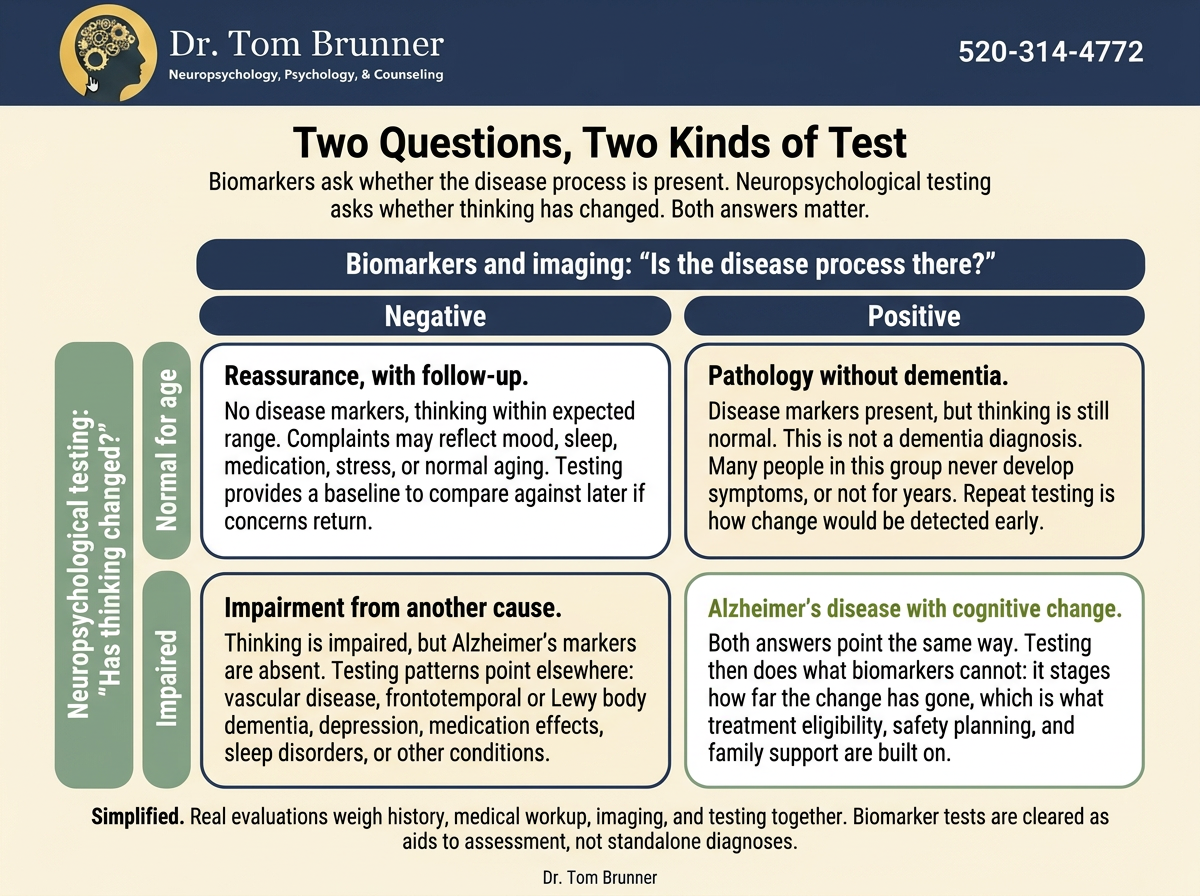
This matrix explains how new FDA cleared blood tests and neuropsychological testing are necessary partners rather than isolated activities. A biomarker answers whether a specific type of physical disease process is present. Neuropsychological testing answers whether this internal biological marker has functionally changed the person, and by how much.
Some of the newest Alzheimer’s treatments are approved only for people at the mild cognitive impairment stage or mild dementia stage with confirmed pathology. This means eligibility requires getting answers from both medical biomarker and neuropsychological testing.
How Different Dementias Show Up on Testing
Clinicians read a neuropsychological profile the way a mechanic reads a set of engine symptoms: no single sign is decisive, but together they point somewhere. The four most common dementia types tend to leave recognizable early patterns.
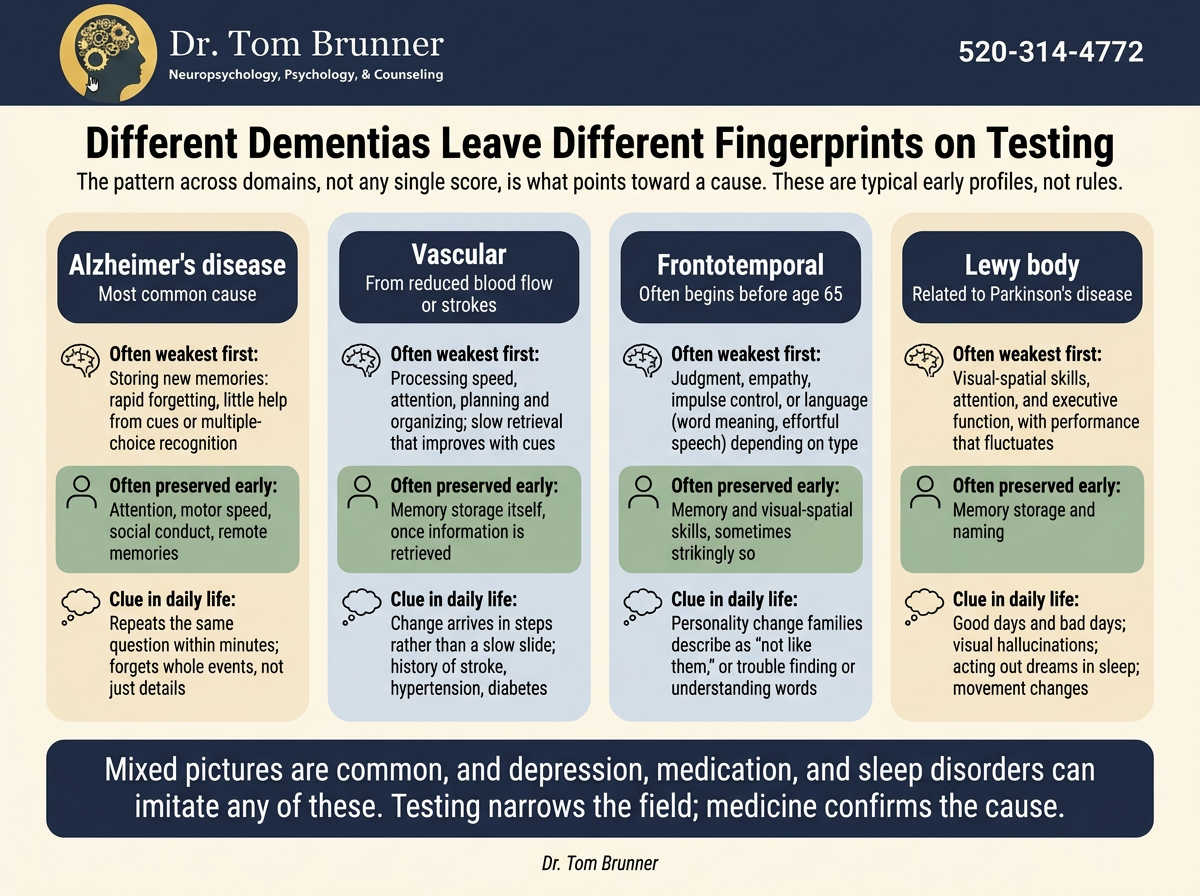
| Type | Typical early testing pattern | What families often notice first |
|---|---|---|
| Alzheimer’s disease | Rapid forgetting of new material; cues and recognition do not help much; naming may slip; attention and motor speed relatively intact early | Repeating the same question; forgetting whole conversations or events rather than details |
| Vascular dementia | Slowed processing, reduced attention, executive weakness; memory retrieval is slow but improves with cues; storage relatively preserved | Change in steps after a stroke or small strokes; history of high blood pressure or diabetes |
| Frontotemporal dementia | Behavioral type: impaired judgment, impulse control, social awareness with memory spared. Language type: word-finding or word-meaning loss | Personality change described as “not like them”; new bluntness or apathy; trouble with words |
| Lewy body dementia | Visual-spatial and attention weakness; executive difficulty; performance fluctuates between and within sessions; memory storage relatively spared | Good days and bad days; visual hallucinations; acting out dreams; movement changes |
Typical early profiles from clinical literature, simplified for orientation. Mixed dementia is common, and individual presentations vary.
There are two common “mimics” that deserve their own mention because they are treatable. First, depression that mimics dementia produces slowed thinking, poor concentration, and memory complaints that can look alarming on a screen and resolve when mood is treated. The second mimic is when cognitive changes in Parkinson’s disease overlap heavily with Lewy body dementia. This is one reason a neurologist’s movement exam and the neuropsychologist’s profile are read together. Testing after a stroke will often follow a vascular pattern and vascular cognitive changes after stroke are covered in a separate article I have written.
Memory Screen vs. Full Neuropsychological Evaluation
For many people their first cognitive test is a brief screen in a primary care office. Screens are valuable filters. They are not deep neuropsychological evaluations. A screen samples a few abilities coarsely and answers “is there enough concern to look further?” A full evaluation samples each major domain in depth and answers “what has changed, how much, and what is the pattern?”
A full evaluation is usually warranted when:
- A screen is abnormal or borderline and the next decision (medication, driving, living arrangements, participation in a clinical trial) depends on knowing more.
- A screen is normal but the family is sure something has changed. Screens can miss early and mild changes, especially in highly educated people who can mask their symptoms by using intact skills to hide weaker skills.
- A complex group of factors. Memory complaints co-occurring alongside factors such as depression, a recent hospitalization, new medications, or a possible stroke need more nuanced testing to sort out the hidden patterns.
- A baseline is needed. Neuropsychological testing can show what a persons typical functioning is like before interventions are tried. In the clinical world a person’s typical functioning is often called their “baseline”. It is critical to obtain a baseline before trying an intervention because to know how well that intervention works we need to be able to measure someone skills preintervention versus their skills postintervention. This “pre” vs “post testing is one of the most informative aspects of neuropsychological assessment.
- Capacity or safety is in question. Decisions about finances, medication management, driving, or living alone are best made after abilities are measured rather than going by subjective or off-the-cuff impressions.
When an individual is complaining of memory problems specifically, rather than complaining of broader changes,,neuropsychological testing is an excellent option because it can precisely clarify the exact contours of any functional changes. I have written a separate article that discusses the importance of working from the ground up and assessing symptoms that rather than rushing to a diagnosis.
If you are in southern Arizona and unsure which level of evaluation fits, a Tucson, Arizona psychology practice that offers neuropsychological assessment can help you decide this after a a brief but professional conversation. A competent neuropsychologist will clarify when screening might be sufficient versus when you might need more in-depth neuropsychological evaluation.
What to Expect From a Dementia Evaluation
Evaluations for older adults are structured differently from those for younger people. Sessions are shorter, breaks are more frequent, and testing may be split across two or more visits so fatigue does not distort the results. A family member is usually interviewed separately about daily functioning, because the person being evaluated may underestimate or overestimate their own difficulties.
For anyone undergoing a neuropsychological evaluation, it is critical that you prepare for the evaluation by keeping the following in mind:
- Bring glasses, hearing aids, and a medication list. Sensory problems and sedating medications can lower scores for reasons that have nothing to do with dementia.it is always good to ask the evaluator if she should continue to take the medication you typically take or not.
- Schedule for the person’s best time of day. Many older adults think most clearly in the morning. Ask the evaluator with the best time of day would be for you to undergo neuropsychological assessment based on your biorhythms and typical performance style across a day.
- Bring prior records. Imaging reports, previous cognitive screens, and any biomarker results help the clinician the clinician more clearly and confidently identify patterns.
- Expect a feedback meeting. Results are explained in plain language, usually with the family present if the person agrees. What goes into the written report matters here, because the report is what the neurologist, primary care doctor, and sometimes an attorney or long-term care planner will act on.
The cost of a neuropsychological evaluation for a dementia question typicallyis higher because these evaluations are often comprehensive in nature. Medicare sometimes provides coverage for neuropsychological testing when a physician documents medical necessity, which a memory complaint with a documented change usually satisfies. Confirm both with the practice before scheduling.

Why Mood Assessment Is Part of Every Dementia Evaluation
Families sometimes ask whether they need psychological or neuropsychological testing for a parent’s memory concern. For a dementia question, the answer is a neuropsychological evaluation, and a good one includes a psychological assessment inside it. Depression in older adults often shows up as poor concentration and memory problems rather than showing up as sadness. Anxiety about memory can itself impair memory performance. Grief, loneliness, and loss of routine after retirement or after the loss of a loved one all can cause psychological or neuropsychological scores to droop.
Thus, screening for psychological issues such as mood or anxiety is not a mere formality. In fact, in some evaluations the presence of a clinically significant mood or anxiety disorder changes the conclusion dramatically. This in turn significantly changes what recommendations are made. A report that says “memory performance is mildly below expectation in the context of untreated depression; reassess after treatment” is a very different clinical recommendation than “pattern consistent with early neurodegenerative process”. Assessing psychological factors such as mood, anxiety, fatigue or lack of motivation often proves to be pivotal to what the eventual conclusion and recommendations are..
Frequently Asked Questions About Neuropsychological Testing for Dementia
Can neuropsychological testing diagnose dementia?
It can establish whether cognitive decline is present, how severe it is, and what pattern it follows, which is a key part of a dementia diagnosis. The formal diagnosis is made by a clinician who combines those results with a medical evaluation so conditions that mimic dementia (e.g., depression based memory issues) can be ruled out.
Can neuropsychological testing tell the difference between Alzheimer’s and other dementias?
It can point strongly toward one type over another based on the pattern of strengths and weaknesses. Confirming the specific disease often involves imaging or biomarker testing as well. Also, mixed forms of dementia can be common, and testing helps identify when more than one dementia process is at work.
Do the new Alzheimer’s blood tests replace neuropsychological testing?
No. Blood based biomarker tests can help detect whether an Alzheimer’s pathology is present. But they do not measure whether or how much thinking has changed. These new tests are cleared for use alongside clinical assessment, not as standalone diagnostics. Neuropsychological testing and medical biomarker tests answer different questions.
How long does neuropsychological testing for dementia take?
A typical range is three to five hours, often split across two sessions for older adults, plus an interview and a feedback meeting. Shorter batteries are used when stamina is limited.
What is the difference between mild cognitive impairment and dementia on testing?
Both show measurable decline. In mild cognitive impairment, daily independence is often largely preserved. In dementia, the decline can often interferes with everyday functioning. Neuropsychological testing measures the decline, and this testing often includes interviews of family members to identify the functional impact.
Should someone with a normal memory screen still get full testing?
If the family has noticed a clear change, yes. Brief screens can miss early and mild decline, especially in people with high education who compensate well. Full testing is more sensitive. Talk with a practitioner whom you consider to have expertise in the area of neuropsychological assessment
How often should testing be repeated?
For monitoring, it is common for testing to occur every one to two years, or more often if there is a clear change or a treatment decision pending. Repeating too soon can produce practice effects that make results hard to read.
The Bottom Line
Neuropsychological testing for dementia measures what no scan or blood test can: whether thinking has actually changed, how the changes fall into repeating patterns, and how much functional skill deterioration has occurred. Neuropsychological evaluation distinguishes a subjective concern from an actual real world functional decline. Neuropsychological testing plays a critical role in helping to determine whether an individual has a mild cognitive impairment versus full blown dementia.
Neuropsychological evaluation also can identify whether factors such as sleep, depression or lack of motivation are making it seem as if a person has dementia but they actually don’t. One of the greatest values of mental assessment is it clarifies what a person’s functional baseline is so the effects of any interventions that are used can be made clear by evaluating an individual again after the intervention occurs. Neuropsychological testing does not see physical pathology, and is best used when used in combination with medical assessment.
If you are worried about a parent or spouse, the practical next step is to start a written diary where you habitually record what changes you are observing, when the changes began and what kinds of functional problems are observable. Bring that diary to a primary care professional or a neuropsychologist and ask them about whether a brief screening process and/or medical workup is called for. If the screen is abnormal, or if it is normal but your diary notes indicate clear functional deterioration, do not be afraid to confidently advocate for the person you’re concerned about. This might mean you need to ask for a full neuropsychological evaluation.
Watching someone you love change is frightening, and not knowing what is actually going on is often the worst part. An evaluation does not undo the change, but it does replace fear with a road map. It is this roadmap that empowers of family to plan rather than just impulsively react.