


Ask three clinics what neuropsychological testing costs and you may get three answers that are thousands of dollars apart. That is not a sign that someone is overcharging. It usually means the three clinics are quoting three different products, and nobody explained the difference.
The honest answer to how much a neuropsychological evaluation costs is a range, and the range is wide: a few hundred dollars for a brief screen, roughly $1,500 to $2,500 for a focused evaluation, $2,500 to $5,000 for a comprehensive one, and $4,500 to $8,000 or more when the report has to stand up in court or to a disability board.
Where you land depends mostly on one thing: the question you need answered.
This article lays out the typical 2026 ranges, explains what the fee actually pays for, walks through the factors that move a quote up or down, and covers the practical ways families lower the out-of-pocket amount. It is general information, not a quote. Prices vary by region and provider, and insurance rules vary by plan, so confirm numbers with the practice and your insurer before you book.
The Short Answer: Typical Neuropsychological Testing Cost Ranges in 2026
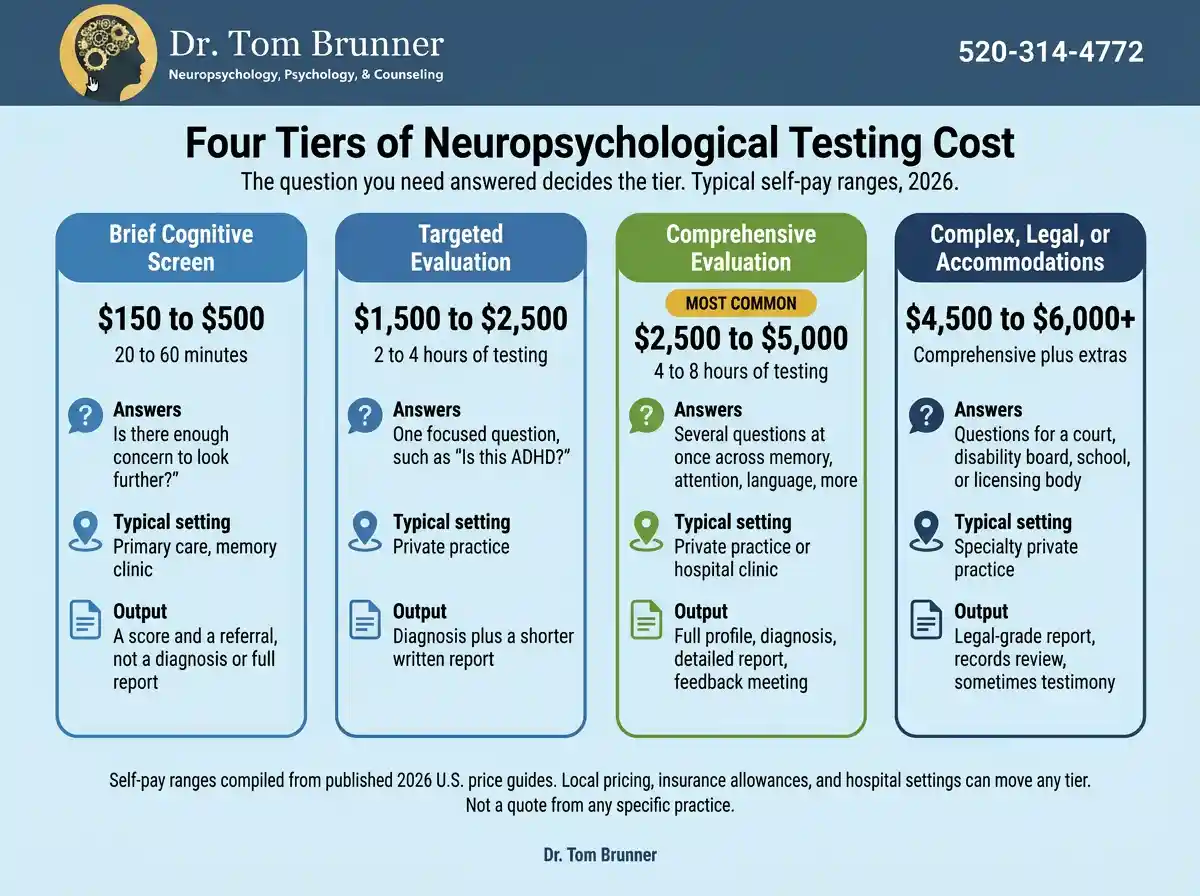
Published self-pay pricing across U.S. practices falls into four tiers. The tiers are defined by scope, not by quality.
| Evaluation type | Typical self-pay range | Testing time | What you get |
|---|---|---|---|
| Brief cognitive screen | $150 to $500 | 20 to 60 minutes | A score and a recommendation about whether to test further |
| Targeted evaluation (one question) | $1,500 to $2,500 | 2 to 4 hours | Diagnosis or answer to one question, shorter report |
| Comprehensive evaluation | $2,500 to $5,000 | 4 to 8 hours | Full cognitive profile, diagnosis if any, detailed report, feedback meeting |
| Complex, legal, or accommodations | $4,500 to $6,000+ | Comprehensive plus records review | Report written for a court, school, licensing board, or disability process |
| Repeat or follow-up testing | $300 to $1,500 | Shorter than initial | Comparison with earlier results to show change |
Ranges compiled from published 2026 U.S. self-pay price guides and clinic fee schedules. Hospital-affiliated settings and high-cost metro areas can run above these bands. Not a quote from any specific practice.
Two things about that table matter more than the numbers. First, insurance can change what you actually pay by thousands, so the question of whether insurance covers neuropsychological testing deserves its own attention before you compare fees. Second, the cheapest tier is not a discounted version of the most expensive one. A brief screen and a comprehensive evaluation answer different questions.
What the Price Actually Covers
Sticker shock usually comes from a mismatch between what people picture (one appointment, a few tests) and what they are buying. A neuropsychological evaluation is a multi-day professional process. If you are new to the field, what clinical neuropsychology covers explains the specialty itself; here the focus is on the hours.
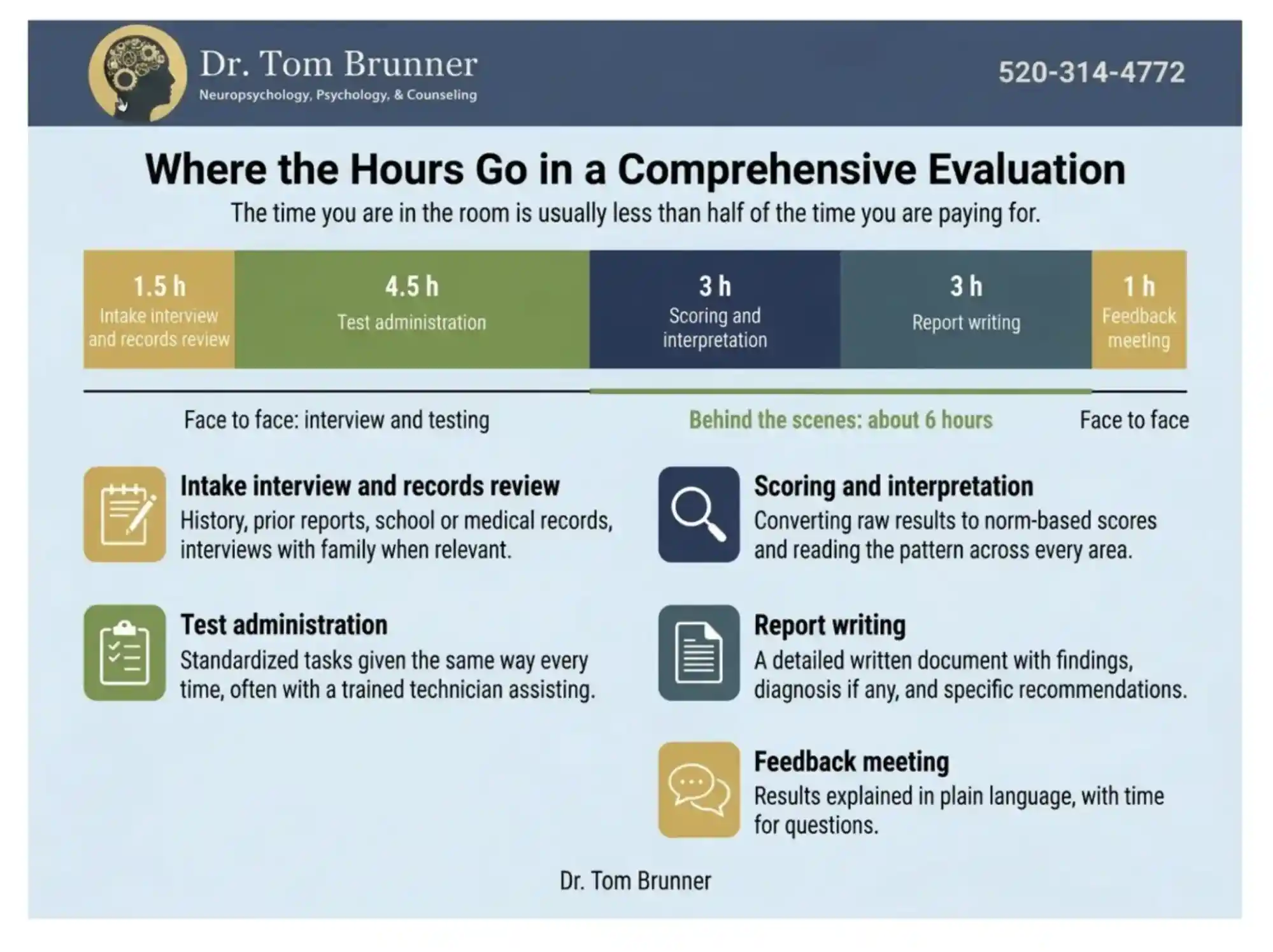
A comprehensive evaluation commonly involves 12 to 18 professional hours, of which the person being tested is present for roughly half. The fee is paying for all of it:
- Intake interview and records review. One to two hours of history taking, plus time reading prior reports, school records, medical notes, and imaging summaries. Interviews with family members or teachers, when relevant, add more.
- Test administration. Three to six hours of standardized tasks. Many practices use a trained technician for part of this, which keeps the fee lower than it would be if the doctor administered every task personally.
- Scoring and interpretation. Two to four hours turning raw performance into scores compared against people of similar age and education, then reading the pattern across every area. This is where the expertise comes in, and it happens with no one else in the room.
- Report writing. Two to four hours producing the document. The written report you receive is often the single most valuable output, because it is what schools, doctors, and insurers act on.
- Feedback meeting. About an hour explaining results in plain language and answering questions.
- Test materials and licensing. Standardized tests are copyrighted instruments. Practices pay per-use fees for many of them, and computerized measures carry subscription costs.
Put differently, an evaluation that quotes at $3,500 for roughly 15 professional hours is billing in the same neighborhood as many specialist medical consultations. The fee looks large because the hours are bundled into one number rather than spread across visits.
Seven Factors That Drive the Cost Up or Down
Once you know the tiers, the factors below explain why two comprehensive evaluations can still differ by a thousand dollars or more.
- The referral question. This is the biggest driver. ADHD-focused neuropsychological testing for a teenager is a narrower job than sorting out why an adult is struggling with memory, mood, and work at the same time. More questions mean more tests, more interpretation, and a longer report. Dementia-related neuropsychological testing often sits in the middle: a defined question, but one that requires care with age norms and medical history.
- How much testing is needed. Clinicians do not give every test to every person. The test battery a clinician chooses is built for the question, and a larger battery costs more in labor hours and materials. Ask whether the quote reflects a fixed battery or one that expands if early results raise new questions.
- Screen or full evaluation. Some concerns can be settled with a shorter assessment. Understanding brief screening versus a full evaluation can save money when brief screening is enough.
- The person being tested. Children often take longer to test than adults because tasks are broken into shorter blocks and school records and teacher input are gathered. Adults with complex medical histories can also require extra time.
- Setting and credentials. Hospital-based clinics tend to carry higher facility fees. Board-certified neuropsychologists and clinicians with forensic or pediatric specialization often charge more per hour than generalists. Neither is automatically better for your question; match the credential to the need.
- Geography. Large coastal metro areas price well above the national bands. Smaller markets, including much of the Southwest, often sit closer to the middle of the range.
- Purpose of the report. A report headed for a courtroom, a licensing board, or a disability determination is written to a different standard, with more records review and more defensive documentation. That work is real and it is billed. If you only need a report for your own doctor, say so; you may not need the legal-grade version.
Flat Fee vs. Hourly Billing: How to Read a Quote
Practices price one of two ways. A flat fee bundles the whole process, from intake to feedback, into one number. Hourly billing charges for each professional hour, so the final amount depends on how long everything takes. Flat fees are easier to budget. Hourly pricing can be cheaper for a simple case and more expensive for a complicated one.
Whichever model a practice uses, the quote should let you answer these questions before you commit:
| Ask this | Why it matters |
|---|---|
| Does the fee include the written report and the feedback meeting? | Some quotes cover testing only. The report and feedback can add several hundred dollars if billed separately. |
| Is the quote a flat fee or an estimate of hours? | An hourly estimate can grow. Ask what happens if testing needs a second session. |
| Who administers the tests, the doctor or a technician? | Technician-administered testing is standard and usually lowers cost. You still want the doctor doing the interpretation and feedback. |
| How long until I receive the report? | Turnaround time is part of what you are buying. Two weeks and eight weeks are both common; know which you are getting. |
| Will you bill my insurance, or do I submit for reimbursement? | Out-of-network practices often provide a superbill. Your reimbursement is based on the insurer’s allowed amount, not the full fee. |
| What is the cancellation and no-show policy? | Testing blocks are long and hard to fill if you cancel the appointment. Policies can be strict, and the fee for a missed block can be substantial. |
Questions apply to any practice. Answers will differ; the point is to compare like with like.
Practices that publish pricing make this easier. If you are comparing providers in southern Arizona, a psychologist in Tucson, Arizona who posts fees up front lets you do the comparison before the first phone call. Dr. Brunner’s practice, for example, maintains a cost transparency page that explains its flat-fee and individualized options so families can see the structure in advance.
Ways to Lower the Out-of-Pocket Cost
A high quote is not the end of the conversation. Most families use one or more of the following:
- Insurance, with a referral. Medical necessity is the key phrase insurers look for, and a physician’s referral usually establishes it. In-network providers cost less and involve less paperwork; out-of-network providers may still be partially reimbursed after your deductible.
- HSA and FSA funds. Neuropsychological evaluation is a qualified medical expense for most health savings and flexible spending accounts, which means paying with pre-tax dollars.
- School-based evaluation for students. Public schools must evaluate children suspected of having a disability that affects learning, at no cost to the family. School evaluations are narrower than a clinical neuropsychological evaluation and do not diagnose medical conditions, but they can answer the school-services question.
- University training clinics. Doctoral programs in clinical psychology often run clinics where advanced students test under close supervision at reduced fees. Wait times can be long.
- Payment plans and medical financing. Many private practices offer installment plans or accept healthcare credit programs. Ask before assuming the full amount is due at once.
- Right-sizing the evaluation. Tell the clinician exactly what question the results need to answer. A narrower question is often resulting in a smaller bill. If how many hours the testing itself takes is a concern for scheduling or stamina, raise that question too; some evaluations can be split across days at no extra charge.
Is Neuropsychological Testing Worth the Cost?
That depends on what a wrong answer would cost you instead. Families often reach for testing after months or years of trying treatments that did not fit, accommodations that were denied for lack of documentation, or a diagnosis that never felt right.
The reasons why people get neuropsychology testing usually come down to replacing guesswork with a measured profile that other professionals will use to solve the problems.
Testing does not guarantee a particular diagnosis or outcome, and it should never be sold that way. What it reliably provides is a documented baseline, a clearer picture of strengths and weaknesses, and recommendations specific enough to use. For a student who needs accommodations, an adult deciding whether to return to a demanding job, or a family trying to understand a parent’s memory changes, that clarity is what the fee buys.
Frequently Asked Questions About Neuropsychological Testing Cost
How much does a neuropsychological evaluation cost?
Most comprehensive evaluations cost between $2,500 and $5,000 out of pocket in 2026. Focused single-question evaluations run about $1,500 to $2,500, and complex or legal evaluations can exceed $6,000. Insurance can reduce the out-of-pocket amount substantially.
Why does the cost of neuropsychological testing vary so much between providers?
Because providers are often quoting different scopes. The referral question, the size of the test battery, the setting, the clinician’s specialization, local market rates, and whether the report is written for legal or disability purposes all move the price.
Does the fee include the written report?
Usually, but not always. Ask directly. Some practices quote testing separately from the report and feedback session, which can add several hundred dollars.
Is a cheaper neuropsychological assessment lower quality?
Not necessarily. A lower price often means a narrower question or a technician-assisted model, both of which are legitimate things to ask about. The thing to check is whether a licensed psychologist with neuropsychology training is interpreting the results and writing the report.
Does neuropsychological testing cost more for a child than an adult?
Often somewhat more, because children require shorter testing blocks, more sessions, and additional collateral information from school teachers and parents. The difference is usually hundreds of dollars rather than thousands.
Can I get a quote before booking?
Yes, and you should. Reputable practices will describe their fee structure after a brief phone consultation about your situation. A practice that will not discuss cost until after intake is a reason to keep comparing.
Does Medicare cover neuropsychological testing?
Medicare Part B covers neuropsychological testing when a physician determines it is medically necessary, subject to the deductible and coinsurance. Coverage rules and documentation requirements vary, so confirm with the practice and Medicare before scheduling.
The Bottom Line
Neuropsychological testing cost is tiered, and the tier is set by the question you bring, not by a menu of add-ons.
A brief screen costs a few hundred dollars; a comprehensive evaluation typically runs $2,500 to $5,000; complex and legal work costs more. The fee covers 12 to 18 professional hours, more than half of them spent scoring, interpreting, and writing while you are not in the room.
The practical next step is to write down the question you need answered, then ask two or three practices for a quote against that specific question. Confirm what the fee includes, how the practice bills, and what your insurer will recognize. Comparing on those terms turns a confusing spread of numbers into a clear best fit choice.
Paying for answers about your own mind, or your child’s, can feel like a leap. It helps to remember what the alternative usually costs: more months of not knowing. A clear evaluation is not a cure, but it is a map, and most families find the map worth having.