

If you have ADHD, there is a good chance something else is going on too. Maybe your focus improved on medication, but you still feel anxious. Maybe the restlessness settled down, but your mood stayed low. Maybe a friend mentioned autism and it made you wonder about yourself.
You are not imagining it, and you are not broken. ADHD very often shows up alongside other conditions. Doctors call this comorbidity, which simply means having two or more conditions at the same time. Understanding those links is the first step to getting help that actually works.
This guide walks through the conditions that most often travel with ADHD, why they overlap, and what that means for diagnosis and treatment. The information here is general and educational. Only a qualified professional who evaluates you in person can say what is happening in your specific case.
How Common Is It to Have More Than One Condition With ADHD?
Having a second condition alongside ADHD is closer to the rule than the exception. Studies of adults with ADHD have found that most of them have at least one other mental health condition at some point in their lives. One large analysis put the figure at roughly 70 percent.

A few points are worth keeping in mind as you read the numbers. Estimates vary a lot between studies. The range depends on who was studied, how the second condition was measured, and whether the group came from a clinic or the general public. Treat the figures as a guide to how common these links are, not as exact odds for any one person.
ADHD and Anxiety
Anxiety is the most common condition to appear alongside ADHD in adults. Research suggests that around half of adults with ADHD also deal with an anxiety disorder at some point. That is far higher than in the general population.
Why the two get tangled
Some of the overlap is practical. When you keep losing track of tasks, missing deadlines, or forgetting appointments, life becomes unpredictable. That constant low-level worry can grow into a full anxiety disorder over time.
Part of it is also biological. ADHD and anxiety share some of the same roots in the brain and in family history, so they tend to run together for reasons that have nothing to do with willpower.
Why it can be hard to tell apart
Both conditions can make it hard to concentrate. With ADHD, the mind drifts because it is understimulated. With anxiety, the mind races because it is overwhelmed. The outward result looks similar, which is one reason a careful evaluation matters.
ADHD and Depression
Depression and low mood also show up often with ADHD. Estimates range widely, from under 20 percent in some studies to more than half in others, but every study agrees the risk is higher than average.
There is an important difference between ordinary sadness and clinical depression. Feeling down after a rough week is normal. Depression is a longer, heavier state that drains energy, interest, and hope for two weeks or more. ADHD can feed into it in a few ways:
- Repeated setbacks. Years of struggling at school, work, or home can chip away at self-worth.
- Harsh self-talk. Many people with ADHD grow up being told they are lazy or careless, and they start to believe it.
- Shared brain chemistry. ADHD and depression both involve the brain systems that handle motivation and reward.
Treating ADHD alone does not always lift depression, and treating depression alone does not fix ADHD. When both are present, both usually need attention.
ADHD and Autism (Sometimes Called AuDHD)
ADHD and autism overlap a great deal. Some people use the informal term AuDHD to describe having both. For many years, the rules did not allow a person to be diagnosed with both conditions. That changed in 2013, when the main diagnostic manual doctors use, the DSM-5, began allowing a dual diagnosis. Research since then has confirmed the overlap is real and common.
How often they occur together
The exact figures vary widely depending on the study. In broad terms, a large share of autistic people also meet the criteria for ADHD, and a meaningful share of people with ADHD show significant autistic traits. The two conditions share genes and affect similar parts of brain development, which helps explain why they cluster.
Why it gets missed
Some autistic traits can hide ADHD, and some ADHD traits can hide autism. A person who masks well, meaning they work hard to appear like everyone else, may go years without either being spotted. If ADHD treatment helps but social and sensory struggles remain, it is worth asking a professional about autism too.
ADHD and OCD
Obsessive-compulsive disorder, or OCD, appears more often in people with ADHD than in the general population. OCD involves unwanted, repeating thoughts (obsessions) and repeated actions done to ease them (compulsions), such as checking or counting.
This pairing can be confusing because the two conditions can look like opposites. ADHD can make a person disorganized and impulsive. OCD can make a person rigid and controlled. Someone can swing between the two. A professional who knows both conditions well can untangle which behaviors come from where, which matters because the treatments differ.
ADHD, Bipolar Disorder, and Other Overlaps
Several other conditions show up alongside ADHD more often than chance would predict. Here is a quick reference for the ones people ask about most.
| Condition | What to know about the link with ADHD |
|---|---|
| Bipolar disorder | Both involve big shifts in energy and focus, so they are easy to confuse. Bipolar mood swings last days or weeks, while ADHD ups and downs shift within a single day. Getting this distinction right changes the treatment. |
| Learning disabilities | Conditions like dyslexia often occur with ADHD. A child may struggle with reading and attention at the same time, and each makes the other harder to manage in class. |
| Rejection sensitivity | Many people with ADHD feel rejection intensely, sometimes called rejection sensitive dysphoria. It is not a formal diagnosis, but it is a real and painful experience that can look like a mood problem. |
| Sleep problems | Trouble falling or staying asleep is very common with ADHD. Poor sleep then worsens focus and mood, creating a loop that can mimic or deepen other conditions. |
| Oppositional behavior | In children, ADHD often appears with oppositional defiant disorder, marked by frequent anger and arguing. Support that addresses both tends to work better than targeting one alone. |
Ranges and links above reflect published research and general clinical patterns; individual cases vary.
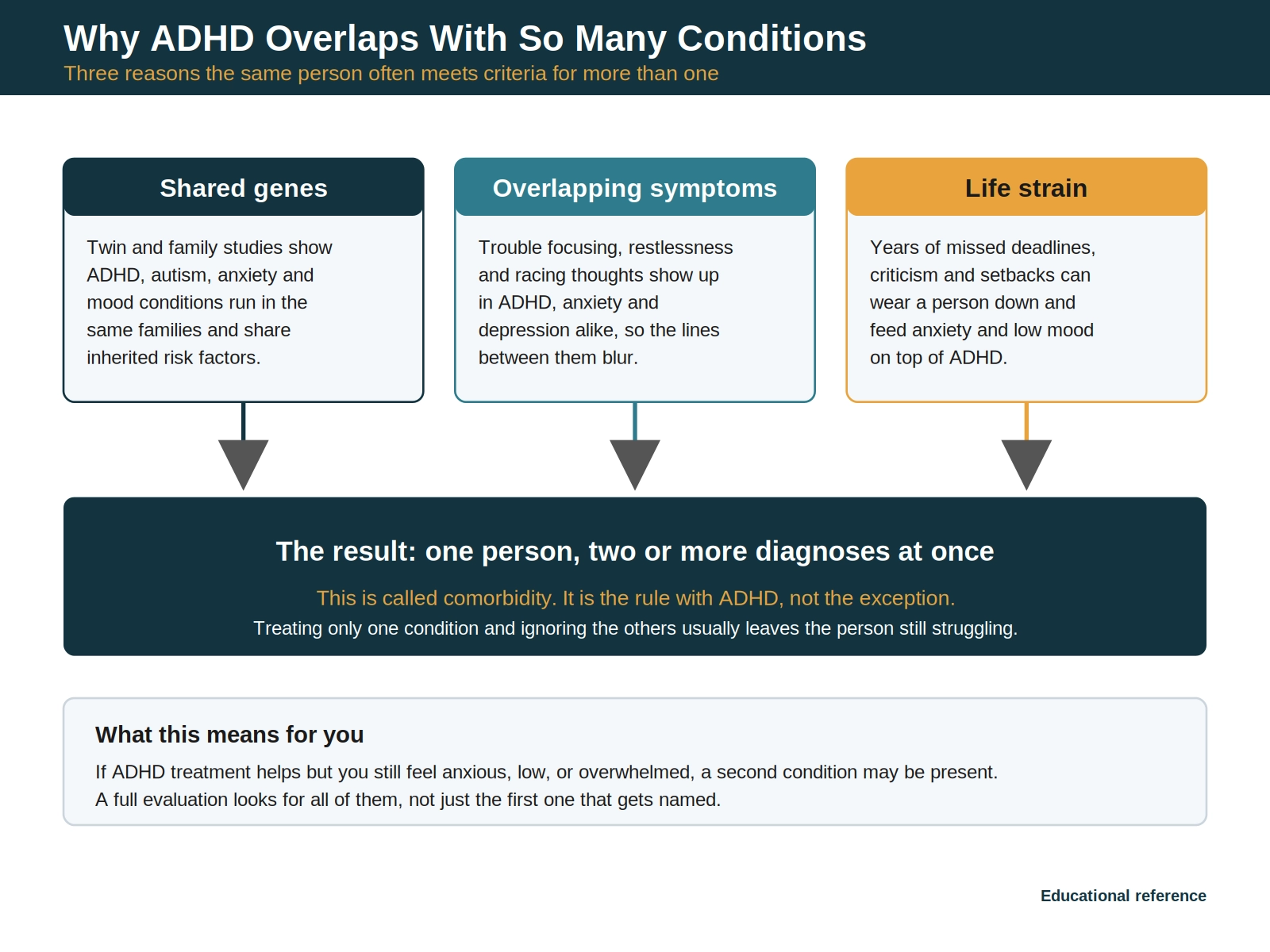
Why Does ADHD Overlap With So Many Conditions?
It can feel unfair that one diagnosis so often comes with others. There are three main reasons, and none of them are your fault.
- Shared genes. ADHD, autism, anxiety, and mood conditions tend to run in the same families. Twin studies show they share inherited risk, so having one raises the odds of another.
- Overlapping symptoms. Trouble focusing, restlessness, and racing thoughts appear in several conditions at once. The same symptom can point to more than one cause, which blurs the lines between diagnoses.
- Life strain. Years of missed deadlines, criticism, and setbacks wear a person down. That strain can feed anxiety and low mood on top of the ADHD that helped cause it.
How Overlapping Conditions Affect Diagnosis
When conditions overlap, a rushed evaluation can miss part of the picture. A doctor who sees only anxiety may treat the anxiety and never look for the ADHD driving it. The reverse happens too.
A thorough assessment looks at your whole history, not just today’s most obvious symptom. It asks how far back the patterns go, how they show up across different parts of life, and whether treating one thing leaves other struggles behind. If you feel like a past evaluation only told half your story, it is reasonable to ask for a fuller one.
How Doctors Decide What to Treat First
When more than one condition is present, treatment is not always about doing everything at once. A common approach is to start with the condition causing the most harm right now, then adjust.
- Safety comes first. Severe depression or a condition that puts someone at risk is usually stabilized before anything else.
- Then the most disruptive condition. Whatever is hurting daily life the most, whether that is ADHD, anxiety, or mood, tends to get early attention.
- Treatments can interact. Some ADHD medications can affect anxiety, and some mood treatments can affect focus. Doctors weigh these effects when they plan the order.
This is a decision to make with a professional. The goal is a plan that treats the whole person, not a single label.
Frequently Asked Questions
Is ADHD a form of autism?
No. ADHD and autism are separate conditions, though they overlap often and share some traits. A person can have one, the other, or both.
Is ADHD on the autism spectrum?
No. ADHD is not part of the autism spectrum. They are both neurodevelopmental conditions, which means they affect how the brain develops, but they are diagnosed separately.
Is ADHD a learning disability?
Not by itself. ADHD affects attention and self-control rather than a specific skill like reading. That said, learning disabilities such as dyslexia frequently occur alongside ADHD.
Can ADHD and depression be treated at the same time?
Often yes. Many people are treated for both together, though the plan depends on the person. A professional decides how to sequence or combine treatments safely.
What is rejection sensitive dysphoria?
It describes the intense emotional pain some people with ADHD feel when they sense rejection or criticism. It is a widely described experience rather than an official diagnosis, but it is very real to those who live with it.
How do I know if I have a second condition and not just ADHD?
A helpful clue is when treating ADHD improves some things but leaves others behind, such as ongoing worry, low mood, or social struggles. That gap is a reason to ask a professional for a fuller evaluation.
The Bottom Line
ADHD rarely travels alone. Anxiety, depression, autism, OCD, and other conditions overlap with it often, driven by shared genes, overlapping symptoms, and the strain of living with an undiagnosed or unsupported brain. Knowing this is not bad news. It explains why a single treatment sometimes only gets you partway.
If any of this sounds like you, the practical next step is a conversation with a qualified professional who will look at the full picture rather than the first label that fits. Bring specific examples of what improved with past treatment and what did not. That gap is often where a second condition is hiding.
Having more than one condition can feel like a heavier load, and it is fair to feel tired by it. It also means there is more than one lever to pull. When the whole picture is finally seen and supported, a lot of people describe it as the first time things start to make sense.