

People who are scheduled for testing often ask the same first question: which tests will I take?
The surprising answer is that there is no fixed list. Two people can walk into the same office with different concerns and leave having taken almost entirely different sets of neuropsychological tests.
That is not carelessness. It is how the field has worked for decades. A neuropsychological test battery is assembled for the unique question being asked and both draws from 1) a core set that nearly everyone gets and 2) a much larger library of specialized measures that are chosen based on the unique problem. Understanding that structure takes most of the mystery out of the process.
This article explains what neuropsychological tests are, the eight common areas of every testing list (often called a “test battery”), how a clinician decides which tests to include, and the named batteries and instruments you may hear about. Test selection is a clinical decision customized to each individual person.
What Neuropsychological Tests Are (and What They Are Not)
A neuropsychological test is a standardized task that measures one aspect of thinking or behavior. Standardized means it is given the same way to everyone, with the same instructions, materials, and time limits, and scored by fixed rules.
Your result is then compared with a large group of people of similar age, and often similar education, to show where you stand. Selecting and interpreting those test tasks is the core work of a clinical neuropsychologist.
Some tests are paper and pencil. Some are spoken questions and answers. Some involve blocks, cards, or drawings. A growing number run on a tablet or computer. What makes them neuropsychological is not the format but the purpose: each one is designed to isolate a specific functional ability so the clinician can see the pattern across all of them.
It helps to be clear about what neuropsychological tests are not:
- Not an IQ test alone. An intelligence test is often part of a battery, but it is one instrument among many. A full evaluation looks at abilities a narrow scope IQ test does not measure well, such as memory over time and sustained attention.
- Not a brain scan. Tests measure function. Imaging shows structure. They answer different questions.
- Not an online quiz. Free tests found on the internet are not normed, not administered under controlled conditions, and cannot be interpreted by anyone. Taking them can even reduce the validity of a real evaluation later.
If you want the bigger picture of what is tested in a neuropsychological exam as a whole process, from interview through report, another article of mine covers it. Here the focus stays on the tests themselves.
Why There Is No Standard Neuropsychological Test Battery
In the middle of the last century, the field’s answer to “which tests?” was a fixed battery: a single set of instruments given in the same order to every patient. The Halstead-Reitan Battery and the Luria-Nebraska Battery are the best-known examples. They were thorough, well researched, and long, often six to eight hours or more.
Most clinicians today use a flexible battery instead. They start from the referral question and the person’s history, form a hypothesis about what may be going on, and choose tests that will confirm or rule it out. A short core covers the domains almost everyone needs. Add-on modules go deeper where the question points.
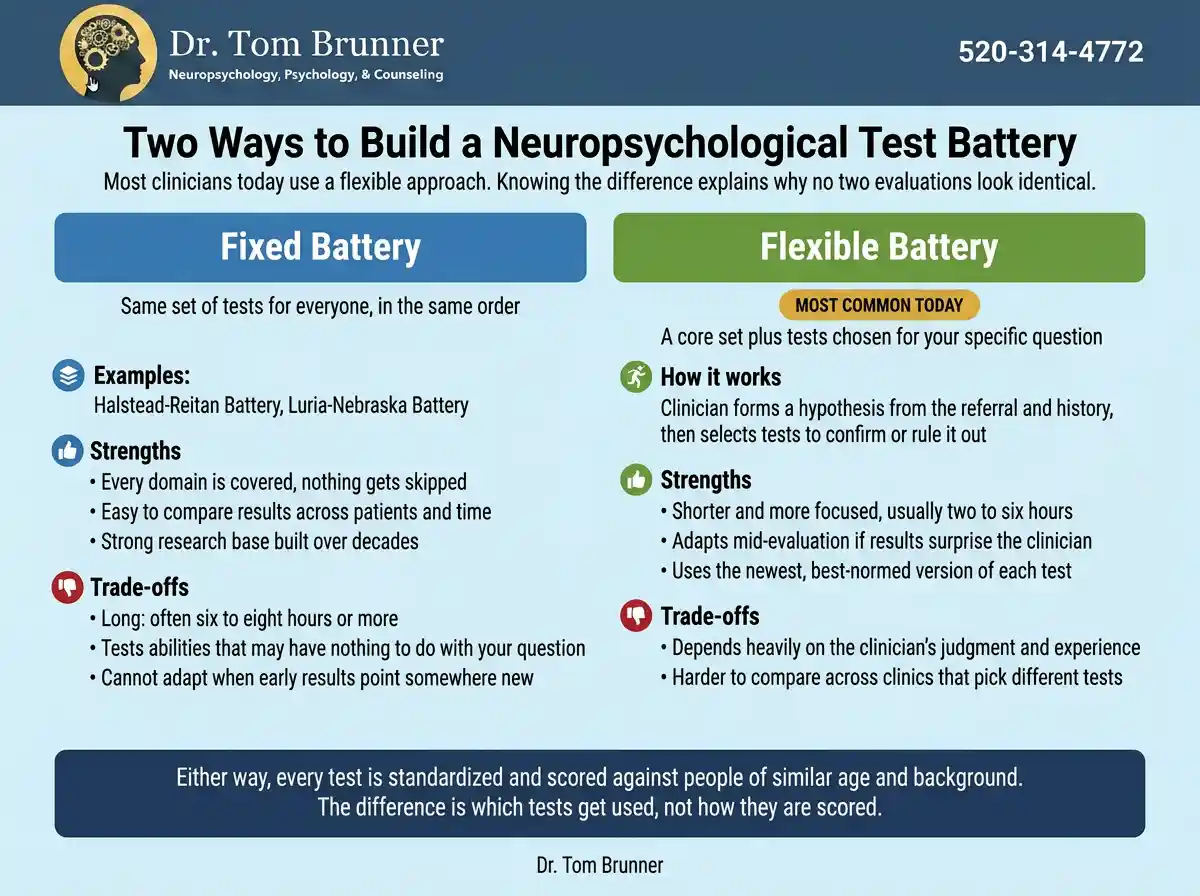
The flexible approach is why price quotes and schedules differ from one office to the next, and why a larger battery affects the cost is a fair question to ask up front. It is also why a good evaluation depends so much on the person choosing the tests. A flexible battery in skilled hands is more efficient and more precise than a fixed one. In careless hands it can miss things. That trade-off is real, and it is one reason the question of accurate neuropsychological testing deserves its own discussion.
What stays the same in every battery
Whatever tests are chosen, three things do not change. Every test is standardized. Every score is compared against norms for people like you. And every time the clinician interprets the pattern across tests rather than focusing on the scores themselves. Scores are never interpreted in isolation.. A low score on one task means very little on its own; a consistent pattern across several tasks that tap the same ability means a great deal.
The Eight Domains Every Neuropsychological Battery Samples
Whether fixed or flexible, batteries are organized around cognitive domains, the major areas of cognitive functioning. This table lists each domain, what it covers, the kind of task used to measure it, and what the task tends to feel like from the chair the patient is sitting in.
| Domain | What it covers | Example task type | What it feels like |
|---|---|---|---|
| Attention and working memory | Focusing, sustaining focus, holding information briefly in mind | Repeating number strings forward and backward; pressing a key for target letters over several minutes | Simple at first, then demanding as strings get longer or the task drags on |
| Learning and memory | Taking in new information and recalling it minutes later | Learning a word list over several trials; hearing a short story and retelling it after a delay | Frustrating in a normal way; nobody remembers everything |
| Language | Understanding and producing words and sentences | Naming pictures; defining words; following multi-step spoken instructions | Familiar, like school vocabulary work |
| Visual-spatial skills | Judging shapes, space, and relationships between objects | Copying complex figures; assembling blocks to match a design; judging line angles | Puzzle-like; some people enjoy these most |
| Executive function | Planning, flexible thinking, self-monitoring, problem solving | Sorting cards by a rule that changes without warning; connecting numbered and lettered dots in alternating order | Mentally effortful; the rules are the challenge |
| Processing speed | How quickly simple mental work gets done | Matching symbols to numbers against a clock; reading color words printed in mismatched ink | Rushed; speed is the whole point |
| Motor and sensory | Fine motor speed, coordination, basic sensation | Tapping a key as fast as possible; placing pegs in a board; identifying shapes by touch | Physical and brief |
| Mood, behavior, and personality | Emotional state and traits that shape how thinking shows up | Questionnaires; structured interview; sometimes ratings from a family member | Reflective rather than performance-based |
Task descriptions are generic examples of common test types. Specific instruments are chosen by the clinician for each evaluation.
Most tasks are still given in person by the clinician or a trained technician. Computer-based neuropsychological assessment is increasingly common for attention and processing speed measures, where precise timing matters, and it is usually mixed into a battery rather than replacing it.
How Your Neuropsychological Test Battery Gets Built
A flexible battery is built in layers. Each layer narrows toward the question that brought you in.
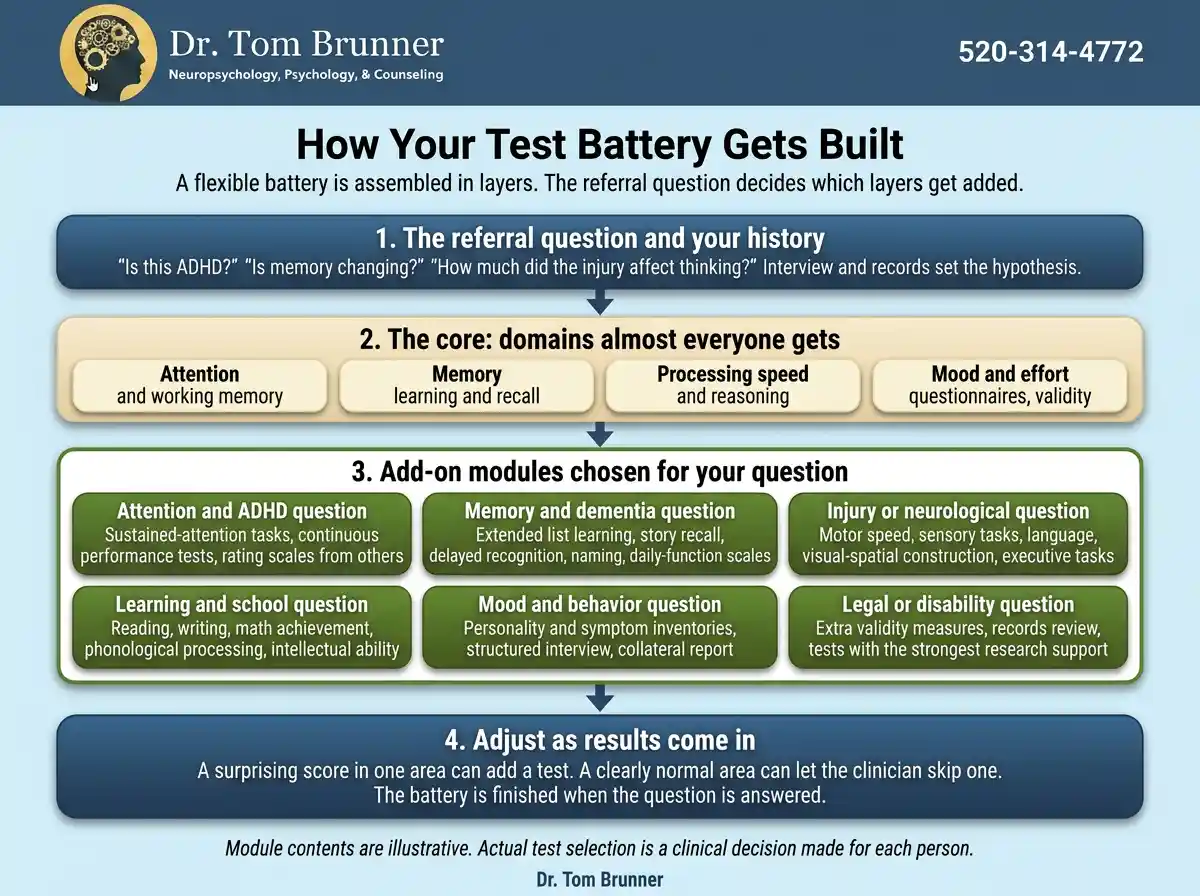
- The referral question and history. The clinician reads the referral, interviews you, and reviews records. By the end of intake there is usually a working hypothesis: what diagnoses are most likely, what other diagnoses are possible, and what diagnoses need to be ruled out through further measurement efforts.
- The core. Nearly every battery samples attention, memory, processing speed, reasoning, and mood, plus one or more performance validity measures. Validity measures are short tasks that look hard but are easy for almost anyone who is trying; they let the clinician confirm the results that reflect real functional ability.
- Add-on modules. This is where batteries diverge. A memory-focused neuropsychological assessment adds extended learning and delayed recall tasks. A school question adds academic achievement testing. An injury battery adds motor, sensory, and language measures. Child neuropsychology evaluations use age-normed versions and lean more on parent and teacher ratings. When the question is dementia, the test battery for dementia emphasizes delayed recall, naming, and measures of daily functioning.
- Adjustment. Results are scored as testing proceeds. A surprising weakness can prompt need for one more test to clarify the specific nature of that impairment. A clearly normal measurement finding can let the clinician skip adminstering redundant measures. The battery is complete when the referral question has an answer, not when a list is exhausted.
When a full battery is more than the situation calls for, a brief neuropsychological screening can settle whether deeper testing is needed at all. Clinicians differ in how they build batteries, so it is reasonable to ask about approach before scheduling. A telehealth psychologist will usually describe how they select tests during the first phone conversation, and a clear answer to that question tells you a lot about the evaluation you are about to receive.
Common Neuropsychological Test Batteries and Instruments by Name
You may see names like these in a referral, a report, or an insurance document. The list is not exhaustive and is not a recommendation. It is a reference so the names are less intimidating when they appear.
| Name | Type | Typically used for |
|---|---|---|
| Halstead-Reitan Neuropsychological Battery | Fixed battery | Comprehensive adult evaluation, historically for brain injury; less common today |
| Luria-Nebraska Neuropsychological Battery | Fixed battery | Comprehensive adult evaluation based on Luria’s methods; rarely used in full today |
| Neuropsychological Assessment Battery (NAB) | Modular battery | Adult evaluation; modules for attention, language, memory, spatial, and executive function |
| RBANS | Brief battery | Screening and repeat testing for memory and thinking change, often in older adults |
| Wechsler Adult Intelligence Scale (WAIS) / Wechsler Memory Scale (WMS) | Component instruments | Intellectual ability and memory within a flexible battery |
| Delis-Kaplan Executive Function System (D-KEFS) | Component instrument | Planning, flexibility, and inhibition in a flexible battery |
| NEPSY-II | Pediatric battery | Developmental evaluation of children and adolescents |
| CANTAB | Computerized battery | Touchscreen measures of attention, memory, and executive function, often in research and clinical trials |
Names and uses are general. Editions, norms, and clinical use vary. Inclusion here is descriptive, not an endorsement.
One caution follows directly from this list: do not look up the tests and practice them. Familiarity with a task artificially inflates scores, which makes the results less accurate and can lead to the wrong conclusion. Rest, eat, wear your glasses or hearing aids, and take the tests cold. That is what the norms assume.
What the Tests Feel Like on the Day
Most people describe testing as tiring but not unpleasant. Tasks come in short blocks with breaks. Some feel easy and some are designed so that almost no one finishes them perfectly; hitting a ceiling is expected, not a failure.
Afterward, the individual test scores produced are only the raw material. What matters is how to interpret neuropsychological tests as a pattern, and how results are written up into a report that other professionals can act on. A list of scores without that interpretation is not an evaluation.

Frequently Asked Questions About Neuropsychological Tests
What are neuropsychological tests, in one sentence?
They are standardized tasks that each measure one aspect of thinking or behavior, scored against people of similar age and background so the clinician can read a pattern across abilities.
What are some examples of neuropsychological tests?
Repeating number strings (attention), learning and recalling a word list (memory), naming pictures (language), copying a complex figure (visual-spatial), sorting cards by a shifting rule (executive function), and matching symbols against a clock (processing speed). Named instruments include the WAIS, WMS, D-KEFS, RBANS, and NEPSY-II.
How many tests are in a neuropsychological battery?
A flexible battery commonly includes 10 to 25 individual tests and subtests, depending on the question. Fixed batteries can include more. The number of tests matters less than whether every relevant domain was sampled.
Is an IQ test a neuropsychological test?
An intelligence test is often one component of a battery, but it is not a neuropsychological evaluation on its own. It does not measure many key skills such as memory over a delay or sustained attention over longer periods, or many executive skills.
What is a neuropsychological test battery?
A battery is the full set of tests given in one evaluation. A fixed battery is the same for everyone; a flexible battery is assembled for the person and a unique person centered question, which is the more common approach today.
Can I take neuropsychological tests online?
Some standardized tests can be given by a clinician over video, and some computerized measures run on a tablet in the office. Free online tests are not neuropsychological tests in any clinical sense and should not be used to self-diagnose.
Are the tests the same for children and adults?
The domains are the same, but children take age-appropriate versions with their own norms, and their evaluations rely more on parent and teacher ratings and on academic achievement measures.
The Bottom Line
Neuropsychological tests are standardized tasks that each isolate one ability. There is no “one size fits all” standard battery because there is no standard question; clinicians build a flexible battery from a shared core plus modules chosen for what you need answered. Fixed batteries still exist and have their uses, but the flexible approach is what most people will meet.
The practical takeaway is to bring a clear question. Tell the clinician what question the results need to answer. Ask the clinician how they choose tests, and then take the tests as they come, rested and unrehearsed. That is how the norms were built, and it is how the results become trustworthy.
Sitting for hours of testing can feel exposing, especially when the stakes are a diagnosis or a child’s school plan. It may help to know that no one is expected to ace these tasks. The point is to identify the key patterns, because pattern recognition is what turns a worry into a plan.