


If you have been wondering whether you or your child has ADHD, you have probably already done some research. Maybe you took an online quiz. Maybe a friend mentioned the idea. Maybe a teacher pulled you aside. Whatever brought you here, the next question is the same: how does this actually work? Where do you go, what do they do, what does it cost, and how long until you get an answer?
This guide walks through the full ADHD diagnosis process from start to finish. You will see the five main steps, learn which screening tools providers use, find out what testing typically costs, and get a clear picture of what to expect at your first appointment. By the end, you will know exactly what to do next.
This article is for general information only. It is not a substitute for a medical evaluation.
Should You Get Tested for ADHD?
Before booking an evaluation, it helps to know whether your symptoms point in that direction. ADHD is diagnosed when several symptoms have been around since childhood, show up in more than one setting, and clearly get in the way of daily life.
Getting tested is worth considering if several of these apply to you:
- You have trouble starting tasks, even when they matter
- You lose track of time, run late, or miss deadlines often
- You forget appointments, bills, or things people just told you
- You feel mentally exhausted from holding it all together
- You have a hard time finishing projects or following through
- You get distracted easily, then beat yourself up about it
- You feel emotions strongly and react quickly
- You had similar problems as a child, even if no one named them
- Anxiety or depression treatment has helped, but something still feels off
- A close family member has ADHD
If you nodded at three or more of those, an evaluation is probably worth your time. The next sections walk through what that actually involves.
The 5 Steps of the ADHD Diagnosis Process
Almost every ADHD evaluation follows the same five-step path, no matter who is doing the testing. The depth of each step varies based on the type of evaluation you choose, but the structure is consistent.
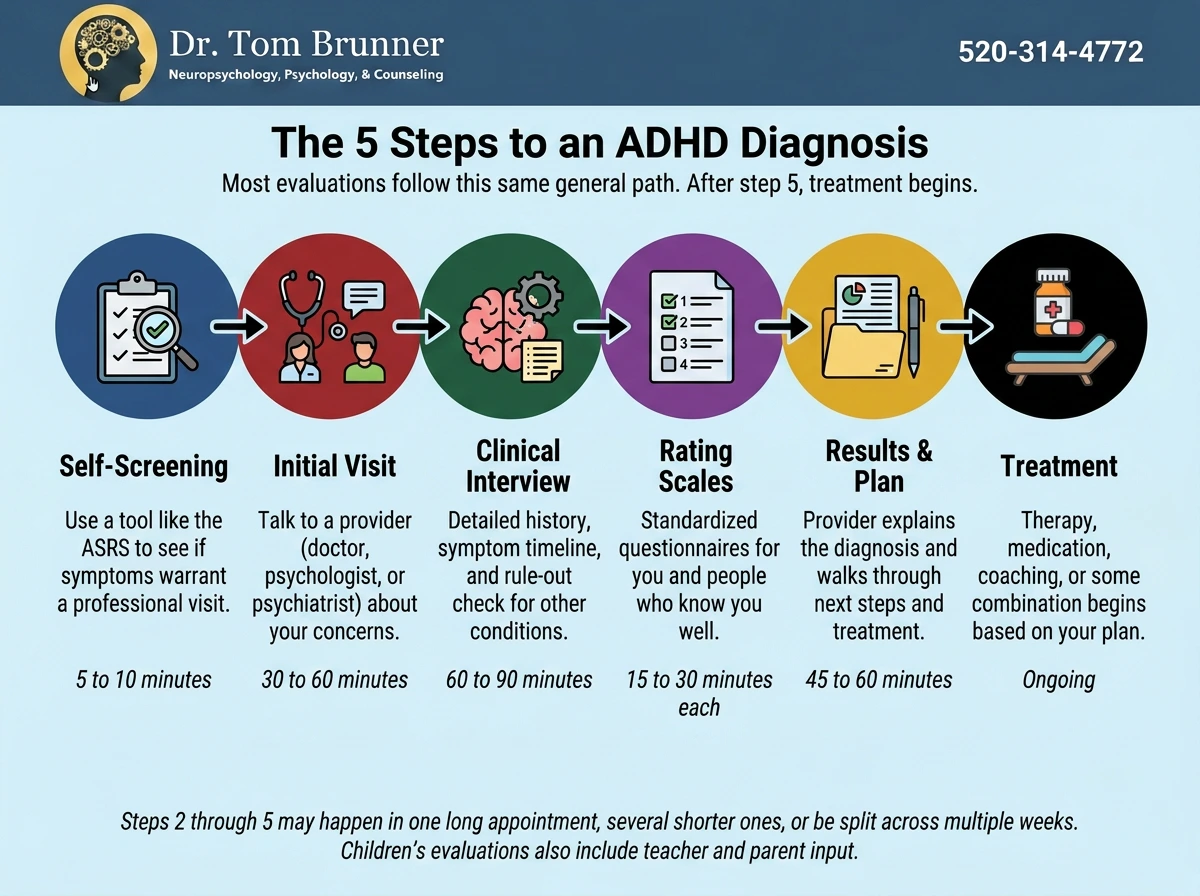
- Self-screening. Most people start by taking a free, validated screening tool to see if their symptoms warrant a professional evaluation. The most widely used tool for adults is the ASRS (Adult ADHD Self-Report Scale), developed by the World Health Organization and Harvard Medical School. It is six questions and takes about 5 minutes. But remember, this measure could easily miss various symptoms, and the most authoritative way to get screened is through a true professional with expertise with ADHD assessment.
- Initial visit. You meet with a provider, usually a primary care doctor, psychologist, psychiatrist, or psychiatric nurse practitioner. This first visit is mostly about getting your story, hearing your concerns, and deciding what kind of evaluation makes sense. Psychologists often have the most training in how to carefully assess for ADHD, and all of the surrounding condition that commonly travel alongside ADHD (e.g., anxiety, trauma, depression, panic).
- Clinical interview. This is the backbone of every legitimate ADHD diagnosis. The provider asks detailed questions about your symptom history, daily life, work or school performance, relationships, and family medical history. They also rule out other conditions that can look like ADHD, such as anxiety, depression, sleep problems, or thyroid issues.
- Rating scales and questionnaires. You will fill out one or more standardized forms, and the provider may ask a partner, parent, or teacher to fill out a version too. These forms compare your behavior to large samples of people with and without ADHD.
- Results and treatment plan. The provider explains the diagnosis (or rules it out), reviews what the testing showed, and walks through next steps. If ADHD is diagnosed, this is where you discuss treatment options and what to do first.
Who Can Diagnose ADHD?
Several types of healthcare providers are qualified to evaluate and diagnose ADHD. The right choice depends on your situation, what you need from the evaluation, and what your insurance covers.
| Provider Type | Best For | What They Can Do |
|---|---|---|
| Primary care doctor | If a medical issue is most likely causing the issues | Initial screening, basic evaluation, prescribe medication, refer to specialists |
| Pediatrician | Children and teens | Full evaluation for kids, work with school, prescribe medication, refer to specialists |
| Psychiatrist | Adults wanting medication | Diagnose, prescribe and manage medication, treat co-occurring conditions like anxiety or depression |
| Psychologist | Obtain thorough evaluation to identify causes and nonmedication based treatments or if medication is needed alongside cognitive or behavioral methods | Comprehensive evaluations, psychological testing, therapy. Cannot prescribe medication in most states |
| Psychiatric nurse practitioner | Affordable, accessible care | Diagnose, prescribe medication, manage treatment in most states |
| Neuropsychologist | Complex or overlapping cases | In-depth testing of cognition, memory, and executive function. Used for school accommodations |
For most adults, a primary care doctor or psychiatric nurse practitioner is the easiest place to start. If they think the case is straightforward, they can run the evaluation themselves. If it looks more complex, they can refer you to a psychologist or psychiatrist. For children, a pediatrician is the standard starting point. But medical professionals sometimes miss nuances that the psychologist will not miss.
ADHD Screening Tools and Tests Used
Providers use validated questionnaires and rating scales to compare your symptoms with established ADHD patterns. These tools do not diagnose on their own. They are used alongside the clinical interview to support the provider’s judgment.
Tools used for adults
- Behavior Rating Inventory of Executive Function (BRIEF). Well validated measure assessing key components of ADHD and more broadly, executive functioning.
- ASRS (Adult ADHD Self-Report Scale). The most widely used adult screener. Developed by WHO and Harvard. The 6-question screener has about 90% accuracy in identifying adults who likely have ADHD.
- BADDS (Brown Attention-Deficit Disorder Symptom Assessment Scale). A 40-item self-report scale that focuses on executive function challenges. Often used when inattention without hyperactivity is suspected.
- ACDS (Adult ADHD Clinical Diagnostic Scale). A semi-structured interview tool used by clinicians during the diagnostic process. Reviews both current symptoms and childhood history.
- WURS (Wender Utah Rating Scale). Specifically asks about ADHD symptoms during childhood. Often used alongside the ASRS to confirm that symptoms started early.
Tools used for children
- Behavior Rating Inventory of Executive Function (BRIEF). Well validated measure assessing key components of ADHD and more broadly, executive functioning.
- Conners Rating Scales. Filled out by parents and teachers. Looks at behavior across home and school settings. Different versions exist for different age ranges.
- Vanderbilt Assessment Scale. Free, widely used by pediatricians. Available in versions for parents and teachers. Screens for ADHD plus common co-occurring conditions.
- BASC (Behavior Assessment System for Children). A broader behavioral assessment that helps separate ADHD from other behavioral or emotional concerns.
If you want to take the ASRS yourself before booking an appointment, the official version is freely available online and is a reasonable first step. Just remember that a high score is not a diagnosis. It is a signal that a professional evaluation is worth pursuing. Taking a measure online cannot replace the credibility that a professional can bring to the table.
How Much Does ADHD Testing Cost?
ADHD testing costs vary a lot depending on the type of evaluation, where you live, and your insurance situation. According to Wellman Psychology, a basic screening from a primary care doctor might run $150 to $300, while a comprehensive psychological evaluation can reach $1,500 or more. Neuropsychological testing tops the list at up to $5,000.

What insurance typically covers
Most insurance plans cover at least part of ADHD testing when it is ordered as medically necessary by a doctor. Coverage tends to be better for clinical evaluations than for in-depth psychological or neuropsychological testing. To find out what your plan covers, call the number on your card and ask three things:
- Is ADHD evaluation covered? Ask specifically about CPT codes 90791 (initial evaluation) and 96130 to 96139 (psychological testing).
- What is my copay or coinsurance? Find out what you will pay per session, including any deductible you have not met.
- Do I need a referral? Some plans require a primary care referral before a specialist visit will be covered.
Ways to lower the cost
- Use HSA or FSA funds. ADHD evaluations qualify as medical expenses, which effectively gives you a 20-35% discount through tax savings.
- Start with a primary care doctor. They can often diagnose ADHD or refer you, and the visit is usually a standard copay.
- Ask about sliding-scale fees. Many psychologists offer reduced rates based on income.
- Consider telehealth ADHD clinics. Online evaluations often run $200 to $500 and many are covered by insurance.
- Check university training clinics. Doctoral students supervised by licensed psychologists offer comprehensive testing at lower rates.
How Long Does the ADHD Diagnosis Process Take?
From your first phone call to a final diagnosis, most adults complete the process in 4 to 8 weeks. The timeline depends on how busy local providers are, what kind of evaluation you need, and whether anyone else (like a teacher or partner) needs to fill out paperwork.
Two situations stretch this timeline. Areas with provider shortages may have wait lists of 3 to 6 months. Comprehensive neuropsychological evaluations also take longer because they involve multiple testing sessions. On the other end, telehealth ADHD clinics often compress the entire process into 2 to 3 weeks because they have streamlined intake systems.
What Happens at Your First Appointment
The first visit usually lasts 30 to 60 minutes. The provider’s goal is to understand your concerns, hear your history, and decide what kind of evaluation makes sense. Here is what to expect:
Questions you will probably hear
- What brought you in today, and how long have you been thinking about this?
- What symptoms are bothering you the most?
- When do you remember these problems starting?
- How are these problems affecting work, school, or home life?
- What is your medical history? Are you on any medications?
- Does anyone in your family have ADHD or other mental health conditions?
- Have you been treated for anxiety, depression, or anything similar before?
- How is your sleep? Your stress level? Your alcohol or drug use?
These questions are not about catching you in something. They are how the provider builds a complete picture and rules out other things that can look like ADHD.
What you might leave with
You usually will not get a diagnosis at the first visit. Instead, you might leave with:
- A list of rating scales to fill out at home
- Forms for a partner, parent, or teacher to complete
- A request to gather old report cards or work reviews
- A scheduled follow-up appointment for the formal evaluation
- A referral to another specialist if needed
How to Prepare for Your ADHD Evaluation
Showing up prepared makes the process faster, more accurate, and less stressful. Here is what to gather and think about before your appointment:
Things to bring
- A list of your current symptoms and how they affect daily life
- Old report cards, work reviews, or anything that shows patterns over time
- A list of all medications and supplements you take
- Names and contact information for any other healthcare providers you see
- Insurance card and a form of payment
- Anyone who knows you well (a parent, partner, or close friend) if appropriate
Things to think about beforehand
- When did you first notice these problems? Did teachers or family members ever mention something?
- What does an average day look like? What is the hardest part?
- How is your sleep, and how much caffeine do you drink?
- What have you tried so far to manage these issues?
- What are your goals? Medication, therapy, accommodations, or just answers?
Bring honest answers, not the answers you think the provider wants. ADHD evaluations work best when the provider gets the real picture.
ADHD Diagnosis: Children vs. Adults
The diagnostic process is similar for kids and adults, but a few key differences are worth knowing.
How it differs for children
Pediatric ADHD evaluations rely heavily on input from people who see the child every day. The pediatrician, psychologist, or psychiatrist will collect information from at least two sources, usually parents and teachers. Common steps include:
- Conners or Vanderbilt rating scales filled out by both parents and teachers
- A review of school records, including grades and behavior reports
- A direct interview or play observation with the child
- A physical exam to rule out vision, hearing, or other medical issues
- Screening for learning disabilities and anxiety, which often go along with ADHD
How it differs for adults
Adult ADHD evaluations rely more on self-report because no one is watching adults the way teachers watch students. The challenge for adults is showing that symptoms started in childhood, which the DSM-5 requires for an ADHD diagnosis. Providers help establish this through:
- A detailed history of school performance, behavior, and friendships growing up
- Old report cards, especially teacher comments
- Conversations with parents or older siblings if available
- Standardized tools like the WURS that ask specifically about childhood symptoms
After the Diagnosis: What Happens Next
Getting an ADHD diagnosis can feel like a lot. Many people describe a mix of relief, sadness, and confusion. The relief usually comes from finally having a name for years of struggle. The sadness comes from grieving what life might have looked like with earlier support. The confusion comes from not knowing what to do next.
After diagnosis, most people start with one or more of these:
- Medication. Stimulants like methylphenidate (Ritalin, Concerta) and amphetamines (Adderall, Vyvanse) are the most common. Non-stimulant options like atomoxetine (Strattera) are also available. Most adults find that medication helps within days to weeks.
- Therapy. Cognitive Behavioral Therapy (CBT) for ADHD focuses on building coping skills, breaking tasks down, managing emotions, and rebuilding self-esteem. It pairs well with medication.
- ADHD coaching. A coach helps you build practical systems for time, task management, and follow-through. Coaches are not therapists, but the structure can be game-changing.
- Workplace or school accommodations. A formal diagnosis can qualify you for accommodations like extended deadlines, quieter workspaces, or extra test time. Children may qualify for an IEP or 504 plan.
- Lifestyle changes. Sleep, exercise, and structure all support brain function. None of these replace treatment, but they make everything else work better.
Most people work through several of these in the first six months after diagnosis to find what fits. The right combination is different for everyone, and it often shifts over time.
Frequently Asked Questions About ADHD Testing
Can I get tested for ADHD online?
Yes. Many telehealth clinics now offer legitimate ADHD evaluations conducted by licensed psychologists, psychiatrists, or psychiatric nurse practitioners. They typically cost $150 to $900 and can result in a formal diagnosis and prescription. Make sure the provider is licensed in your state and that the evaluation includes a real clinical interview, not just a quiz.
How accurate are online ADHD quizzes?
Online quizzes can give you a rough sense of whether your symptoms line up with ADHD, but they are not a diagnosis. The official ASRS, available free online, is a validated screening tool with about 90% accuracy. Even so, it is just a screen. Only a qualified professional can diagnose ADHD.
How long does an ADHD test take?
A clinical evaluation typically takes 1 to 2 hours total, sometimes split across two visits. Comprehensive psychological testing takes 3 to 6 hours, often spread over multiple sessions. Neuropsychological evaluations are the longest, running 6 to 10 hours of testing time.
Do I need to be referred to get tested for ADHD?
It depends on your insurance. HMO plans often require a referral from your primary care doctor before they will cover a specialist visit. PPO plans usually let you book directly with a psychologist or psychiatrist. Call your insurance to confirm before scheduling.
Will my insurance cover ADHD testing?
Most insurance plans cover at least part of an ADHD evaluation when it is ordered as medically necessary. Coverage is usually better for standard clinical evaluations than for comprehensive neuropsychological testing. Coverage varies widely by plan, so verify your benefits before booking.
Can my primary care doctor diagnose ADHD?
Yes. Primary care doctors can evaluate, diagnose, and treat ADHD in straightforward cases. For complex situations, including overlapping anxiety or depression, learning disabilities, or unclear symptom history, your doctor may refer you to a specialist.
What if I get tested and it is not ADHD?
Then you have valuable information. ADHD shares symptoms with anxiety, depression, sleep disorders, thyroid problems, and trauma responses. Ruling out ADHD points the evaluation toward what is actually going on, which is the first step to getting the right help.
Sources
The information in this article was drawn from the following authoritative sources. Each link goes to the original publication.
- Centers for Disease Control and Prevention (CDC): Diagnosing ADHD. Federal overview of how ADHD is diagnosed in children and adults, including the role of the DSM-5 criteria.
- American Psychiatric Association: DSM-5. Official diagnostic criteria used by clinicians in the United States to evaluate ADHD.
- Harvard Medical School: Adult ADHD Self-Report Scale (ASRS). Source for the WHO/Harvard validated 6-question adult ADHD screening tool referenced in this article.
- Children and Adults with Attention-Deficit/Hyperactivity Disorder (CHADD). National nonprofit funded in part by the CDC. Resource for finding qualified providers and understanding evaluation options.
- National Institute of Mental Health (NIMH): ADHD. Federal research summary on ADHD diagnosis, including the role of clinical interview and rating scales.
- American Academy of Pediatrics: ADHD. Pediatric guidelines for ADHD evaluation and diagnosis in children, including the use of teacher and parent rating scales.
The Bottom Line
Getting tested for ADHD is more straightforward than most people think. The process has five clear steps, several validated tools, and a range of cost options to fit different budgets. For most adults, a clinical evaluation by a primary care doctor, psychiatric nurse practitioner, or psychiatrist is enough to get an accurate diagnosis and start treatment.
If you have read this far, you have already done the hardest part: deciding to take the question seriously. The next step is just a phone call. Call your primary care doctor, look into a local psychologist or telehealth ADHD clinic, and ask to schedule an evaluation. Bring this article with you if it helps.
ADHD is one of the most treatable conditions in mental health. Getting an answer, one way or the other, is the door to whatever comes next.