

When most people think of ADHD medication, they picture stimulants like Adderall or Ritalin. But stimulants are not the only option, and they are not right for everyone. Some people cannot tolerate the side effects, some have conditions that make stimulants risky, and some simply prefer not to take a controlled substance. For all of them, non-stimulant medications offer a real alternative.
This guide explains the main non-stimulant options, how each one works, and the honest pros and cons of going this route. The goal is to help you have a more informed conversation with your prescriber, not to replace it.
This article is for general education only and is not medical advice. Never start, stop, or change any medication without your prescriber. Individual responses to these medications vary widely, and only a qualified clinician can decide what is right for you.
Stimulants vs Non-Stimulants: The Big Picture
Stimulants are usually the first medication doctors try for ADHD, because they work quickly and tend to be the most effective. But non-stimulants fill an important gap. They are often chosen when stimulants do not work well, cause bothersome side effects, or are not a good fit, for example, for someone with significant anxiety, a tic disorder, or a history of substance misuse.
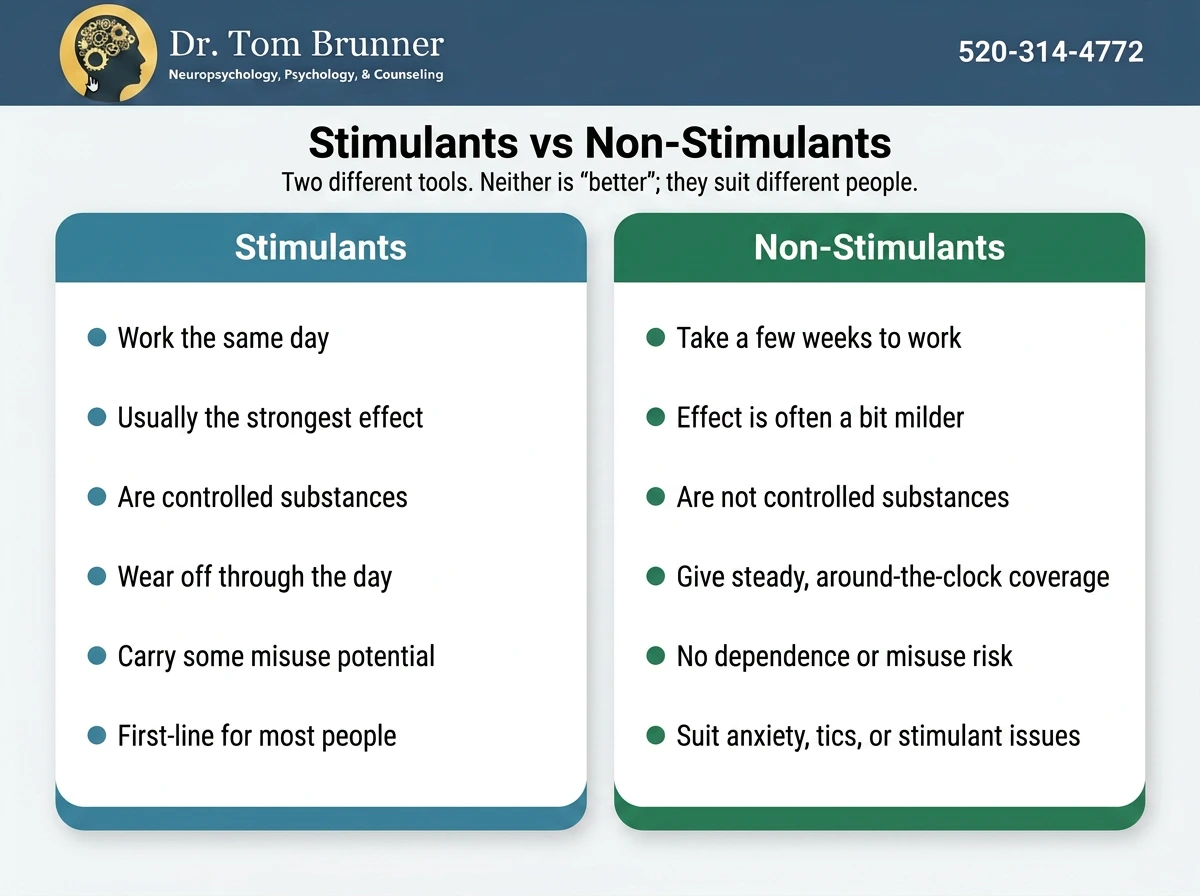
The biggest practical differences: stimulants work the same day, while non-stimulants usually take a few weeks to reach full effect. Stimulants are controlled substances with some misuse potential, while non-stimulants are not controlled and carry no dependence risk. And non-stimulants provide steady, around-the-clock coverage rather than wearing off during the day.
Doctors especially consider a non-stimulant when someone has significant anxiety that stimulants might worsen, a tic disorder, a personal or family history of substance misuse, certain heart concerns, or a strong preference to avoid a controlled medication. They are also useful for people who hate the daily on-off cycle of stimulants, or who get an unpleasant rebound as a stimulant wears off. In other words, the choice is rarely about which drug is strongest, and more about which one fits the whole person.
The FDA-Approved Non-Stimulants
The U.S. Food and Drug Administration has approved four non-stimulant medications specifically for ADHD. They fall into two groups based on how they work: norepinephrine reuptake inhibitors and alpha-2 agonists. A fifth medication, bupropion, is used off-label. Here is how they compare.
| Medication | How it works | Approved for ADHD? | Commonly noted for |
|---|---|---|---|
| Atomoxetine (Strattera) | Norepinephrine reuptake inhibitor | Yes, ages 6+ and adults | The most-used non-stimulant; can also ease anxiety |
| Viloxazine (Qelbree) | Norepinephrine reuptake inhibitor | Yes, ages 6+ and adults | Newer; may work a little faster; once daily |
| Guanfacine (Intuniv) | Alpha-2A agonist | Yes, ages 6 to 17 | Eases hyperactivity; less sedating than clonidine |
| Clonidine (Kapvay) | Alpha-2A agonist | Yes, ages 6 to 17 | Can also help with sleep; more sedating |
| Bupropion (Wellbutrin) | Norepinephrine-dopamine reuptake inhibitor | No, used off-label | An option for adults, especially with depression |
A simplified overview. Approved age ranges and uses can change, and any of these can be used differently in practice under a doctor’s care.
Atomoxetine (Strattera)
Atomoxetine was the first non-stimulant approved for ADHD, back in 2003, and it is still the most commonly prescribed. It works by boosting norepinephrine, a brain chemical involved in attention. It provides 24-hour coverage and is not habit-forming. The main trade-off is patience: it can take two to six weeks to reach full effect. Common side effects include stomach upset, reduced appetite, fatigue, and a small rise in blood pressure and heart rate. Like several antidepressant-type medications, it carries a warning about a small increased risk of suicidal thoughts in children and teens, so young people are monitored closely when starting it.
Viloxazine (Qelbree)
Viloxazine is the newest non-stimulant, approved in 2021 for children and extended to adults in 2022. It works in a similar way to atomoxetine, on norepinephrine, and some early evidence suggests it may start helping a bit sooner. It is taken once a day, and the capsule can be opened and sprinkled on food, which helps children who struggle with pills. Common side effects include sleepiness, trouble sleeping, reduced appetite, and headache.
Guanfacine (Intuniv) and Clonidine (Kapvay)
These two are a different class, called alpha-2 agonists, originally blood-pressure medications. In ADHD they help with hyperactivity, impulsivity, and emotional regulation, and they can be used alone or added to a stimulant. Because they lower blood pressure, they can cause drowsiness and low blood pressure, and clonidine tends to be more sedating than guanfacine, which is why some doctors prefer guanfacine. One important safety point: these should never be stopped suddenly, as that can cause a rebound spike in blood pressure. Any change is tapered under a doctor’s guidance.
It is worth highlighting that combination is common with this class. A doctor may pair a low dose of guanfacine or clonidine with a stimulant to smooth out rough edges, better control impulsivity, or ease the evening comedown. So non-stimulants are not always an either-or choice. Sometimes they work best as a teammate to a stimulant rather than a replacement for one.
Off-Label Options: Wellbutrin and Others
Beyond the approved four, doctors sometimes reach for medications approved for other conditions but supported by research for ADHD. The best known is bupropion (Wellbutrin), an antidepressant. As the experts at ADDitude and others describe, it works on dopamine and norepinephrine, the same chemicals stimulants target, which makes it a rational choice, especially for adults who also have depression.
Bupropion is not FDA-approved for ADHD, and research suggests it is somewhat less effective than stimulants, though it clearly beats a placebo and helps many adults. It is not habit-forming. The main cautions are that it can slightly raise the risk of seizures (which is why it is avoided in people with a seizure disorder or eating disorder) and, like other antidepressants, it carries a suicidality warning. Other off-label choices, used less often, include certain older antidepressants. All of these are decisions for a knowledgeable prescriber.
Strattera, Wellbutrin, and Anxiety
A very common question is which ADHD medication is best when anxiety is also in the picture. This is one area where non-stimulants shine. Stimulants can sometimes worsen anxiety or jitteriness, while several non-stimulants tend to be gentler, and some may help both conditions.
Atomoxetine (Strattera) is often chosen for people with ADHD and anxiety, because it can ease anxiety symptoms rather than aggravate them. Bupropion (Wellbutrin) can be a good fit when depression is part of the picture. That said, everyone’s chemistry is different, and the right choice depends on your full health history. If anxiety is a major concern, it is worth raising specifically with your prescriber.
Pros and Cons of Non-Stimulants
So how do you weigh whether a non-stimulant is right for you? It comes down to trade-offs.
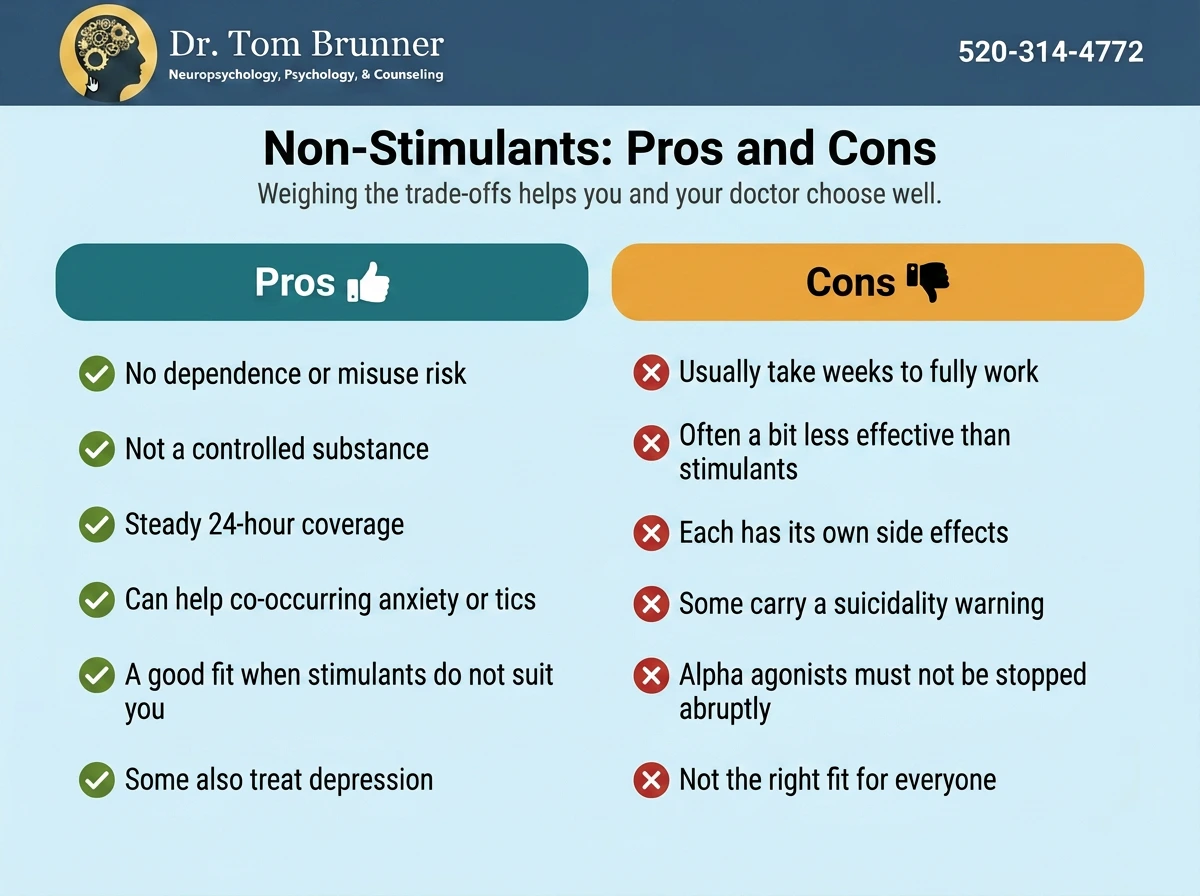
In short, non-stimulants are a strong option if you value a non-controlled medication, want steady all-day coverage, cannot tolerate stimulants, or have co-occurring anxiety. The main downsides are that they usually take longer to work and are often a little less powerful. For many people, especially those for whom stimulants are not a good fit, that trade is well worth it.
Medications People Ask About That Are Not ADHD Treatments
Search results sometimes list drugs that are not actually treatments for ADHD. It is worth clearing these up, because taking the wrong medication for the wrong reason helps no one.
- Mood stabilizers and antipsychotics (like Seroquel). These treat conditions such as bipolar disorder, not ADHD. They may show up only if someone has a separate co-occurring condition, and they are not a treatment for ADHD itself.
- Trazodone. This is an antidepressant used mainly off-label for sleep. It does not treat ADHD, though a doctor might use it for ADHD-related insomnia.
- Cannabis (weed). Despite online claims, cannabis is not an evidence-based ADHD treatment, and it can worsen attention, memory, and motivation. It can also interact with medications. Be cautious and honest with your doctor about any use.
If you have seen any of these suggested for ADHD, treat that as a prompt to ask a professional rather than to self-experiment.
Frequently Asked Questions
What are the non-stimulant ADHD medications?
The four FDA-approved for ADHD are atomoxetine (Strattera), viloxazine (Qelbree), guanfacine (Intuniv), and clonidine (Kapvay). Bupropion (Wellbutrin) is commonly used off-label, especially in adults.
How long do non-stimulants take to work?
Longer than stimulants. Most take about two to six weeks to reach their full effect, so patience is needed. This is very different from stimulants, which work the same day.
How does clonidine work for ADHD?
Clonidine is an alpha-2 agonist, originally a blood-pressure medicine. It calms the nervous system, which can reduce hyperactivity, impulsivity, and emotional intensity, and it can also help with sleep. It should never be stopped abruptly.
Which non-stimulant is best for ADHD and anxiety?
Atomoxetine (Strattera) is often chosen when anxiety is present, because it can help anxiety rather than worsen it. But the best choice depends on your full history, so discuss it with your prescriber.
Is Wellbutrin a stimulant?
No. Wellbutrin (bupropion) is an antidepressant, not a stimulant or a controlled substance. It is used off-label for ADHD because it acts on dopamine and norepinephrine, similar to how stimulants work.
Can you take a non-stimulant together with a stimulant?
Yes, in some cases. Doctors sometimes add a low dose of guanfacine or clonidine to a stimulant to improve impulse control or ease the evening wear-off. This is a common, well-established combination when a single medication is not enough on its own.
Are non-stimulants safe to take long term?
For most people, yes, under a doctor’s supervision. They are not habit-forming, and they can be taken over long periods with regular check-ins to monitor blood pressure, mood, and side effects. As always, any changes should be made with your prescriber rather than on your own.
Sources
The information in this article was drawn from the following authoritative sources. Each link goes to the original publication.
U.S. Food and Drug Administration (FDA): Treating and Dealing With ADHD. Lists the FDA-approved stimulant and non-stimulant medications for ADHD.
Child Mind Institute: Nonstimulant Medications for ADHD. Plain-language overview of how the non-stimulant medications work.
ADDitude: Wellbutrin for ADHD. Reviews the off-label use of bupropion for ADHD.
Children and Adults with Attention-Deficit/Hyperactivity Disorder (CHADD). National nonprofit with medication and treatment resources.
National Institute of Mental Health (NIMH): ADHD. Federal research summary on ADHD treatment.
The Bottom Line
Non-stimulants are a genuine alternative for people who cannot or would rather not take stimulants. The four approved for ADHD, atomoxetine, viloxazine, guanfacine, and clonidine, plus off-label bupropion, each work differently and suit different needs. They tend to take longer to kick in and be a bit milder than stimulants, but they offer steady coverage, no misuse risk, and, for some, extra help with anxiety or depression.
There is no single best ADHD medication, only the one that fits your body, your symptoms, and your life. Finding it often takes some trial and adjustment, so stay in close contact with your prescriber, especially in the early weeks.
And be wary of anything online suggesting drugs like mood stabilizers, antipsychotics, or cannabis for ADHD. When in doubt, the safest move is always the same: bring your questions to a professional who knows your history.