

If ADHD is part of your relationship, you have probably felt the pattern: a small comment turns into a big fight, plans get forgotten, feelings run hot and fast, and both people end up hurt without quite knowing how they got there. It can leave one partner feeling unseen and the other feeling like they can never get it right.
Here is the most important thing to know up front. These patterns are not a sign that the love is gone or that anyone is trying to hurt anyone. They come from how the ADHD brain handles attention, emotion, and stimulation. Once you can name what is really happening, you can start working with it instead of against it. This guide covers the emotional side of ADHD in relationships, why it feels so intense, and what actually helps.
This article is for general education only. It is not a substitute for professional care. If ADHD is straining your relationship or mental health, a licensed therapist, especially one who understands ADHD, can help.
How ADHD Shows Up in Relationships
ADHD affects relationships mainly through three channels: communication, emotional regulation, and executive function, the brain’s system for planning and follow-through. None of these is about love or commitment. A partner who forgets an anniversary is usually not careless about the relationship. Their brain simply dropped the reminder.
The trouble is that these differences are easy to misread. Forgetfulness looks like not caring. A quick temper looks like meanness. Zoning out mid-conversation looks like disrespect. When the partner without ADHD keeps running into these patterns, they can slowly build up resentment, while the partner with ADHD feels like they are always disappointing someone they love. Naming the real cause is how couples stop taking it personally and start solving it together.
It is worth saying plainly that the partner without ADHD carries a real burden too. Often they end up handling most of the planning, remembering, and organizing, and over time that unequal load can lead to burnout, resentment, and loneliness. Their frustration is valid. A healthy path forward takes both people seriously: the one with ADHD is not lazy, and the one without it is not nagging. Both are responding to a pattern neither chose.
Emotional Dysregulation: When Feelings Run Hot
Emotional dysregulation may be the single most relationship-straining part of ADHD. It means emotions come on fast and strong, and they are hard to dial back down. A minor frustration can feel like a five-alarm fire, and it can take a while to cool off. This is not drama or immaturity. The same brain wiring that affects focus also affects the brakes on emotion.
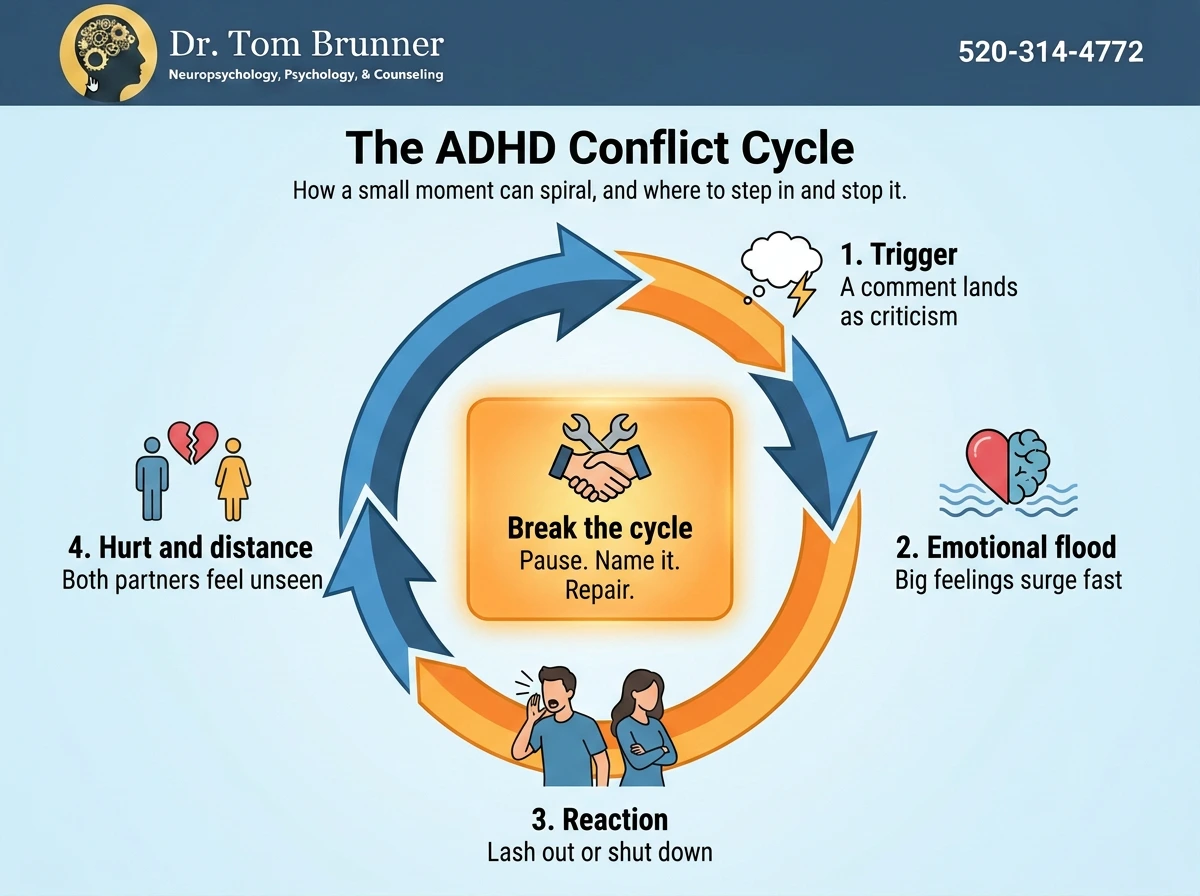
In a relationship, this often shows up as sudden mood swings or anger outbursts, sometimes called rage attacks, that flare up and then pass quickly. The person may feel calm again in minutes while their partner is still shaken. Understanding that the wave is real, intense, and short can help both people ride it out without saying things they will regret. The goal is not to never feel big feelings. It is to add a pause between the feeling and the reaction.
A common example: one partner asks, in a totally neutral tone, whether the bills got paid. The partner with ADHD, already carrying a quiet sense of falling behind, feels a hot rush of shame and snaps back. Ten minutes later the storm has passed and they feel awful about it, while their partner is left wondering what just happened. Nothing was actually wrong with the question. The reaction came from a nervous system that turns the volume up on emotion. Once a couple can spot that dynamic in the moment, they can name it and let it pass instead of feeding it.
Rejection Sensitive Dysphoria (RSD)
Rejection sensitive dysphoria, or RSD, is a term for the intense emotional pain many people with ADHD feel in response to rejection, criticism, or even the hint of it. It is worth knowing that RSD is not a formal diagnosis and does not appear in the manual doctors use. It is a popular way to describe a real experience that falls under emotional dysregulation.
RSD can quietly wreck communication. When one partner brings up a normal concern, say, a dish left in the sink, the partner with RSD may not hear “please rinse your plate.” They may hear “you are a failure,” and react as if under attack. That defensiveness can escalate a tiny issue into a painful fight. Recognizing RSD for what it is helps the couple slow down: one partner learns to raise things gently, and the other learns to notice when the rejection alarm is firing louder than the situation calls for.
Overstimulation and Sensory Overload
Many people with ADHD are more sensitive to the world around them. Loud rooms, bright lights, background noise, too many things happening at once, all of it can pile up until the brain feels flooded. This is called overstimulation, and it happens because the ADHD brain has a harder time filtering out what does not matter. Hypersensitivity is a related idea: a steady, built-in sensitivity to certain sounds, lights, or textures.
When someone hits sensory overload, they may get irritable, anxious, or shut down completely, and they often need to withdraw to recover. In a relationship, a partner can misread this as coldness or rejection: “We were having fun and suddenly they went quiet and wanted to leave.” Naming overstimulation ahead of time changes everything. If a partner knows that a loud party can tip their loved one into overload, they can plan an exit, find a quieter corner, or simply give some space without taking it personally.
Are People with ADHD More Empathetic?
You may have seen the idea of the “ADHD empath” online, the notion that people with ADHD feel others’ emotions especially deeply. There is something real behind it. Emotional sensitivity is common in ADHD, so many people with it do feel emotions, their own and other people’s, very intensely.
But the full picture is more mixed. The same ADHD traits that bring deep feeling can also cause someone to miss social cues, interrupt, or get so caught up in their own experience that they overlook a partner’s. So it is not that ADHD makes someone more or less caring. It is that their empathy can be intense and uneven at the same time. “Empath” is a popular label, not a clinical one, and it is most useful as a reminder that big feelings are part of the package.
Common ADHD Relationship Problems
Certain patterns come up again and again in ADHD relationships. Seeing them laid out, with what is really going on underneath and what helps, makes them far less mysterious.
| The pattern | What is really going on | What helps |
|---|---|---|
| Forgotten dates and tasks | Working memory struggles, not indifference | External reminders and shared systems |
| The parent-child dynamic | One partner over-manages to compensate | Rebalance tasks around each person’s strengths |
| Interrupting or zoning out | Impulsivity and distractibility | Slow the pace, take turns, cut distractions |
| Intense passion that fades | Early hyperfixation, then attention shifts | Build steady routines of connection, not just sparks |
| Blowups over small things | Emotional dysregulation and RSD | Pause, name the feeling, and repair afterward |
The parent-child dynamic, where one partner becomes the manager and the other the managed, is one of the most common and corrosive patterns, and a good target for couples work.
Building Stronger Connections: What Helps
The encouraging news is that ADHD relationships can be warm, funny, passionate, and deeply loving. The traits that cause friction, spontaneity, intensity, and creativity, are also gifts. The work is in building habits that protect the connection from the rough edges.
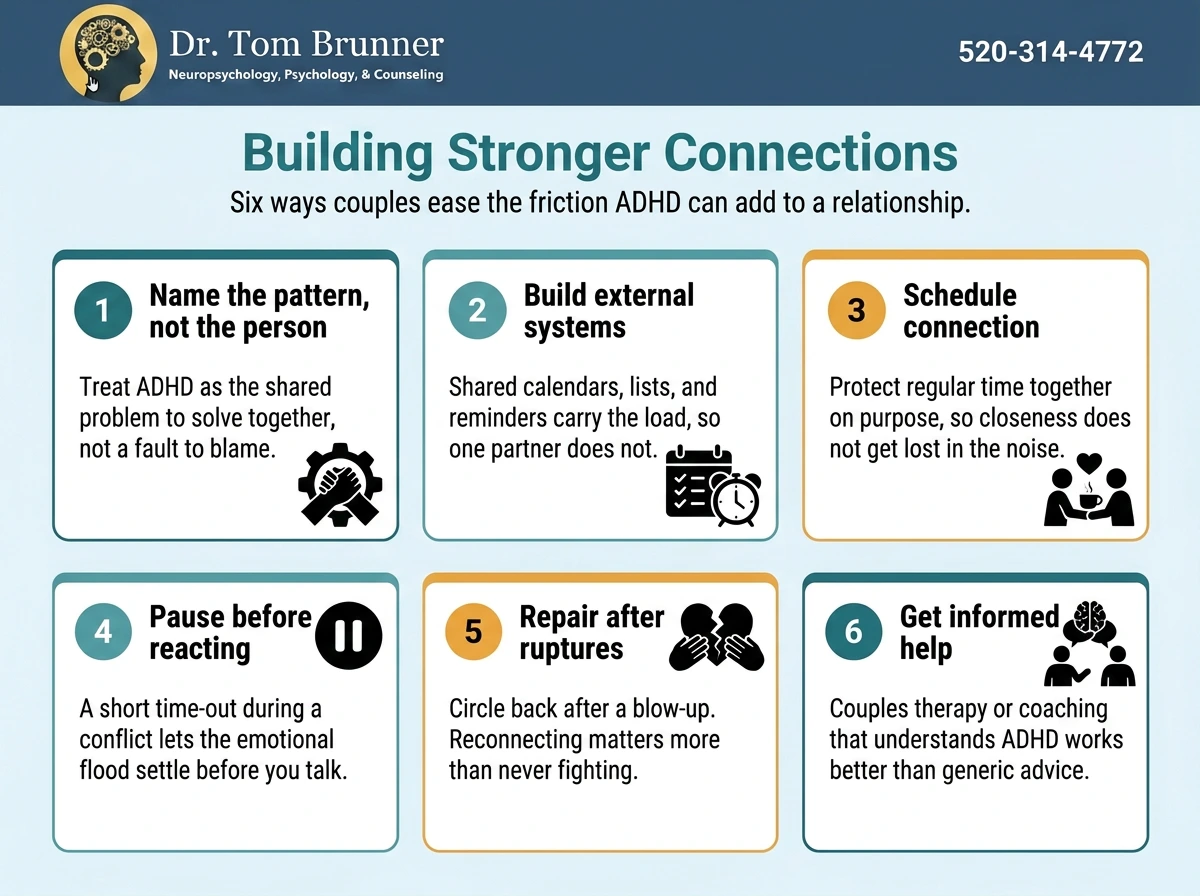
A few of these deserve a special mention. Building external systems, like shared calendars and reminders, takes the mental load off the partner who has been carrying it and helps break the parent-child dynamic. And getting ADHD-informed help matters: couples therapy with someone who actually understands ADHD tends to work far better than generic advice, because it targets the real patterns instead of blaming either person.
When It Feels Like Too Much: Mental Health and Getting Help
The emotional weight of ADHD can get heavy, especially when it goes untreated. Years of conflict, criticism, and feeling like you are letting people down can wear anyone down. According to CHADD, people with ADHD are at higher risk for depression, anxiety, and suicidal thoughts, in large part because of these pressures. Some people also try to cope by self-medicating with alcohol or other substances, which tends to make things worse.
The hopeful part is that this is treatable, and treating the ADHD itself lowers the risk. If your emotions feel unmanageable, or you find yourself reaching for substances to cope, that is a sign to reach out to a professional, not to push through alone. Support helps, and things can get better.
| If you are struggling or in crisis
If you or someone you love is having thoughts of suicide or self-harm, you are not alone. In the U.S., call or text 988 to reach the 988 Suicide and Crisis Lifeline, available 24/7, or text HOME to 741741 for the Crisis Text Line. If someone is in immediate danger, call 911. |
This section touches on a sensitive topic. If it brings up difficult feelings, please consider reaching out to a trusted person or one of the resources above.
Frequently Asked Questions
Does ADHD cause mood swings?
It can. Emotional dysregulation in ADHD can cause quick, intense mood shifts. These usually come as reactions to something and pass fairly fast, which is different from the longer mood episodes seen in bipolar disorder. If you are unsure which you are dealing with, a professional can help sort it out.
What are ADHD rage attacks?
They are sudden bursts of intense anger that flare up and then fade quickly. They come from emotional dysregulation, not from wanting to hurt anyone. Recognizing the wave, and building in a pause before reacting, helps you and the people around you ride it out.
How does ADHD affect women in relationships?
Women with ADHD are often diagnosed late, and many learn to mask their symptoms. In relationships, that can show up as over-giving, people-pleasing, and strong rejection sensitivity. Getting an accurate diagnosis is often a turning point that helps everything else make sense.
Why do people with ADHD ruminate so much?
Rumination, replaying a conversation or mistake over and over, is common in ADHD and closely tied to rejection sensitivity. The mind gets stuck on a perceived slight. Naming the loop, and treating the underlying ADHD and any anxiety, can quiet it.
What is ADHD imposter syndrome?
Many people with ADHD feel like frauds who are one step from being found out, often because they have spent years underperforming relative to their potential. It is a common feeling, not a fact, and it tends to ease as you understand your brain and build supports that let your strengths show.
Sources
The information in this article was drawn from the following authoritative sources. Each link goes to the original publication.
Children and Adults with Attention-Deficit/Hyperactivity Disorder (CHADD). National nonprofit with resources on ADHD, relationships, and emotional regulation.
CHADD: ADHD and Suicide Risk Factors. Overview of why ADHD raises mental health risk and how treatment helps.
Attention Deficit Disorder Association (ADDA). Nonprofit focused on adults with ADHD, including sensory overload and daily life.
National Institute of Mental Health (NIMH): ADHD. Federal research summary on ADHD symptoms and treatment.
988 Suicide and Crisis Lifeline. Free, confidential crisis support, available 24/7 by call or text at 988.
The Bottom Line
ADHD does not make someone a bad partner. It changes how they handle emotion, attention, and stimulation, and those differences can create real friction if no one understands them. Emotional dysregulation, rejection sensitivity, and overstimulation are the big three on the emotional side, and each one gets easier to handle once it has a name.
The path forward is not about trying harder or loving more. It is about building the right structure: external systems that share the load, a pause between feeling and reaction, repair after the hard moments, and help from someone who understands ADHD. Small, steady changes protect the connection far more than grand gestures.
If the emotional weight ever feels like too much, reaching out for support is a sign of strength, not failure. With understanding and the right tools, ADHD relationships can be some of the most loving and alive there are.