


ADHD does not look the same in everyone. One person cannot sit still. Another sits perfectly still but has not heard a word you said. Both can have ADHD. They just have different types of it.
Doctors sort ADHD into three types, officially called presentations. This guide explains all three in plain language, clears up the common confusion between ADD and ADHD, and shows how doctors decide which type someone has. By the end, you will know which presentation sounds most like you or your child, and what that label actually means.
The information here is general and educational. Only a qualified professional who evaluates a person can diagnose ADHD or its type.
The 3 Types of ADHD at a Glance
Here is the short version before we go deeper. ADHD has three presentations, based on which symptoms stand out.
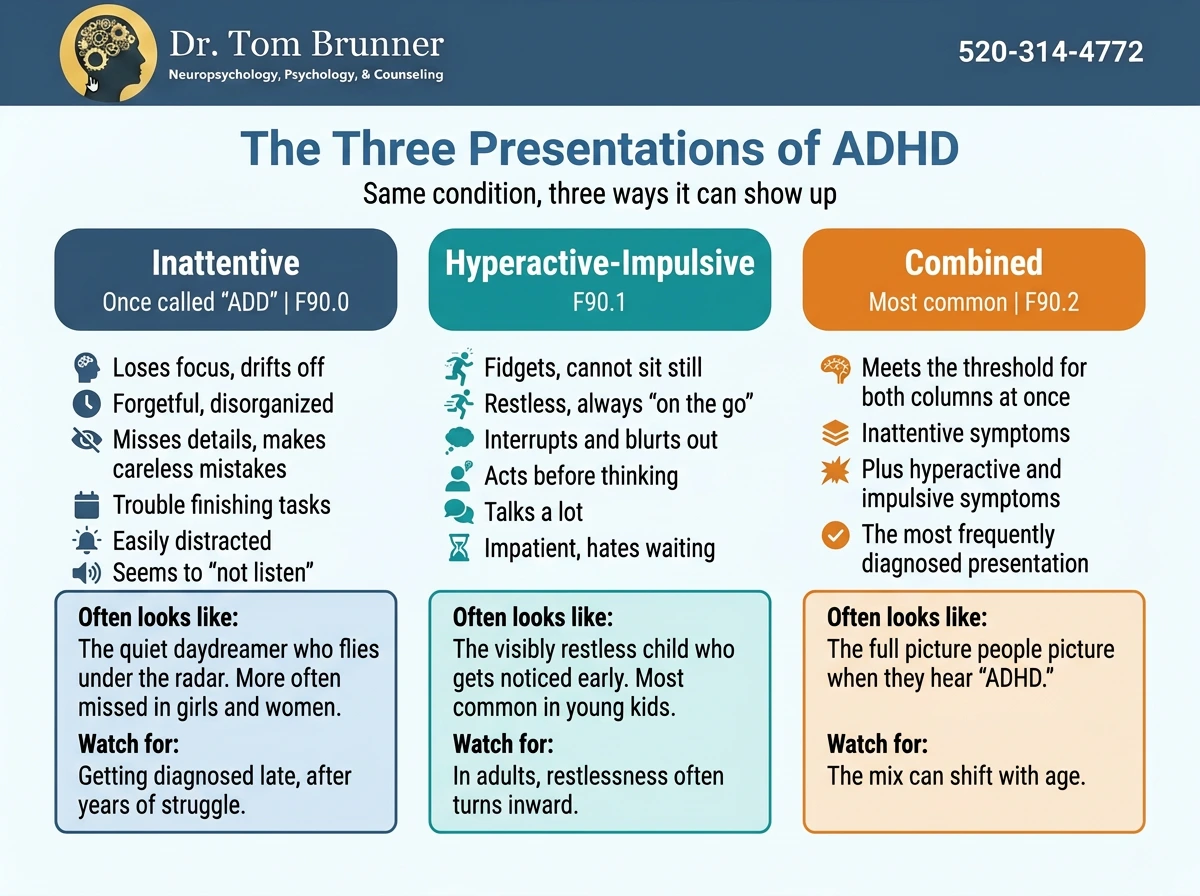
- Inattentive presentation. Focus, memory, and organization are the main struggles. This is what used to be called ADD.
- Hyperactive-impulsive presentation. Restlessness, fidgeting, and acting before thinking stand out the most.
- Combined presentation. Both sets of symptoms are present. This is the most commonly diagnosed type.
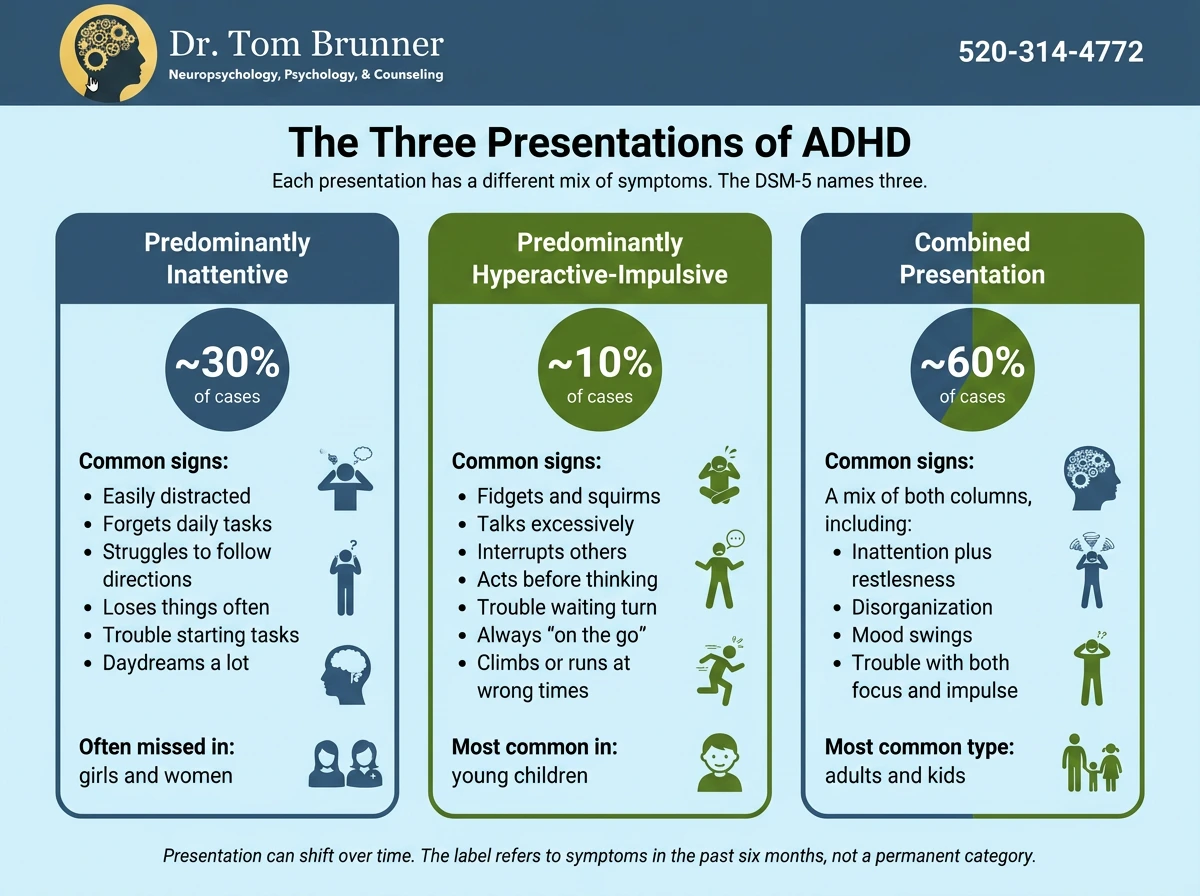
Type 1: Inattentive Presentation (Once Called ADD)
The inattentive presentation is about attention, not activity. People with this type are not bouncing off the walls. Their struggle is quieter and happens on the inside, which is exactly why it gets missed so often.
Common signs
- Loses focus quickly and drifts off mid-task
- Forgetful in daily life, from keys to appointments
- Disorganized, with a hard time keeping track of things
- Misses details or makes careless mistakes
- Struggles to finish what they start
- Seems to not listen, even when spoken to directly
Who it gets missed in
Because there is no obvious disruption, the inattentive presentation often flies under the radar. It is missed more often in girls and women, who may be seen as dreamy or scattered rather than as having ADHD. Many people with this type are not diagnosed until adulthood, after years of quietly struggling and wondering why.
Type 2: Hyperactive-Impulsive Presentation
This is the presentation most people picture when they hear the word ADHD. The main features are physical restlessness and acting on impulse. It tends to be the most visible type, which means it usually gets noticed early.
Common signs
- Fidgets, squirms, or cannot stay seated
- Feels restless and always on the go
- Interrupts others or blurts out answers
- Acts before thinking it through
- Talks a great deal
- Impatient and dislikes waiting
How it changes with age
This presentation is most common in young children, especially the visible running-and-climbing kind. In teens and adults, the outward hyperactivity often turns inward. Instead of running around, an adult may feel a constant inner restlessness, or the sense that they cannot switch off. The impulsivity usually stays.
Type 3: Combined Presentation
The combined presentation means a person has enough symptoms from both of the other two types at the same time. In other words, they have significant trouble with attention and with hyperactivity or impulsivity together.
This is the most frequently diagnosed presentation. Part of the reason is simple: when both the quiet struggles and the visible ones show up, the pattern is harder to overlook, so more of these cases reach a doctor. It is also the presentation most often linked with real difficulty at school and work, because it comes at a person from two directions at once.
ADD vs. ADHD: What Is the Difference?
This is one of the most searched questions about ADHD, and the answer is refreshingly simple: there is no medical difference anymore. ADD is just an older name.

Years ago, ADD (attention deficit disorder) was used for people who had attention problems without hyperactivity. Then research showed that inattention and hyperactivity are not two separate conditions. They are different expressions of the same thing. So the name was updated to ADHD, and the three presentations were added to describe how it shows up.
Today, ADD is considered an outdated term. If someone says they have ADD, what they have in current terms is ADHD, inattentive presentation. The condition is the same. Only the label changed.
How Doctors Decide Which Type You Have
Doctors in the United States use a guidebook called the DSM-5 to diagnose ADHD. It sets clear rules, which keeps the diagnosis consistent from one doctor to the next. Here is the plain-English version of what it looks for.
- Enough symptoms. Children up to age 16 need at least six symptoms in a category. For people 17 and older, the threshold drops to five, because symptoms often become subtler with age.
- Present before age 12. Several symptoms must have shown up in childhood, even if the diagnosis comes much later.
- Show up in more than one place. The symptoms have to appear in at least two settings, such as home and work or home and school, not just one.
- Actually cause problems. The symptoms must clearly interfere with daily life, not just be mild quirks.
- Not better explained by something else. The doctor rules out other conditions that could cause similar symptoms.
Which category the symptoms fall into, inattentive, hyperactive-impulsive, or both, decides the presentation.
A note on presentations versus subtypes
You may see these called subtypes in older articles. The current term is presentations, and the change is meaningful. A subtype sounds permanent, like a fixed box you belong to. A presentation describes how ADHD shows up right now. Someone can be combined as a child and mostly inattentive as an adult, as visible hyperactivity fades. The type can shift over a lifetime.
What About the ICD-10 Codes?
If you have seen a code like F90 on paperwork, that comes from a different system called the ICD-10, used mainly for medical records and billing. The three presentations map directly onto these codes, so they line up neatly with the DSM-5.
| Presentation | ICD-10-CM code | Also seen as |
|---|---|---|
| Inattentive | F90.0 | The old ADD |
| Hyperactive-impulsive | F90.1 | Predominantly hyperactive |
| Combined | F90.2 | The most common code |
Codes are for records and insurance. You do not need to memorize them, but it helps to know what they mean if you see one.
Is There Mild, Moderate, and Severe ADHD?
Yes. On top of the three presentations, a doctor may add a severity level: mild, moderate, or severe. This describes how much the symptoms disrupt daily life, not a separate kind of ADHD.
Mild means the symptoms are present but fairly manageable. Severe means they cause major problems across many parts of life. The same person can move between levels over time, especially with treatment and support. You may also hear the phrase high-functioning ADHD in everyday conversation. It is not an official term, but people use it to describe someone who copes well on the surface while still struggling underneath.
Frequently Asked Questions
What are the three types of ADHD?
Inattentive presentation, hyperactive-impulsive presentation, and combined presentation. They differ by which symptoms stand out.
Is ADD the same as ADHD?
Yes, in effect. ADD is an outdated name for what is now called ADHD, inattentive presentation. It is the same condition with an updated label.
Which type of ADHD is most common?
The combined presentation is the most frequently diagnosed, because both attention and hyperactivity symptoms are present, which makes the pattern easier to spot.
What is the difference between ADD and ADHD?
There is no current medical difference. The field replaced ADD with ADHD and now uses three presentations to describe how it appears. ADD lives on only in casual use.
Can your type of ADHD change over time?
Yes. That is why doctors say presentations rather than fixed subtypes. A child with the combined presentation may become mostly inattentive as an adult when visible hyperactivity fades.
What is the ICD-10 code for ADHD?
The ADHD codes fall in the F90 group. F90.0 is inattentive, F90.1 is hyperactive-impulsive, and F90.2 is combined. These are used mainly for records and billing.
The Bottom Line
ADHD comes in three presentations. Inattentive is the quiet, focus-and-memory type once called ADD. Hyperactive-impulsive is the visible, restless, act-first type. Combined is both at once, and it is the most common. ADD and ADHD are not two different conditions. ADD is simply the old name for one presentation.
If one of these types sounds familiar, the useful next step is a conversation with a qualified professional. A proper evaluation looks at your symptoms, your history, and how much daily life is affected, then names the presentation that fits. That label is not a box you are stuck in. It is a starting point for getting the right support.
Knowing your type matters because it shapes what helps. Two people with ADHD can need very different tools, and understanding which presentation you have is the first move toward finding the ones that work for you.