


If you have ADHD, you have probably noticed that coffee hits you a little differently. Maybe it helps you settle and focus, maybe it actually makes you sleepy, or maybe it just leaves you wired and anxious. Because caffeine is a stimulant, and ADHD is often treated with stimulants, it is natural to wonder whether your daily cup is quietly doing some of that work, and whether you could lean on it on purpose.
This guide looks at what caffeine really does in the ADHD brain, whether it helps, how it compares to prescription medication, how much is reasonable, and gentler alternatives. The short version: caffeine can offer a mild lift for some people, but it is not a treatment, and it comes with trade-offs.
This article is for general education only and is not medical advice. Caffeine is not a treatment for ADHD. If you take ADHD medication or have any health condition, talk with your prescriber before relying on caffeine, since the two can interact.
Does Caffeine Actually Help ADHD?
The honest answer is: sometimes, a little, and it depends on the person. Research on caffeine and ADHD is limited and mixed. Older studies were small and generally found caffeine less effective than prescription stimulants, though it helped some people. As ADDA notes, caffeine may improve focus and alertness for some adults with ADHD, do very little for others, and even cause fatigue or a crash in others still. It is genuinely variable.
What is clear is that caffeine is not a reliable ADHD treatment and should never replace one. It can be a small, everyday tool, but it is a blunt instrument compared to the precise, well-tested help that proper treatment provides. Here is a balanced look before we get into the how and why.
| Aspect | What to know |
|---|---|
| Effectiveness | A mild boost for some, but weaker and far less reliable than proper treatment |
| Availability | Cheap, easy, and low-stigma, which is why many people self-medicate with it |
| Sleep | Can disrupt sleep, and poor sleep makes ADHD symptoms noticeably worse |
| Side effects | Jitters, anxiety, a faster heartbeat, and energy crashes are common |
| With medication | It adds to stimulant effects and can amplify side effects, so check with your doctor |
A general overview. Everyone reacts differently to caffeine, so your own experience matters most.
How Caffeine Affects the ADHD Brain
To understand why caffeine is hit or miss, it helps to see how it works. Caffeine’s main job is to block adenosine, a brain chemical that builds up through the day and makes you feel drowsy. By blocking that sleepy signal, caffeine boosts alertness. Only secondarily, and more weakly, does it nudge up dopamine and norepinephrine, the brain chemicals most involved in focus.
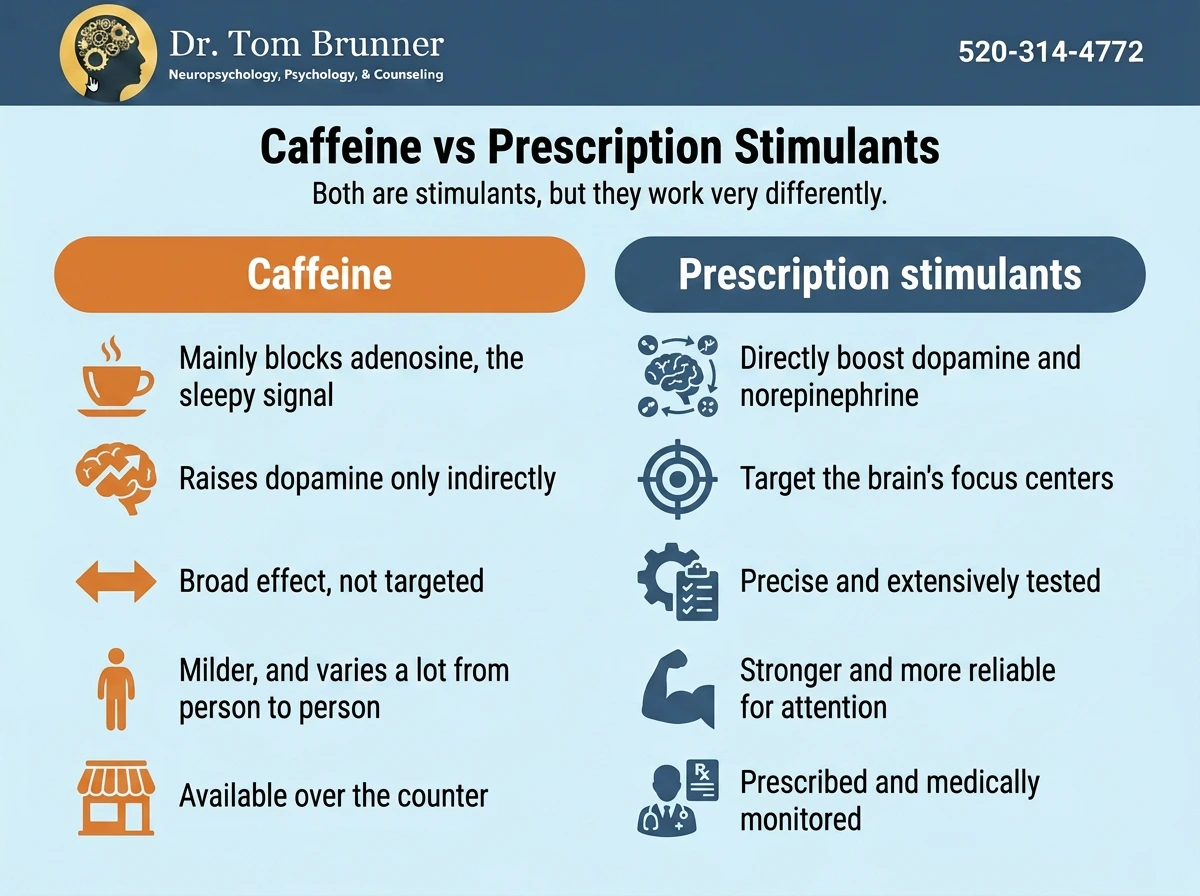
Prescription stimulants work differently and more precisely. They directly increase dopamine and norepinephrine in the exact brain regions that regulate focus, motivation, and self-control, and they are carefully dosed and monitored. Caffeine’s effect on those same chemicals is real but indirect and scattershot. That is the core reason it helps less reliably: it is aiming at the target from far away, while medication is aiming up close.
Why Does Caffeine Calm Me Down or Make Me Tired?
One of the most common questions from people with ADHD is why caffeine seems to calm them, or even make them sleepy, when it revs up everyone else. It is a real and frequently reported experience, though the science behind it is still thin and not fully settled.
The leading explanations tie back to dopamine. For a brain that runs a little low on it, the small dopamine bump from caffeine may feel grounding and focusing rather than jittery, similar to how a stimulant medication can be calming for ADHD. As for the sleepy effect, some people find that the brief lift is followed by a noticeable dip, or that caffeine simply unmasks how tired they already were once the buzz fades. Either way, if caffeine reliably makes you tired or foggy, that is useful information: it may not be the tool for you.
How Much Caffeine? Dosing and Safety
Because caffeine is not an approved ADHD treatment, there is no established therapeutic dose for it. What exists are general safety limits. For most healthy adults, up to about 400 milligrams a day, roughly four cups of coffee, is considered safe. Teenagers should have far less, around 100 milligrams or below, and caffeine is not recommended for young children at all.
More practically, the right amount is the amount that helps without causing problems, and for many people that is quite modest. Pay attention to your own response, keep an eye on the clock (caffeine can linger for many hours and wreck sleep), and remember that energy drinks and pre-workout powders can pack surprisingly high doses. When in doubt, less is usually more.
If you find coffee too jittery, gentler forms of caffeine can help. Tea delivers a smaller dose along with an amino acid called L-theanine, which many people find smooths out caffeine’s sharp edges for a calmer kind of alertness. Spacing caffeine out in smaller amounts, rather than one big hit, and always pairing it with food and water can also soften the spikes and crashes. The goal is a steady, gentle lift, not a rollercoaster.
Caffeine and ADHD Medication
This is the part that deserves real caution. If you take a stimulant medication like Adderall or Ritalin, adding caffeine stacks one stimulant on top of another. As Understood and others explain, that combination can intensify the medication’s effects and, more to the point, its side effects: more anxiety, more jitteriness, a faster heart rate, and worse sleep.
This does not mean you can never have a coffee on medication. Many people tolerate a small, early cup just fine. But it does mean you should be thoughtful about timing and amount, notice how the combination feels, and bring it up with your prescriber rather than experimenting blindly. If you take a non-stimulant medication, caffeine still affects sleep and anxiety, so the same mindfulness applies.
When Caffeine Becomes a Crutch
Plenty of people with ADHD, especially those who are undiagnosed, discover on their own that caffeine takes the edge off and quietly build their day around it. That is understandable, it is legal, cheap, and everywhere, but self-medicating has limits. It treats the surface without addressing the underlying condition, and it can mask symptoms that would be better managed properly.
Caffeine also carries a real potential for dependence. Regular use builds tolerance, so you need more for the same effect, and cutting back can bring withdrawal headaches, fatigue, and irritability. For a brain that is already prone to seeking stimulation, it is easy to overdo it. If you find yourself needing steadily more caffeine just to function, or reaching for it instead of seeking treatment, that is worth an honest look and a conversation with a professional.
Interestingly, noticing that caffeine affects you unusually, calming you down, sharpening your focus, or being something you seem to depend on more than most, leads some people to wonder about ADHD in the first place. It is worth being clear that this is not a self-test: how you respond to caffeine cannot diagnose ADHD, and plenty of people without ADHD love their coffee too. But if that pattern rings true alongside other lifelong struggles with focus and organization, it can be a nudge to pursue a proper evaluation rather than a reason to simply drink more.
Better Alternatives
If you are leaning on caffeine to focus, there are steadier ways to support your brain, ones without the crash or the sleep cost. None is a magic fix, but together they do more than another cup ever could.
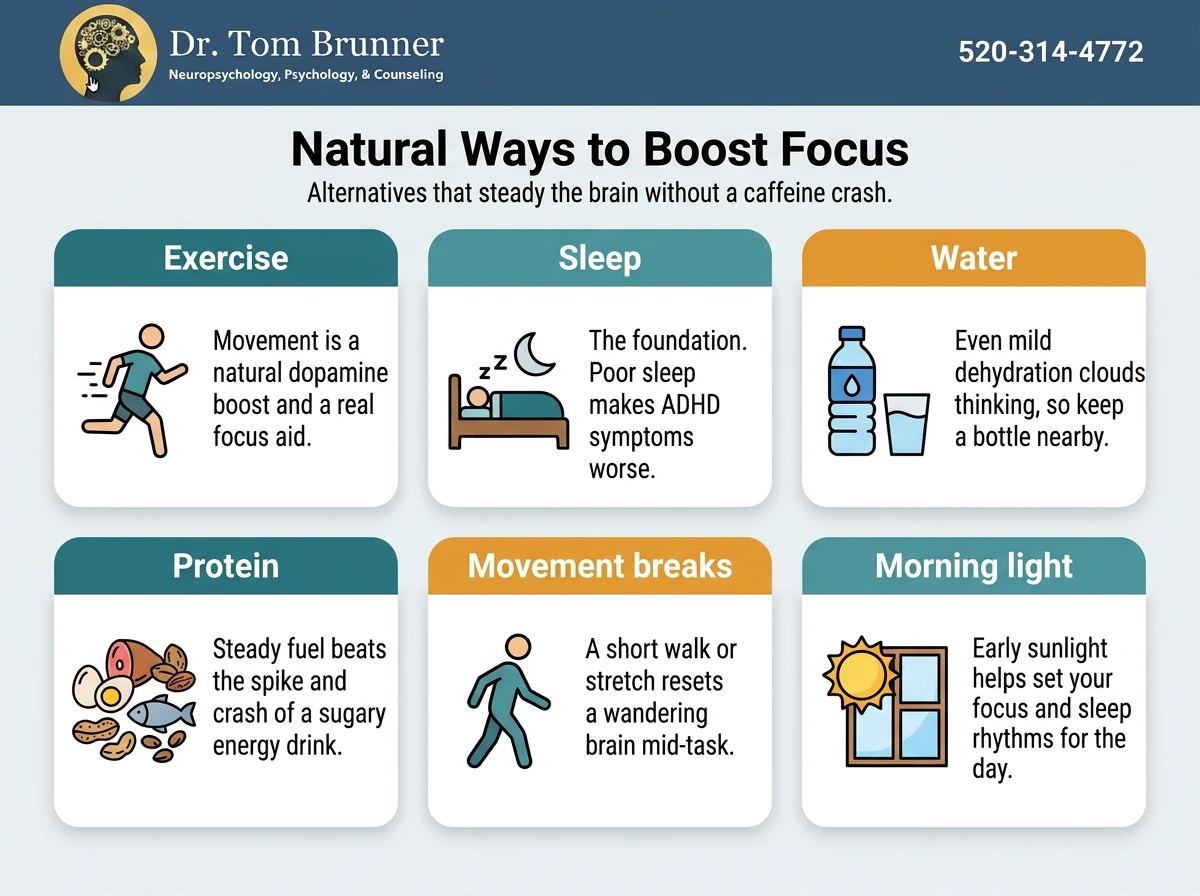
Exercise is the standout, a natural dopamine boost that genuinely aids focus. Good sleep is the foundation beneath everything, since being tired makes every ADHD symptom louder. Add steady hydration, protein-based fuel instead of sugar spikes, short movement breaks to reset a wandering mind, and a dose of morning sunlight to set your rhythms, and you have a toolkit that supports focus all day. And, of course, the most effective alternative to self-medicating is getting an actual assessment and treatment plan.
Frequently Asked Questions
Does caffeine work like Adderall for ADHD?
Not really. Both are stimulants, but caffeine mainly blocks the brain’s sleepy signal and only indirectly raises dopamine, while medications like Adderall directly and precisely boost the chemicals that drive focus. Caffeine is milder, broader, and much less reliable.
Why does caffeine calm me down or make me sleepy?
Many people with ADHD report this. The likely reason is that a small dopamine boost can feel grounding rather than jittery for a brain that runs low on it. For some, caffeine also unmasks existing tiredness once the initial lift fades. The science is still limited, so treat your own reaction as the best guide.
How much caffeine is okay with ADHD?
There is no official ADHD dose. General safety limits are up to about 400 milligrams a day for adults, much less for teens, and none for young children. Practically, use the smallest amount that helps, and avoid it later in the day so it does not harm your sleep.
Can I drink coffee while taking ADHD medication?
Often yes, in moderation, but caffeine adds to your medication’s stimulant effects and can worsen anxiety, jitters, and sleep. Keep it modest, watch how you feel, and check with your prescriber, especially about timing.
Can caffeine replace ADHD medication?
No. Caffeine can be a small support, but it does not address ADHD the way evidence-based treatment does. If you are relying on caffeine to get through the day, that is a sign to seek a proper evaluation rather than a stronger coffee.
Sources
The information in this article was drawn from the following authoritative sources. Each link goes to the original publication.
Understood: ADHD and Caffeine. Explains how caffeine affects the ADHD brain and interacts with medication.
ADDA: Does Caffeine Help ADHD?. Nonprofit overview of the potential benefits and risks of caffeine.
Healthline: Caffeine and ADHD. Reviews how caffeine acts as a stimulant in ADHD.
Children and Adults with Attention-Deficit/Hyperactivity Disorder (CHADD). National nonprofit with evidence-based ADHD resources.
The Bottom Line
Caffeine and ADHD have a real but modest relationship. As a mild stimulant, caffeine can give some people a small lift in focus and alertness, and for a subset it even feels calming. But it works indirectly and unpredictably, it is no match for proper treatment, and it brings downsides like disrupted sleep, jitters, crashes, and dependence.
If a sensible cup of coffee helps you feel a bit sharper, there is nothing wrong with enjoying it. Just keep it moderate, mind your sleep, and be extra careful if you also take stimulant medication.
Most importantly, do not let caffeine stand in for real help. If you are relying on it to function, the better path is an honest conversation with a professional about what is actually going on, and a plan built to support your brain for the long haul.