


If you have ADHD, you may have been told you are smart but scattered, that you just need to try harder or focus more. That advice misses what is really going on. The struggles at the heart of ADHD, forgetting things, losing focus, freezing before a task, blurting things out, are all about executive function: the brain’s management system. Understanding it changes everything, because it turns a story about character flaws into one about a skill set you can support.
This guide explains what executive function is, how ADHD affects memory, focus, and processing, and, most importantly, practical ways to improve and work around these challenges.
This article is for general education only and is not medical advice. Executive function difficulties can also stem from other conditions, so see a qualified professional for assessment and a plan that fits you.
What Is Executive Function?
Executive function is the set of mental skills that let you plan, organize, and carry out what you intend to do. Think of it as the brain’s chief executive: it decides what to focus on, holds information in mind while you use it, starts and stops actions, manages time, and keeps emotions in check. When it runs smoothly, you barely notice it. When it does not, ordinary tasks can feel like wading through mud.
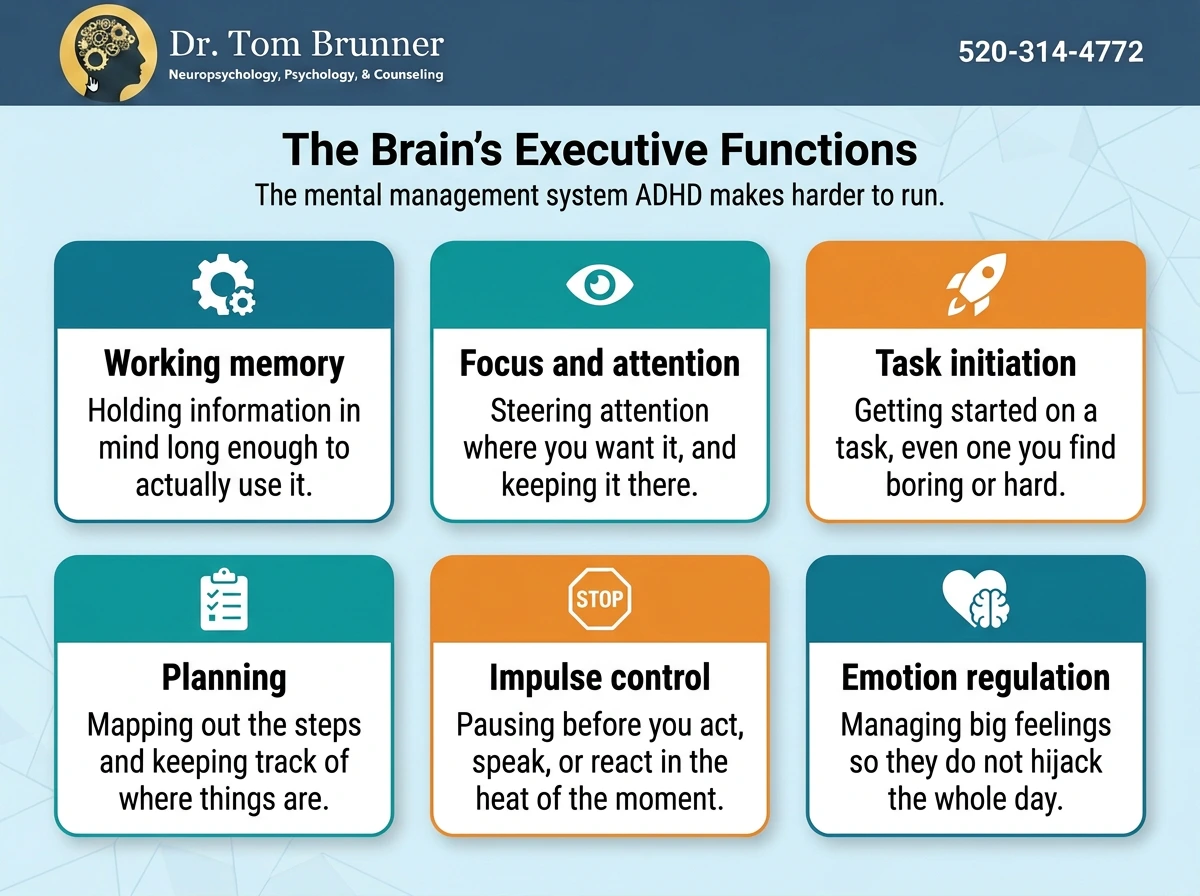
Researchers group these skills a few different ways, but the core ones include working memory, focus and attention, task initiation, planning and organization, impulse control, and emotional regulation. Most people with ADHD have real strengths in some of these and real struggles in others. The mix is personal, which is why no two people with ADHD look exactly alike.
Why ADHD Is an Executive Function Challenge
Many leading experts now argue that ADHD is, at its core, not an attention problem but a self-regulation problem, one rooted in weaker executive function. Attention issues are just the most visible symptom. Underneath, the brain has trouble managing itself: holding a plan in mind, resisting distraction, and steering behavior toward a goal.
Here is a helpful way to picture it. Your brain runs on two systems. An automatic system handles most of your day on autopilot, and an effortful executive system handles the rest, the parts that need conscious planning and self-control. For people with ADHD, that executive system is harder to switch on and more exhausting to run. That is why the same person can hyperfocus for hours on something fascinating yet be unable to start a boring email. It is not about willpower. It is about how much effort the management system demands.
It also helps to know that executive skills develop later in people with ADHD. Researchers describe a developmental delay, with these abilities often maturing several years behind peers rather than being permanently missing. That is why a bright, capable adult can still wrestle with time and organization long after school, and it is also why there is room for growth. The skills keep developing, and the right supports speed things along.
Working Memory and Forgetting
Of all the executive functions, working memory may be the most important, and the most affected by ADHD. As ADDitude explains, working memory is your brain’s mental sticky note: it holds information just long enough for you to act on it, like remembering the start of a sentence while you finish it, or the reason you walked into a room.
This is different from long-term memory. People with ADHD usually remember facts and events fine, but the temporary holding space is small and leaky. That is why you might forget an instruction seconds after hearing it, lose your train of thought mid-task, or walk into the kitchen and blank on why. It is also why appointments, keys, and follow-ups slip away so easily.
One reframe helps a lot: your memory is not bad, it is uneven. Treating it that way lowers the shame and points you toward the real fix, which is not trying harder to remember, but getting information out of your head and into a trusted external system.
Focus, Attention, and Hyperfocus
ADHD is often described as a deficit of attention, but that is not quite right. The real issue is regulating attention: directing it where you want, when you want, and holding it there. Sometimes that means a wandering mind that drifts off mid-conversation or mid-task. Other times it means the opposite.
That opposite is hyperfocus, a state of intense, locked-in concentration on something genuinely interesting, so deep that hours vanish and the rest of the world disappears. Hyperfocus can be a superpower for creative or passion projects, but it has a downside: it is hard to control, and it tends to grab the fun stuff, not the tax return. The goal is not more attention overall, but more say over where your attention goes.
Processing: Speed, Listening, and Brain Fog
Executive function also shapes how quickly and cleanly you process information. Many people with ADHD have slower processing speed, meaning it takes a beat longer to take in, sort, and respond to information, especially under pressure. This has nothing to do with intelligence. It just means the mental gears turn at their own pace.
A related struggle is spoken information. Plenty of adults with ADHD find that words go in but do not stick, so they nod along in a meeting and realize afterward they caught only half of it. This can overlap with auditory processing difficulties, where the brain has trouble making sense of what it hears even when hearing is fine. And then there is brain fog, that cloudy, sluggish feeling when thinking is a slog. It is a real experience, often worse with poor sleep, stress, or overwhelm, and it usually lifts when those underlying factors, and the ADHD itself, are addressed.
Task Paralysis: When You Are Stuck
One of the most frustrating executive-function struggles has become almost a meme: ADHD paralysis. You know exactly what you need to do, you may even want to do it, and yet you simply cannot start. You freeze, scroll, or drift to something easier, all while the stress builds.
This usually happens when a task feels too big, too vague, or too boring for the brain to get traction. Task initiation, getting started, is its own executive skill, and it is a common weak spot. The way out is almost always to shrink the task. Instead of “do my taxes,” the first step becomes “open the folder.” Tiny, concrete first steps give the brain something small enough to grab onto, and momentum usually follows.
How to Improve Executive Function
Here is the encouraging part: executive function is not fixed. You cannot simply will it stronger, but you can support it with the right strategies, tools, and treatment, and it often improves. The key principle is to stop relying on your brain to do what an external system can do better.
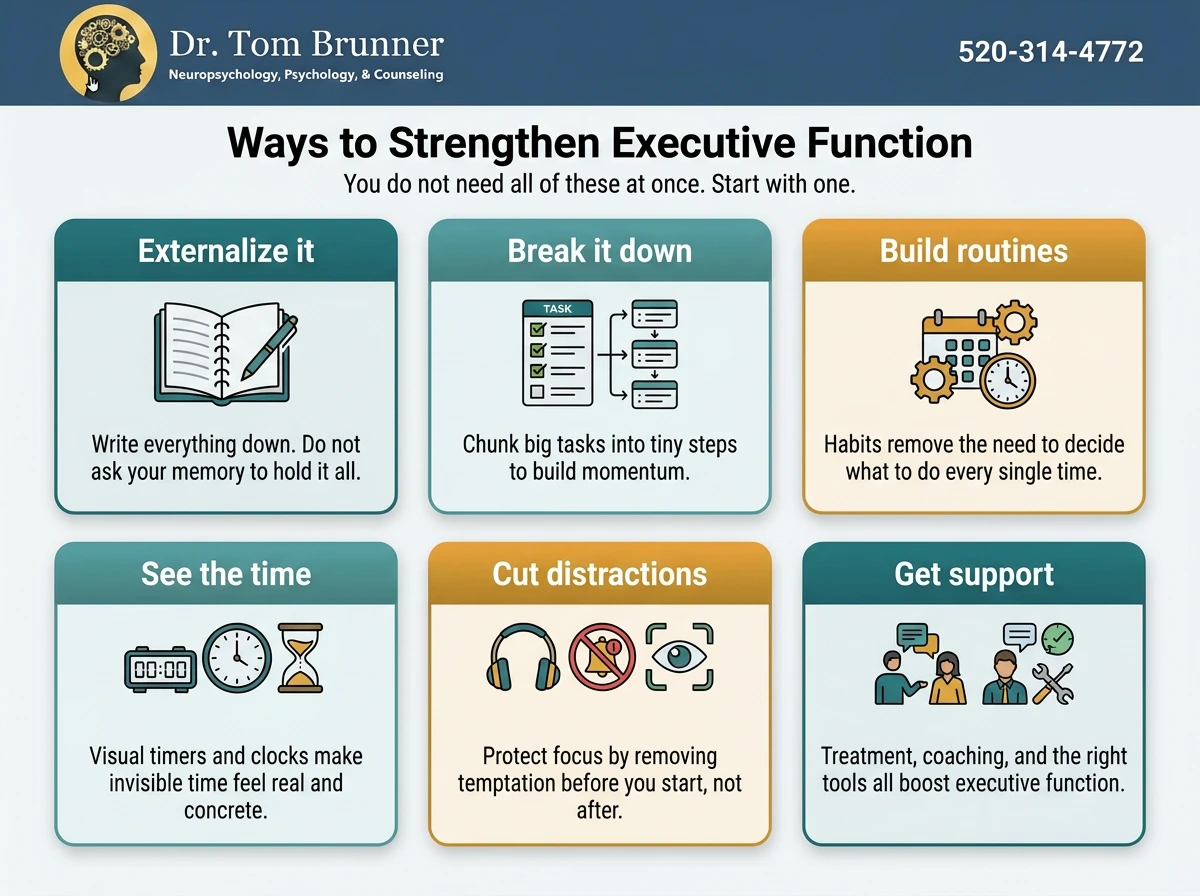
The table below matches common struggles with strategies that tend to help. You do not need to adopt them all at once, in fact, trying to would be its own executive-function overload. Pick the one struggle that costs you the most and start there.
| The struggle | What tends to help |
|---|---|
| Forgetting tasks and information | Write it down right away; keep one trusted list and set reminders |
| Losing focus | Cut distractions, work in short timed sprints, take movement breaks |
| Missing spoken information | Ask for it in writing, repeat it back, and slow the pace |
| Getting stuck (task paralysis) | Shrink the task to a tiny first step and start a short timer |
| Overwhelm and disorganization | Break big projects into steps and lean on a simple routine |
Adapted from strategies described by ADDA, CHADD, and ADHD clinicians. Individual needs vary.
Beyond personal strategies, professional help matters. As ADDA notes, treating the underlying ADHD often improves executive function directly. Medication can make the management system easier to run, cognitive behavioral therapy teaches concrete skills for time and organization, and an ADHD coach can build personalized systems with you. These work best together, not in place of one another.
One more idea ties these together: design your environment so it does the work for you. Executive function is a limited resource, so the fewer decisions and distractions you face, the more of it you have for what matters. That might mean a launch pad by the door for keys and wallet, a single visible calendar, phone notifications turned off during focus time, or a set morning routine you never have to think about. You are not lowering the bar. You are building a runway so your brain can take off more easily.
Frequently Asked Questions
Is executive dysfunction the same as ADHD?
Not exactly. Executive dysfunction means difficulty with those management skills, and it is a core feature of ADHD. But executive dysfunction can also appear with other conditions, like anxiety, depression, or after a brain injury. ADHD is one common cause, not the only one.
Is bad memory a symptom of ADHD?
Working memory problems are, yes. People with ADHD often forget tasks, instructions, and where they put things, because the brain’s short-term holding space is weaker. Long-term memory is usually fine. It helps to think of the memory as uneven rather than bad.
Can you improve executive function?
Yes, though not by willpower alone. External systems like lists and reminders, breaking tasks down, building routines, and treatment such as medication, CBT, or coaching can all meaningfully improve day-to-day executive function.
Why can I hyperfocus but not do simple tasks?
Because ADHD affects the regulation of attention, not the raw amount. Your brain locks onto things that are novel or rewarding and struggles to engage with things that are boring, even important ones. It is a feature of how ADHD works, not a sign of laziness.
What is ADHD paralysis?
It is the experience of being unable to start (or switch) tasks even when you want to, often because the task feels too big, vague, or dull. Shrinking the task to a tiny first step and setting a short timer is the most reliable way through it.
Sources
The information in this article was drawn from the following authoritative sources. Each link goes to the original publication.
ADDA: Executive Function Disorder and ADHD. Explains executive dysfunction and strategies to improve it.
ADDitude: How Working Memory Powers Executive Function. Detailed look at working memory in ADHD.
Children and Adults with Attention-Deficit/Hyperactivity Disorder (CHADD). National nonprofit with resources on executive function and ADHD.
National Institute of Mental Health (NIMH): ADHD. Federal research summary on ADHD.
The Bottom Line
Executive function is the mental machinery behind getting things done, and ADHD makes that machinery harder to run. Memory feels leaky, focus wanders or over-locks, processing lags, and tasks stall before they start. None of that reflects intelligence or effort. It reflects how the ADHD brain is wired.
The good news is that these are skills you can support. By moving information out of your head, shrinking tasks, building routines, and getting the right treatment, you can work with your brain instead of fighting it. Start with a single strategy for your biggest struggle, and build from there.
Most of all, trade the harsh self-talk for a clearer story. You are not broken or lazy. Your management system just needs the right supports, and once it has them, it can run a whole lot better.