

If you have just been diagnosed with ADHD as an adult, or you have been managing it for years, you may be wondering what treatment actually looks like beyond a prescription. The answer is bigger and more hopeful than most people expect. Medication is one useful tool, but it is far from the whole picture.
There is a saying in the ADHD world: pills don’t teach skills. Medication can turn down the volume on symptoms, but it cannot build the habits, systems, and support that help you actually thrive. That is where therapy, coaching, support groups, and good daily routines come in. This guide walks through each piece and how to combine them into a plan that fits your life.
This article is for general education only and is not medical advice. A licensed professional should guide your diagnosis and treatment. Use this as a map for the conversations to have, not a substitute for them.
Why Adult ADHD Treatment Is More Than Medication
For adults, the leading treatment guidelines around the world recommend a multimodal approach, which is a fancy way of saying you combine several things rather than relying on one. Typically that means education about ADHD, medication when appropriate, and psychological support like therapy or coaching, all working together.
Why not just medication? Because even when medication works well, it leaves a lot untouched. It will not automatically fix a chaotic schedule, years of low self-esteem, a messy system for paying bills, or the shame that many adults carry from a lifetime of feeling behind. Those things respond to skills, structure, and support. The most successful plans treat the symptoms and the life around them.
The Building Blocks of an Adult ADHD Plan
Think of your treatment as a set of building blocks. You do not need every one, and you can add them over time, but knowing the full menu helps you and your provider design something that works.
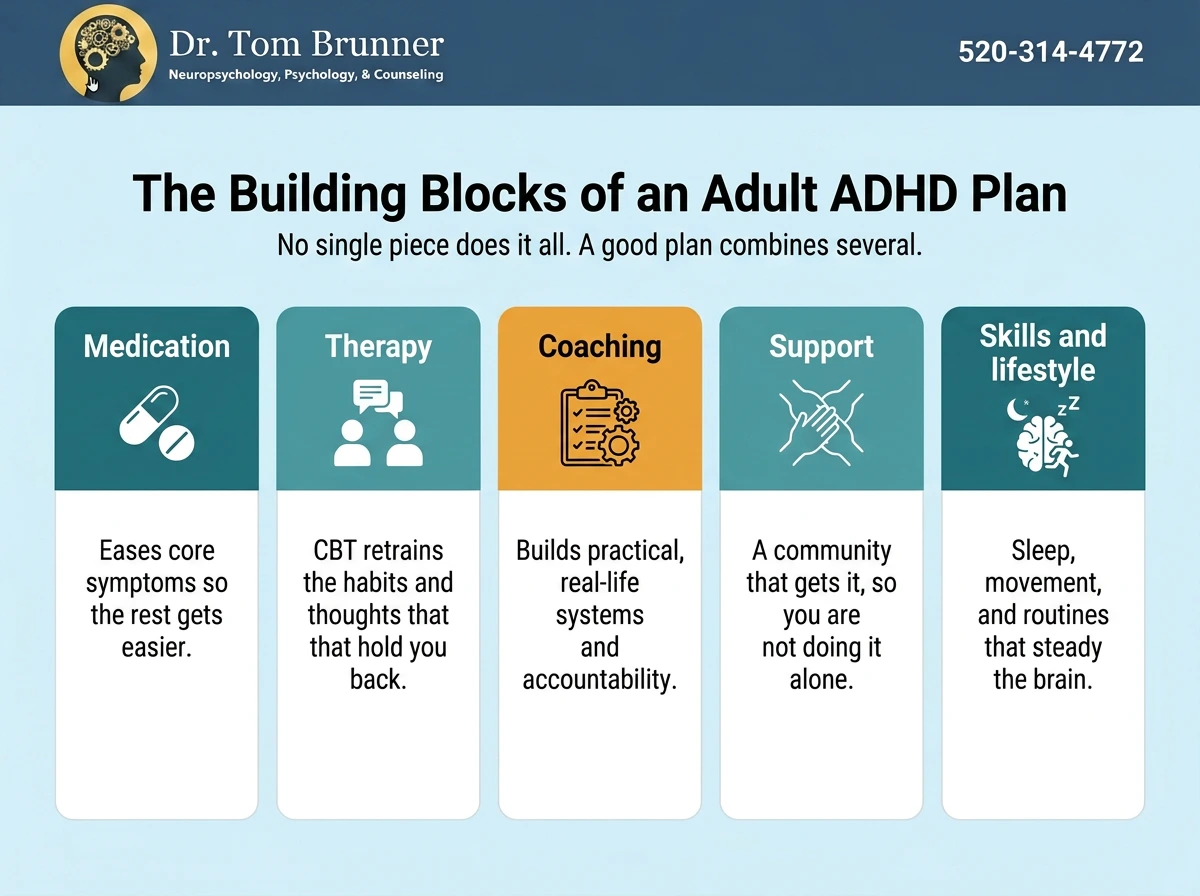
Most people start with one or two blocks and build from there. Someone might begin with medication to steady their focus, then add coaching to set up systems, then join a support group for community. There is no single right order. What matters is that the pieces fit your specific challenges.
Therapy for Adult ADHD
Therapy is where you work on the mental and emotional side of ADHD with a licensed professional. It is especially valuable because ADHD so often travels with anxiety, depression, or a deep well of self-criticism built up over years.
Cognitive Behavioral Therapy (CBT)
CBT is the most evidence-based therapy for adult ADHD, and treatment guidelines in several countries recommend it, often alongside medication. It works on two fronts. First, it teaches practical strategies for the executive-function struggles at the heart of ADHD: time awareness, prioritizing, scheduling, tracking tasks, and beating procrastination. Second, it helps you notice and rework the negative thought patterns that fuel anxiety and low self-worth, like “I always mess this up.” Studies show CBT can meaningfully reduce ADHD symptoms and improve mood, especially when combined with medication.
Some common CBT techniques for ADHD include breaking tasks into small steps, using external reminders instead of relying on memory, scheduling hard tasks for your best hours, and challenging all-or-nothing thinking. A good ADHD-informed therapist tailors these to your real life.
CBT for ADHD is usually short and structured rather than open-ended. Many programs run for roughly eight to fifteen sessions, one-on-one or in a small group, and follow a clear plan built around your goals. That structure is part of what makes it work, because it gives an ADHD brain a concrete path to follow rather than a vague, endless process.
Other therapy approaches
A few other approaches can help too. Dialectical behavior therapy (DBT) adds skills for emotional regulation and distress tolerance, which is useful if big emotions are a struggle. Acceptance and commitment therapy (ACT) focuses on accepting your ADHD brain while acting on your values. Mindfulness practices can strengthen attention and calm. These are often woven into treatment rather than used alone.
ADHD Coaching
ADHD coaching is practical and forward-focused. As CHADD describes it, a coach is like a thinking partner who helps you build systems that fit how your brain works: managing time, getting organized, starting and finishing tasks, and staying accountable week to week. Many people find coaching fills the gap between knowing what to do and actually doing it.
One important thing to understand: coaching is not therapy. Coaches are not licensed to diagnose or treat mental health conditions, and the field is largely unregulated, so quality varies. A good coach will refer you to a therapist if deeper emotional work is needed. When choosing a coach, look for real training or a credential, and use a trusted directory. Most coaching happens online, and it is usually not covered by insurance, which is worth factoring in.
| Option | What it is | Best for | Who provides it |
|---|---|---|---|
| Therapy | Treats the emotional and thought-pattern side of ADHD | Anxiety, depression, self-esteem, late-diagnosis grief | Licensed therapists and psychologists |
| Coaching | Builds practical skills, systems, and accountability | Time management, organization, follow-through | ADHD coaches (look for training) |
| Support groups | Peer connection and shared experience | Feeling less alone, real-world tips | CHADD, ADDA, and peer communities |
Many adults benefit from more than one of these. They complement each other rather than compete.
Support Groups and Community
There is real power in talking with people who get it. Support groups reduce the isolation many adults with ADHD feel, and they are a great source of practical, been-there advice. Two national nonprofits lead the way: CHADD, which runs local chapters and virtual groups plus the only national ADHD helpline, and the Attention Deficit Disorder Association, which focuses on adults and hosts dozens of online groups.
What is especially helpful about groups like ADDA’s is how specific they get. There are online groups for people newly diagnosed, for women diagnosed later in life, for couples, and for many other communities. Whether you prefer an in-person chapter or a virtual room from your couch, there is likely a group that fits.
Skills, Habits, and Lifestyle
Some of the most powerful treatment is free and in your own hands. The daily habits that support any brain matter even more for an ADHD one. Regular exercise boosts the same brain chemicals that ADHD medication targets. Consistent sleep steadies focus and mood. And simple external systems, calendars, reminders, checklists, and a designated home for your keys, take pressure off a working memory that is easily overloaded.
The trick is to build these gradually and without shame. You are not lazy for needing systems. You are working with your brain instead of against it. Pick one habit to strengthen at a time, and let coaching or therapy help you make it stick.
Two more pieces round this out. Psychoeducation, simply learning how ADHD works, is treatment in itself, because understanding why you do what you do replaces self-blame with strategy. And workplace or school accommodations, from a flexible schedule to a quieter space, can remove barriers that no amount of willpower would. These low-cost, high-impact pieces are easy to overlook, but they often make the biggest daily difference.
In-Person vs Online: Getting Started
Good news: getting help has never been easier. Alongside traditional in-person care, telehealth has opened up online options for nearly every part of a plan. Online psychiatrists and doctors can diagnose ADHD and manage medication, licensed therapists offer video sessions, coaches work remotely by design, and support groups meet virtually.
Online care is convenient and expands your choices, especially if good local providers are scarce. A couple of cautions: make sure anyone diagnosing or prescribing is properly licensed, and be a little wary of services that promise a fast diagnosis or medication with little evaluation. To find providers, professional directories from CHADD, ADDA, and Psychology Today let you filter by specialty, location, and sometimes insurance.
Cost is a real factor worth planning for. Therapy with a licensed clinician is often covered by insurance, at least in part, while coaching usually is not, since it is not a clinical service. If money is tight, a few options help: ask therapists about sliding-scale fees, look into community mental health centers, and lean on the free or low-cost pieces of a plan, like support groups, nonprofit webinars, exercise, and better sleep. A strong plan does not have to be expensive to be effective.
Building Your Comprehensive Plan
So how do you pull it all together? You do not have to do everything at once. A comprehensive plan comes together in steps, at whatever pace works for you.
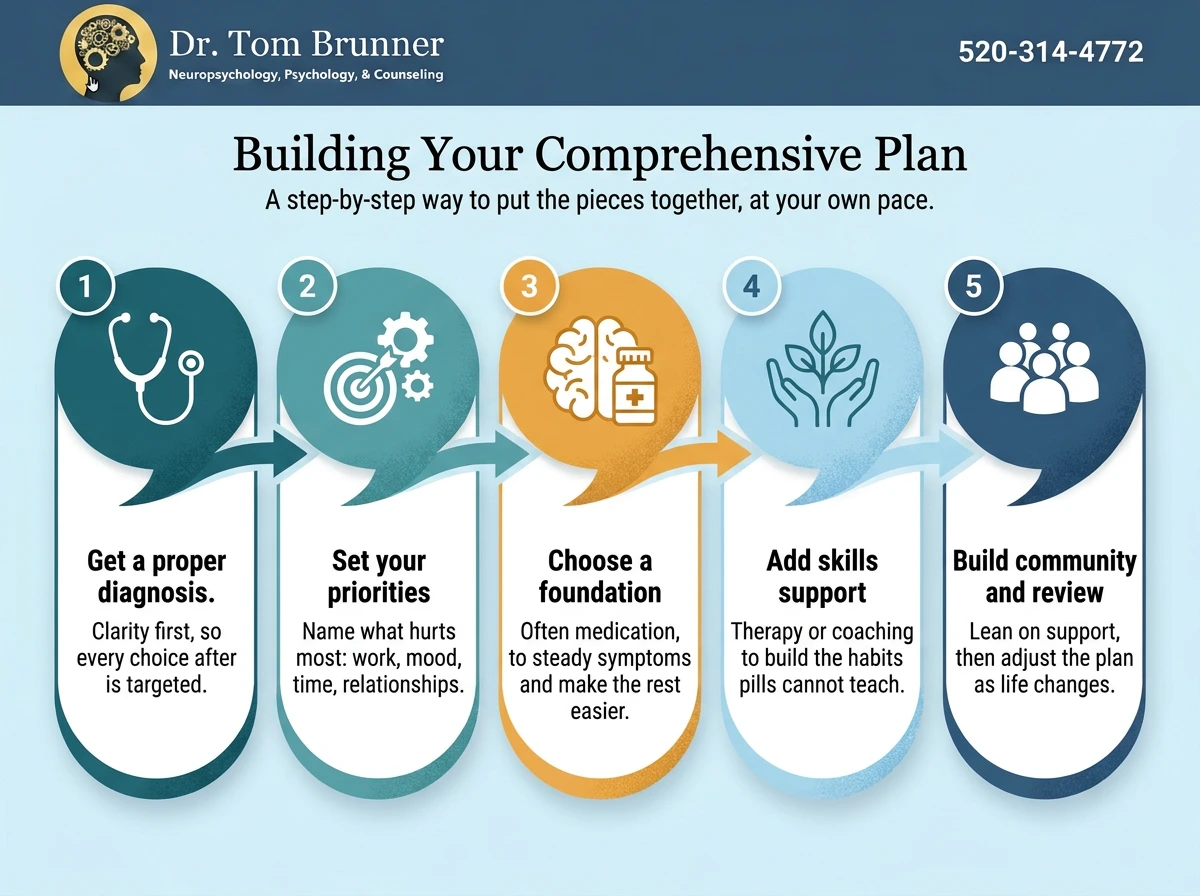
Start with a solid diagnosis, so you know what you are working with. Name the areas causing you the most trouble, whether that is work, mood, time, or relationships. Choose a foundation, which for many people is medication, to steady symptoms. Then add the skills support, therapy or coaching, that pills cannot provide. Finally, build community and treat the plan as a living thing you revisit and adjust as life changes. Progress, not perfection, is the goal.
Frequently Asked Questions
What is the best treatment for adult ADHD?
There is no single best treatment. The most effective approach is usually a combination: medication when appropriate, plus therapy or coaching to build skills, plus supportive habits and community. The right mix depends on your specific challenges.
What is the difference between ADHD coaching and therapy?
Therapy is provided by a licensed professional and treats the emotional and mental health side, including anxiety, depression, and self-worth. Coaching is practical and forward-focused, building systems and accountability. Coaches are not licensed to treat mental health conditions. Many people benefit from both.
Does CBT work for ADHD?
Yes. CBT is the most evidence-based therapy for adult ADHD. It teaches practical strategies for time and organization and reworks the negative thoughts that come with ADHD. It works especially well alongside medication.
Where can I find an ADHD support group?
CHADD offers local chapters and virtual groups plus a national helpline, and ADDA hosts many online groups for adults, including specialized ones. Both nonprofits also list therapists and coaches in their directories.
Can you treat ADHD without medication?
Yes, though it depends on the person. Therapy, coaching, strong routines, exercise, and support can meaningfully improve functioning, and some people manage well without medication. For others, medication makes everything else easier. It is a personal decision to make with your provider.
Sources
The information in this article was drawn from the following authoritative sources. Each link goes to the original publication.
CHADD: Coaching. Explains what ADHD coaching is and how it differs from therapy.
ADDA: How to Find an ADHD Coach. Guidance on coaching, therapy, and choosing the right professional.
Children and Adults with Attention-Deficit/Hyperactivity Disorder (CHADD). National nonprofit with support groups, a helpline, and directories.
Attention Deficit Disorder Association (ADDA). Nonprofit focused on adults with ADHD, with virtual support groups and resources.
National Institute of Mental Health (NIMH): ADHD. Federal research summary on ADHD treatment.
The Bottom Line
Treating adult ADHD well is less about finding one magic fix and more about assembling the right team of tools. Medication can steady the symptoms, but therapy reworks unhelpful patterns, coaching builds the systems, support groups remind you that you are not alone, and daily habits hold it all together.
You do not have to build the whole plan overnight. Start with a clear diagnosis and the piece that would help most right now, then add to it over time. The plan can grow and change as you do.
Most of all, be patient and kind with yourself. Living well with ADHD is a skill you build, not a switch you flip. With the right combination of support, adults with ADHD do not just cope. They thrive.