


Living with ADHD is not about trying harder. If effort alone fixed it, you would have solved this years ago. The truth is that a brain wired for ADHD needs different systems, not more willpower.
This guide is built around that idea. Instead of telling you to focus more, it gives you practical strategies that work with an ADHD brain: at work, in your closest relationships, and in the small daily routines that quietly run your life. Pick one or two to start. Trying to change everything at once is a classic ADHD trap.
The information here is general and educational. It is not medical advice, and it does not replace working with a doctor or therapist who knows your situation.
Why Daily Life Feels So Hard With ADHD
ADHD affects the brain’s management system, sometimes called executive function. That system handles starting tasks, keeping track of time, holding steps in memory, and managing emotions. When it works unevenly, ordinary tasks turn into uphill climbs.
This is why living with ADHD can feel exhausting in ways other people do not see. You are not lazy or careless. You are doing hidden work all day just to keep up. Naming that is the first step, because the strategies below are designed to carry some of that load for you.
ADHD Burnout: The Cycle to Watch For
Many adults with ADHD run into a pattern called ADHD burnout. It is the crash that comes after pushing too hard for too long. Understanding the cycle makes it easier to catch before it flattens you.
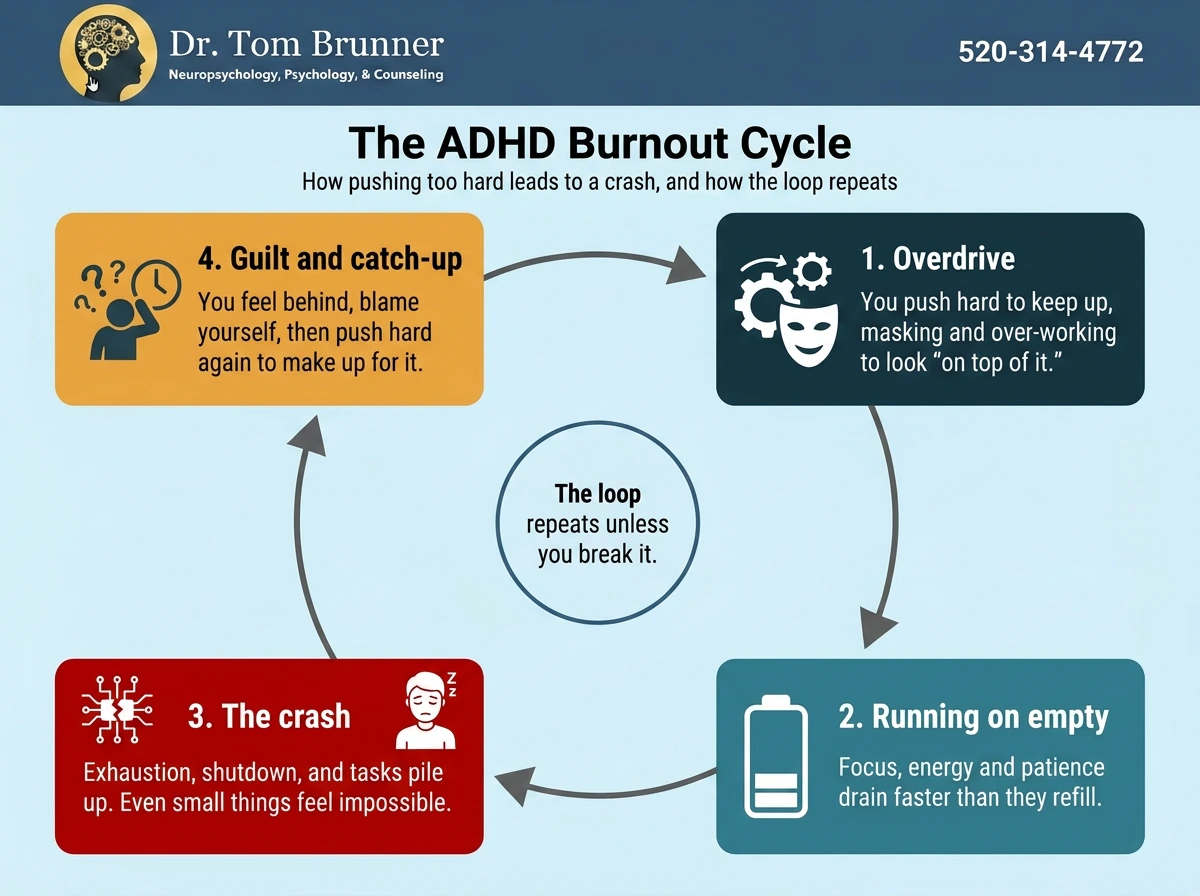
The way out is not to push harder, which only feeds the loop. It is to build in rest and lower expectations before the crash, not after. A few ways to interrupt the cycle:
- Schedule recovery time. Treat rest as part of the plan, not a reward you earn after collapsing.
- Watch for early warning signs. Growing dread, snapping at people, or avoiding easy tasks often come before a full crash.
- Shrink the load fast. When you feel the slide starting, cut nonessential tasks that week rather than white-knuckling through.
Managing ADHD at Work
Work is where ADHD struggles often cost the most, and where good systems help the most. The goal is to make your environment do some of the remembering and focusing for you
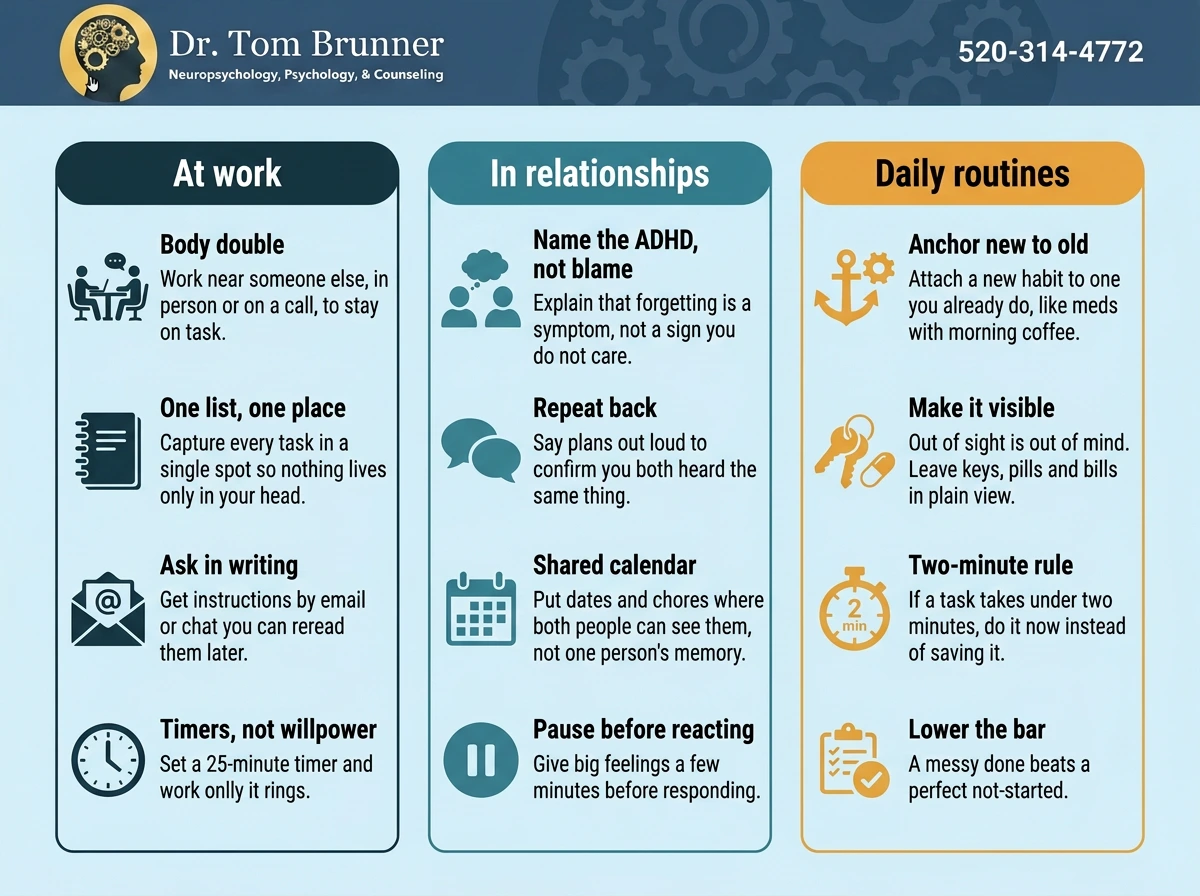
Strategies that help most people
- Capture every task in one place. A single list, digital or paper, means tasks stop living only in your head where they get lost.
- Use timers to start and stop. Set a short timer, work only until it rings, then take a real break. Starting is often the hardest part, and a timer lowers the wall.
- Try body doubling. Working near another person, in the room or on a video call, makes it far easier to stay on task. This is why so many people with ADHD swear by it.
- Get instructions in writing. Ask for tasks by email or chat so you can reread them instead of relying on memory.
- Break big projects into tiny steps. The first step should be so small it feels almost silly. Open the document. Write one sentence. Momentum builds from there.
ADHD in Relationships and Friendships
ADHD does not only affect you. It shows up in relationships too, in forgotten plans, interrupted conversations, and big emotions that arrive fast. None of this means you care less. It means the same brain differences follow you home.
What tends to cause friction
- Forgetfulness read as not caring. A missed date or chore can feel like a slight to a partner, even though it is a symptom.
- Interrupting or zoning out. Both are common with ADHD and can leave others feeling unheard.
- Intense reactions. Strong feelings that pass quickly for you can land hard on someone else.
What helps
The single most useful move is to name ADHD as the cause, not blame or indifference. When the people close to you understand that a forgotten errand is a symptom, it changes how they read it. From there, shared tools do the heavy lifting.
- Use a shared calendar. Put plans and chores where both people can see them, so nothing depends on one person’s memory.
- Repeat plans back. Saying arrangements out loud confirms you both heard the same thing.
- Pause before reacting. Give big feelings a few minutes before you respond. The urge usually softens.
Daily Routines and Home Life
Chores, bills, and self-care are where a lot of ADHD energy quietly leaks away. These small systems make them stick.
- Anchor new habits to old ones. Attach something new to something you already do without thinking, like taking medication with your morning coffee.
- Keep important things visible. Out of sight really is out of mind with ADHD. Leave keys, pills, and bills in plain view.
- Use the two-minute rule. If a task takes under two minutes, do it now rather than adding it to a list you will forget.
- Lower the bar on purpose. A messy, finished task beats a perfect one you never start. Done is the goal.
- Try a simple cleaning schedule. One small zone a day beats waiting for a big cleanup that never comes.
Getting Support: You Do Not Have to Do This Alone
Living with ADHD gets easier with the right support around you. That can mean professionals, peers, or both.
- Support groups. National nonprofits run local and virtual groups. CHADD (chadd.org) and the Attention Deficit Disorder Association, or ADDA (add.org), both host groups for adults with ADHD.
- ADHD coaching. An ADHD coach helps you build and stick to systems. The ADHD Coaches Organization (adhdcoaches.org) is one place to find one.
- Therapy. A therapist can help with the emotional side, including the anxiety and low self-worth that often build up over years.
- The people in your corner. Friends and family who understand ADHD can be part of your system, from a text reminder to a standing check-in.
What Happens If ADHD Goes Unmanaged
It is worth being honest about the stakes, not to scare you, but to explain why these systems matter. Untreated or unmanaged ADHD tends to make daily life harder over time. Work can suffer, relationships can strain, and the constant sense of falling behind can wear down mood and confidence.
The encouraging part is that this is not fixed. With the right mix of strategies, support, and, for many people, treatment from a professional, the day-to-day load gets lighter. The goal is not a perfect life. It is a workable one.
Finding Work That Fits an ADHD Brain
There is no single best job for someone with ADHD, but some kinds of work play to common ADHD strengths and sidestep common struggles.
| Often a good fit | Often harder |
|---|---|
| Varied, hands-on, or fast-moving roles that reward energy and quick thinking | Repetitive, low-stimulation work with long stretches of the same task |
| Creative or problem-solving jobs where fresh ideas are valued | Roles built almost entirely on careful, error-free paperwork |
| Work with clear deadlines and visible results that create healthy urgency | Open-ended jobs with no structure and no external deadlines |
| Positions that allow movement, autonomy, or a flexible schedule | Rigid settings that punish restlessness or a nonstandard pace |
These are general patterns. Plenty of people with ADHD thrive in jobs on the right, especially with the right supports and interest in the work.
Frequently Asked Questions
How do I deal with ADHD day to day?
Start with one or two systems that carry the load for you, such as a single task list and a shared calendar. Build from there rather than overhauling everything at once.
What is ADHD burnout?
It is the exhaustion and shutdown that follow pushing too hard for too long. It tends to cycle: overdrive, running on empty, a crash, then guilt-driven catch-up that starts the loop again.
How can I help someone with ADHD?
Treat their forgetfulness as a symptom rather than a lack of care, use shared tools like calendars and reminders, and ask what actually helps instead of assuming. Patience and clear systems go a long way.
Are there support groups for adults with ADHD?
Yes. CHADD and ADDA both run local and virtual groups for adults. Connecting with others who understand can ease the isolation that often comes with ADHD.
Can you manage ADHD without medication?
Many people use strategies, coaching, therapy, and lifestyle changes to manage ADHD. Some combine these with medication and some do not. What works best is a personal decision to make with a professional.
Why is starting tasks so hard with ADHD?
The brain’s starting system works unevenly with ADHD, so tasks without urgency or interest feel like a wall. Timers, tiny first steps, and body doubling all lower that wall.
The Bottom Line
Living well with ADHD comes down to building systems that fit your brain instead of fighting it. The strategies here work because they move the effort out of your head and into your environment: one list, visible reminders, timers, shared calendars, and people who understand what is really going on.
Do not try to adopt all of this at once. Pick one strategy from the area that is causing you the most pain this week, whether that is work, a relationship, or your morning routine. Use it for a while, then add another. Small, steady changes stick where big overhauls collapse.
If the daily load still feels crushing, that is a signal to bring in support, not a personal failure. A lot of people describe the same relief once the right systems and help are finally in place: the sense that life has stopped fighting them at every turn.