


ADHD is one of the most common brain-based conditions in the world, and it affects far more people than most folks realize. The CDC reports that about 7 million U.S. children and 15.5 million U.S. adults have a current ADHD diagnosis.
That adds up to roughly 22 million people in this country alone, and many more go through life without knowing why focus, organization, and impulse control feel so much harder for them than for everyone else.
If you have landed on this page, you are probably trying to understand what ADHD actually is. Maybe you have heard the term used loosely, seen it on social media, or wondered whether it might explain something you, your child, or someone you love is going through.
This guide walks through what the letters stand for, how the condition shows up in real life, the three main types, what causes it, and how it gets diagnosed and treated.
This article is for general education only. It is not a substitute for medical advice. If you think you or your child may have ADHD, talk to a licensed healthcare provider for a proper evaluation.
What Does ADHD Stand For?
ADHD stands for Attention-Deficit/Hyperactivity Disorder. The name describes the two main groups of symptoms that come with the condition: trouble paying attention, and being more active or impulsive than expected for someone of that age.
ADHD is a neurodevelopmental disorder, which is a long word that just means it has to do with tendencies some brains are born with. It is not caused by laziness, bad parenting, too much sugar, diet, or too much screen time. The brain of a person with ADHD is wired a little differently, and that wiring shows up in everyday behavior.
Some quick facts about the name:
- ADHD is the official medical term. It comes from the Diagnostic and Statistical Manual of Mental Disorders, Fifth Edition (DSM-5), which all behavioral mental health providers in the United States reference.
- ADD is an older name. You may still hear people say ADD, which stands for Attention-Deficit Disorder. Doctors stopped using that term officially in 1994. Today, all of these patterns are grouped under ADHD.
- ADHD has different presentations. The same diagnosis can look very different from one person to the next, which is why people sometimes feel confused about what the term covers. Your unique personality can change the complexion of how ADHD looks on you.
ADD vs. ADHD: Are They the Same Thing?
Short answer: yes, they are the same condition. The longer answer explains why the names changed and why the older term is still floating around.
Before 1987, doctors used the term Attention-Deficit Disorder, or ADD, to describe people who had focus problems but were not necessarily hyperactive. The condition was then renamed several times as researchers learned more about it. In 1994, the official manual settled on the name ADHD with three different presentations, and that is the system still in use today.
Here is how the old terms map to what doctors say now.
|
You may hear |
What it means today |
|---|---|
|
ADD |
The old school term used by many people, which indicates a person has a focusing problem but no issues with hyperactivity. This acronym now is called ADHD-Inattentive type. |
|
ADHD |
The commonly used umbrella term for all three presentations of the disorder. In the behavioral health world, diagnosis of this condition requires a specifier after the acronym ADHD |
|
ADHD-Inattentive |
Predominantly Inattentive ADHD (focus problems without many hyperactivity symptoms) |
|
ADHD-Hyperactive |
Predominantly Hyperactive-Impulsive ADHD (mostly restless, impulsive behavior symptoms) |
|
ADHD-Combined |
Combined Presentation (a mix of both inattentive and hyperactive symptoms) |
So if a parent, teacher, or older relative says someone has ADD, they almost always mean what doctors now call inattentive-type ADHD. The behaviors are the same. Only the label has changed.
The Three Types of ADHD
ADHD does not look the same in every person. The DSM-5 lists three presentations, and a doctor will pick one based on which symptoms have been present in the past six months. The presentation can also change as a person grows up.
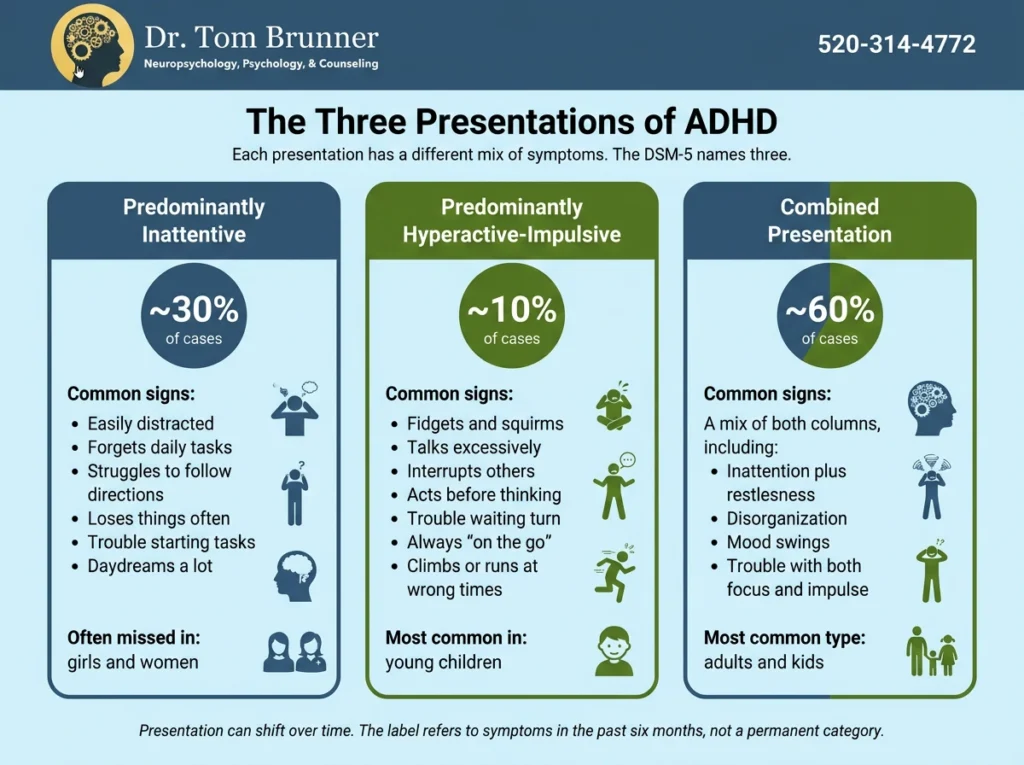
1. Predominantly Inattentive Presentation
People with inattentive ADHD often look quiet or daydreamy on the outside, even though their brains are bouncing in many directions. They may forget assignments, lose things constantly, or seem to tune out during conversations. This subtype requires you have at least six focusing related DSM-5 symptoms. This is the type most often missed in girls and women, who tend to mask their symptoms or get labeled as scattered instead of being accurately identified and evaluated.
2. Predominantly Hyperactive-Impulsive Presentation
This type involves a lot of physical and verbal energy. You need at least six hyperactive related DSM-5 symptoms to qualify for this subtype. People with this presentation may struggle to sit still, talk constantly, blurt out answers, or act before thinking. It is the type most often spotted in young children, especially boys, because the symptoms are easy to see in a classroom setting.
3. Combined Presentation
Combined is the most common type and includes a mix of inattentive and hyperactive-impulsive symptoms. A person with combined ADHD might have trouble both sitting still in a meeting and remembering what was said in it. Because both groups of symptoms are present, this type is often the most disruptive to daily life and the most likely to lead someone to seek help.
How ADHD Affects the Brain
ADHD is not a willpower problem. Brain imaging is beginning to identify differences in how certain brain areas develop and communicate in people with ADHD, but there is still no definitive “ADHD brain image”.
The condition mainly affects an area called the prefrontal cortex, which is where your forehead is located, just above your eyes. This is the part of the brain that handles executive tasks such as planning, focus, decision-making, and impulse control. Tasks that an executive running a company must carry out.
ADHD is strongly linked to how the brain uses dopamine. Brain scientists have found the brains of those with types of ADHD may seek immediate rewards over longer term rewards because of altered signaling with biochemical pathways. This alteration causes those with ADHD to seek more immediately stimulating activities vs getting going on boring and tedious tasks. When you have ADHD, it often feels harder to focus unless the activity is more thrilling.
This is why people with ADHD often:
- Find boring tasks almost impossible, but can hyperfocus on something interesting for hours
- Know what they should do, but cannot make themselves start
- Forget important things even when they care about them
- Feel emotions more strongly and react faster than other people
- Feel mentally tired after tasks that seem easy for others
Understanding the brain side of ADHD matters because it changes how people respond to someone with the condition. The behaviors are not chosen. They come from a brain that has to work harder to do things many people take for granted.
Common Signs of ADHD in Adults and Kids
Symptoms tend to show up by age 12, but they often go unnoticed until life gets harder, like in middle school, college, or a first full-time job. Adults can also be diagnosed for the first time later in life, especially women whose symptoms were missed in childhood.
Inattention signs
- Trouble paying close attention to details, leading to careless mistakes
- Difficulty staying focused on tasks, conversations, or reading
- Seeming not to listen, even when spoken to directly
- Trouble following through on instructions or finishing what was started
- Avoiding tasks that need long mental effort, like paperwork or homework
- Losing keys, phones, wallets, glasses, and other everyday items
- Getting distracted by anything in the environment
- Forgetting daily routines, appointments, and chores
Hyperactivity and impulsivity signs
- Fidgeting, tapping, or squirming when seated
- Getting up at times when sitting is expected
- Feeling restless inside, even when sitting still on the outside (more common in adults)
- Talking too much, often without realizing it
- Blurting out answers or finishing other people’s sentences
- Trouble waiting in line or taking turns
- Interrupting conversations or activities
- Acting on impulse, including with money, food, or relationships
ADHD in Spanish-Speaking Communities
Spanish speakers may know ADHD by a few different names. The most common term is Trastorno por Déficit de Atención e Hiperactividad, abbreviated TDAH. You may also hear Déficit de Atención, which lines up with the older English term ADD.
ADHD is a real and recognized condition in every country, but rates of diagnosis and treatment can be very different in Hispanic and Latino communities than in other groups. CDC data shows that Hispanic children in the U.S. are diagnosed with ADHD at a lower rate (about 10%) than non-Hispanic children (about 12%).
That gap does not mean ADHD is less common. It often means it is being missed, sometimes because of language barriers, less access to specialists, or cultural reasons that affect how families talk about behavior and mental health.
If you or your child speaks Spanish at home and you suspect ADHD, ask your provider whether they offer evaluations in Spanish, or ask for a referral to a clinic that does. The CDC and CHADD both publish free Spanish-language ADHD resources.
What Causes ADHD?
There is no single cause of ADHD. Researchers know it is mostly inherited, but several other factors can play a role in whether the condition shows up and how strong it is.
- Genetics. ADHD runs in families. If a parent has ADHD, there is a much higher chance their child will too. Twin studies suggest genes account for the majority of the risk.
- Brain development. Differences in how the brain develops, especially in the prefrontal cortex, are central to ADHD. These differences are visible on brain scans.
- Premature birth or low birth weight. Babies born early or very small have a higher chance of being diagnosed with ADHD later in life.
- Exposure to toxins. Lead exposure in early childhood and exposure to alcohol, tobacco, or certain drugs during pregnancy can increase the risk.
- Brain injury. A small number of cases come from a serious head injury that affects the same brain areas involved in attention and impulse control.
It is just as important to know what does not cause ADHD. Despite popular myths, ADHD is not caused by eating too much sugar, watching too much TV, vaccines, bad parenting, or food dyes.
How ADHD Is Diagnosed
There is no single blood test or brain scan that confirms ADHD. A diagnosis is made by a trained healthcare provider based on a careful look at a person’s history, behavior patterns, and how the symptoms affect daily life. The DSM-5 requires a person to have either 6 inattentive group symptoms (ADHD-Inattentive) or 6 hyperactivity related symptoms (ADHD-Hyperactive).
A typical evaluation includes:
- A detailed interview about current symptoms and when they started
- Standardized rating scales filled out by parents, teachers, partners, or the person themselves
- A review of school, work, or medical records when available
- A physical exam to rule out other causes like insomnia, anxiety, trauma, thyroid problems, sleep disorders, or vision issues
- A check for other conditions that look similar or appear alongside ADHD, such as anxiety, depression, or learning differences
To meet the diagnosis, a person must have several specific symptoms that have been present for at least six months, started before age 12, show up in more than one setting (like home and school, or home and work), and clearly get in the way of daily life. According to CHADD, about 78% of children with ADHD also have at least one other condition, so a careful evaluation matters.
ADHD Treatment Options
ADHD has no cure, but it is one of the most treatable conditions in mental health. The right plan often combines several approaches and is adjusted over time.
|
Approach |
What It Does |
Best For |
|---|---|---|
|
Medication |
Helps the brain find the best biochemical balance among neurochemicals such as dopamine, so focus and impulse control can be optimized |
Children 6 and older, teens, and adults with moderate to severe symptoms |
|
Behavior therapy |
Teaches skills for creating new mental and physical habits, managing emotions, mental tactics, and replacing problem behaviors |
Children and adults of any age |
|
Cognitive behavioral therapy |
Helps people of all ages adults change unhelpful thought patterns and build coping skills |
Adolescents and adults, especially those with anxiety or depression alongside ADHD |
|
School or workplace support |
Includes accommodations like extra time, written instructions, or quiet workspaces |
Anyone whose ADHD affects school or job performance |
|
Lifestyle changes |
Sleep, exercise, nutrition, and structure that support the brain’s ability to focus |
Everyone with ADHD, alongside other treatments |
For young children, the American Academy of Child and Adolescent Pediatrics (AACAP) recommends behavior therapy first. For children 6 and older, the recommendation is therapy and medication together. Adults often do best with medication, therapy, and changes to their daily systems. But if the ADHD symptoms are milder, medication may not be needed.
Living Well With ADHD
ADHD is a lifelong condition for most people, but it does not have to be a life sentence of struggle. Plenty of people with ADHD build successful careers, strong relationships, and meaningful lives. Some of the most creative people in the world, and some of the best athletes in the world have ADHD of some type.
Examples of those with ADHD of some type include: Olympic gold medal swimmer Michael Phelps, Olympic gold medal gymnast Simone Biles, NFL football quarterback Terry Bradshaw, Hall of Fame baseball player Peter Rose and musical artist/actor Justin Timberlake.
Many adults describe their ADHD as a mix of strengths and challenges. They report being creative, good in a crisis, able to hyperfocus on things they love, and skilled at thinking outside the box. The challenges are real, but they are not the whole story. The key is understanding how the brain works and building systems and supports around it instead of fighting against it.
Frequently Asked Questions About ADHD
What does ADHD mean in simple terms?
ADHD is a brain-based condition that makes it harder than usual to focus, sit still, or control impulses. It is not a result of laziness or poor effort. People are born with it, and it usually shows up in childhood.
Is ADHD a mental illness or a learning disability?
ADHD is classified as a neurodevelopmental disorder, not a mental illness or a learning disability. It can make learning harder, and can cause someone to have a learning disability, such as in reading. ADHD can also lead to anxiety or depression if untreated, but it is its own separate condition.
Can adults develop ADHD?
ADHD does not appear out of nowhere in adulthood. The symptoms have to start before age 12 to fit the diagnosis. Many adults are diagnosed late, though, because their childhood symptoms were missed or written off as something else.
What is the definition of ADHD in plain English?
ADHD is a long-term condition that affects how the brain pays attention, controls movement, and manages impulses. It is real, common, and well understood by doctors. With the right support, people with ADHD can do well in school, work, and life.
Is ADHD genetic?
Yes, ADHD has a strong genetic link. If a parent or sibling has ADHD, the chance of another family member having it is much higher than in the general population.
Does everyone with ADHD have hyperactivity?
No. People with the predominantly inattentive presentation (what used to be called ADD) may have very little hyperactivity at all. They are often quiet, scattered, or daydreamy rather than restless or loud.
Sources
The information in this article was drawn from the following authoritative sources. Each link goes to the original publication.
- Centers for Disease Control and Prevention (CDC): Data and Statistics on ADHD. Current U.S. prevalence figures for children and adults, demographic breakdowns, and treatment patterns.
- Centers for Disease Control and Prevention (CDC): About ADHD. Overview of ADHD types, symptoms, risk factors, and the diagnostic process.
- American Psychiatric Association: DSM-5. The official diagnostic criteria used by clinicians in the United States to evaluate ADHD.
- Children and Adults with Attention-Deficit/Hyperactivity Disorder (CHADD). National nonprofit funded in part by the CDC. Source for co-occurring condition rates and family resources.
- National Institute of Mental Health (NIMH): Attention-Deficit/Hyperactivity Disorder. Federal research summary on ADHD symptoms, causes, and current treatment science.
- American Academy of Pediatrics: ADHD Clinical Practice Guideline. Age-specific treatment recommendations, including behavior therapy as first-line care for young children.
The Bottom Line
ADHD is a real, well-studied brain condition that makes attention, organization, and impulse control harder than usual. It is not a personality flaw or a parenting failure. The name has changed over the years, the older term ADD is still around, and the symptoms can look very different from one person to the next, but the underlying condition is the same.
If you recognize yourself or your child in what you have read, the next step is simple: talk to a healthcare provider you trust. A primary care doctor, pediatrician, psychologist, or psychiatrist can start the evaluation process and point you toward the right kind of support. Psychiatrists may favor prescribing medication, and a psychologist may favor trying non-medication approaches at first unless the ADHD is more severe.
ADHD is one of the most treatable conditions in all of mental health. The earlier it is identified, the easier it is to build a life that works with the brain you have, instead of against it.