


Not everyone with ADHD wants to take medication, and not everyone needs to. Maybe you have mild symptoms, maybe medication is not a good fit for your body, maybe you are a parent looking for options for a young child, or maybe you simply want to do everything else you can alongside treatment. Whatever the reason, there is a real and growing toolkit of non-medication approaches, from therapy and exercise to sleep, supplements, and simple daily strategies.
This guide walks through what actually works, what is merely hype, and how to combine these approaches into a plan. The tone throughout is honest: some of these tools are genuinely powerful, others are modest helpers, and a few popular ones do not hold up to scrutiny. Knowing the difference is what makes a plan effective.
This article is for general education only and is not medical advice. No natural remedy cures ADHD, and for many people medication remains the single most effective treatment for core symptoms. Decisions about whether to use, add, or avoid medication should be made with a qualified professional. Never stop a prescribed treatment without guidance.
Can You Really Manage ADHD Without Medication?
The honest answer is: sometimes yes, and it depends on the person. For young children, behavioral approaches are actually recommended first, before medication is even considered. For adults and older kids with mild symptoms, or those who cannot take medication, a well-built plan of non-medication strategies can meaningfully improve daily life.
People come to this question for all sorts of valid reasons. Some have mild symptoms that respond well to structure and lifestyle changes. Some experience side effects from medication, or have a health condition that rules it out. Some are parents seeking gentler first steps for a child. Some are waiting on a diagnosis and want to start helping themselves now. And some simply prefer to try everything else first, or to build these habits around whatever medication they do take. All of those are reasonable starting points.
But it is important to set expectations honestly. Research is clear that, unlike medication, no single non-medication approach produces a strong, consistent effect on the core symptoms of ADHD. These tools tend to help around the edges and add up when combined, and they often work best alongside medication rather than fully replacing it, especially for moderate to severe ADHD. Think of the goal as building the most effective plan for you, not proving a point about avoiding medication.
The Non-Medication Toolkit
Non-medication support falls into a handful of categories. You do not need all of them, and the right mix is personal, but here is the full menu at a glance.
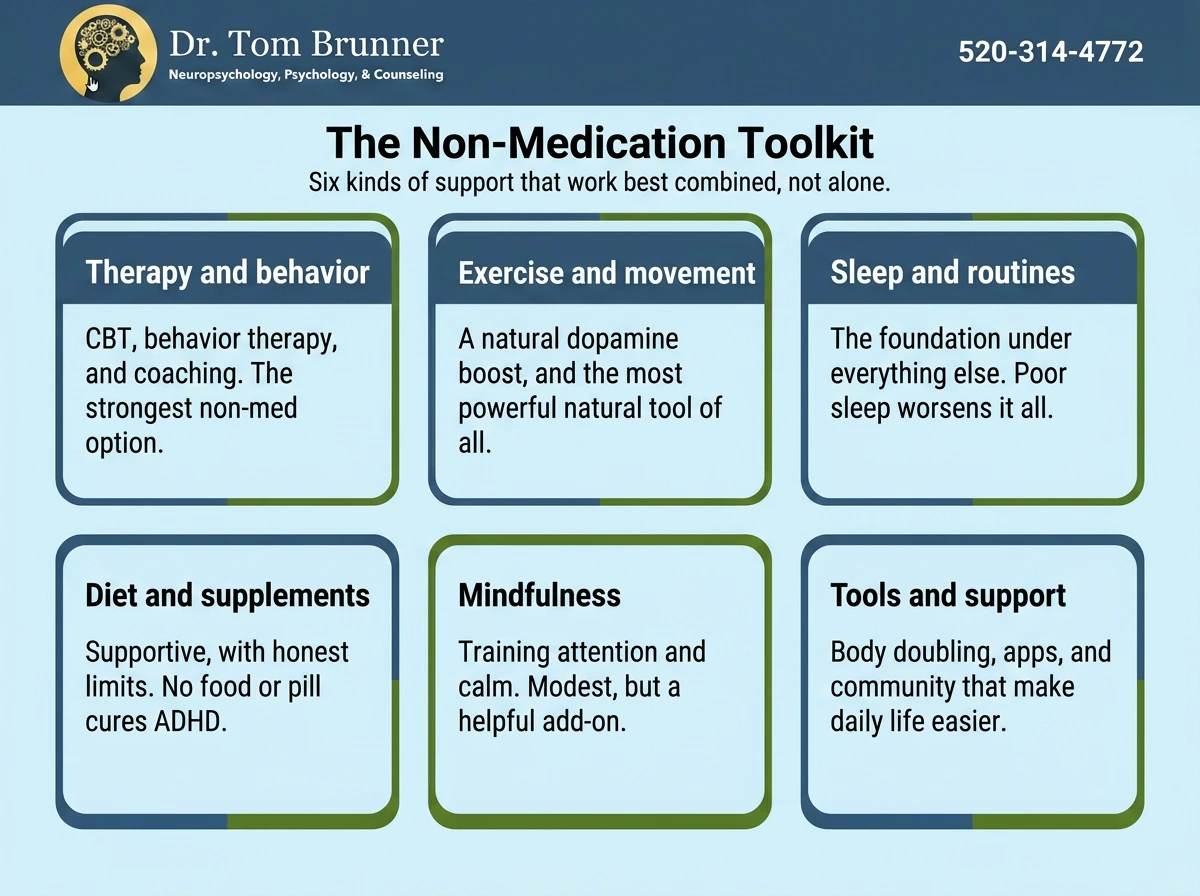
Notice that these range from strongly supported (therapy, exercise) to modest (diet, mindfulness) to practical everyday tools. A good plan usually pulls from several. Let us go through them, strongest evidence first.
Therapy and Behavioral Approaches
Of all the non-medication options, structured therapy has the strongest evidence, and it is the backbone of any medication-free plan. For adults, cognitive behavioral therapy (CBT) is the standout: it teaches concrete skills for time management, organization, and follow-through, while reworking the negative thought patterns that build up over years of struggle.
For children, the picture is even clearer. Leading pediatric guidelines recommend evidence-based behavior therapy, often delivered through parent training, as the first-line treatment for preschoolers, before medication. It teaches parents and kids practical routines, clear expectations, and positive reinforcement. Alongside therapy, ADHD coaching offers hands-on, forward-focused help building day-to-day systems. Together, these approaches do what no pill can: they build lasting skills.
Exercise, Sleep, and Daily Structure
If therapy is the backbone, lifestyle is the foundation, and exercise is its star. Research consistently ranks physical activity as the most effective natural approach for ADHD. Aerobic exercise boosts dopamine and norepinephrine, the very brain chemicals that run low in ADHD, which is why even twenty to thirty minutes of movement can sharpen focus and steady mood. The catch is that the benefit fades if you stop, so consistency matters more than intensity.
Sleep is the quiet foundation beneath everything. Poor sleep makes every ADHD symptom louder, yet ADHD often makes sleep harder, a frustrating loop. Good sleep habits, a consistent schedule, a wind-down routine, and less screen time at night, pay off enormously, and for children, a doctor may suggest melatonin. Finally, structure itself is a treatment: predictable routines, a tidy and low-distraction environment, and reliable systems for reminders all reduce the mental load an ADHD brain carries. None of these is flashy, but together they move the needle.
Focus Tools: Body Doubling, Music, and Apps
Beyond the big categories, a few everyday tools have become ADHD favorites for a reason. The most popular is body doubling: simply working alongside another person, in the room or on a video call, so their presence helps you start and stay on task. It sounds almost too simple, but for beating procrastination and task paralysis, many people find nothing works better.
Background sound is another common aid. Many people with ADHD focus better with certain music, brown or white noise, or instrumental focus playlists, which seem to give a restless brain just enough stimulation to settle. Some prefer lyric-free tracks or steady, repetitive beats so the words do not compete with their thinking, while others swear by the low rumble of brown noise. The evidence here is limited, but it is low-risk and highly personal, so it is worth experimenting to find what helps you. And a whole ecosystem of apps can externalize your memory, structure your time, and gently hold you accountable. These tools do not treat ADHD, but they make living with it noticeably easier.
Diet and Supplements: What the Evidence Says
Nutrition is where marketing gets loudest, so here is the measured truth. No diet cures ADHD, but balanced, whole-food eating that keeps blood sugar steady supports focus and mood. A protein-rich breakfast, complex carbohydrates, plenty of produce, and regular meals cover the basics. A sensitive minority of children react to artificial dyes and additives, so cutting back on ultra-processed foods is a reasonable, low-risk experiment.
On supplements, keep expectations realistic. Omega-3 fatty acids have the most evidence, but even that is a small, modest effect, not a transformation. For vitamins and minerals like magnesium, zinc, iron, vitamin D, and B12, the rule is simple: they help if a blood test shows you are genuinely low, and do little if you are not. Be skeptical of products marketed as ADHD “brain boosters,” which are largely unregulated and unproven, and always check with a doctor before starting anything, since more is not better and some supplements can be harmful in excess.
Mindfulness, Neurofeedback, and What to Approach with Caution
Mindfulness and meditation have a genuine, if modest, evidence base. Regular practice can improve attention and, especially, emotional regulation, helping you notice a racing mind or an impulsive urge and gently steer back. It will not erase core symptoms, but as a low-cost, low-risk addition, it is worth a try. Even a few minutes a day can build a useful internal skill over time.
Two areas call for more caution. Neurofeedback, which trains brainwaves using real-time feedback, is heavily marketed and popular, but the science is underwhelming: when studies are properly blinded, its benefits largely disappear, suggesting much of the effect is placebo. It is safe, but it is also expensive and time-intensive for uncertain results, so go in with clear eyes. And treatments like homeopathy have no credible evidence for ADHD at all. As a rule, be wary of anything promising a natural cure, demanding a lot of money, or discouraging you from proven care.
Evidence at a Glance
Here is how the main non-medication approaches stack up, so you can prioritize what is most likely to help.
|
Approach |
How strong is the evidence |
Best used for |
|---|---|---|
|
Behavior therapy and CBT |
Strong; the best non-med option |
Skills, emotions, behavior; first-line for young kids |
|
Exercise |
Strong for a natural approach |
Focus, mood, and energy; a daily brain boost |
|
Sleep and routines |
Foundational |
Steadying nearly every symptom |
|
Diet and omega-3 |
Small to Modest |
Supporting the brain; a sensitive few react to additives |
|
Other vitamins and minerals |
Helps only if you are deficient |
Correcting a real, tested deficiency |
|
Mindfulness |
Modest |
Attention and emotional regulation |
|
Neurofeedback |
Weak once studies are blinded |
Approach with caution; it is costly |
|
Body doubling and tools |
Practical, not a cure |
Getting started and staying on task |
A simplified summary. Evidence continues to evolve, and individual responses vary widely.
Building Your Non-Medication Plan
With so many options, the key is to be strategic rather than trying everything at once. Here is a sensible way to put a plan together.
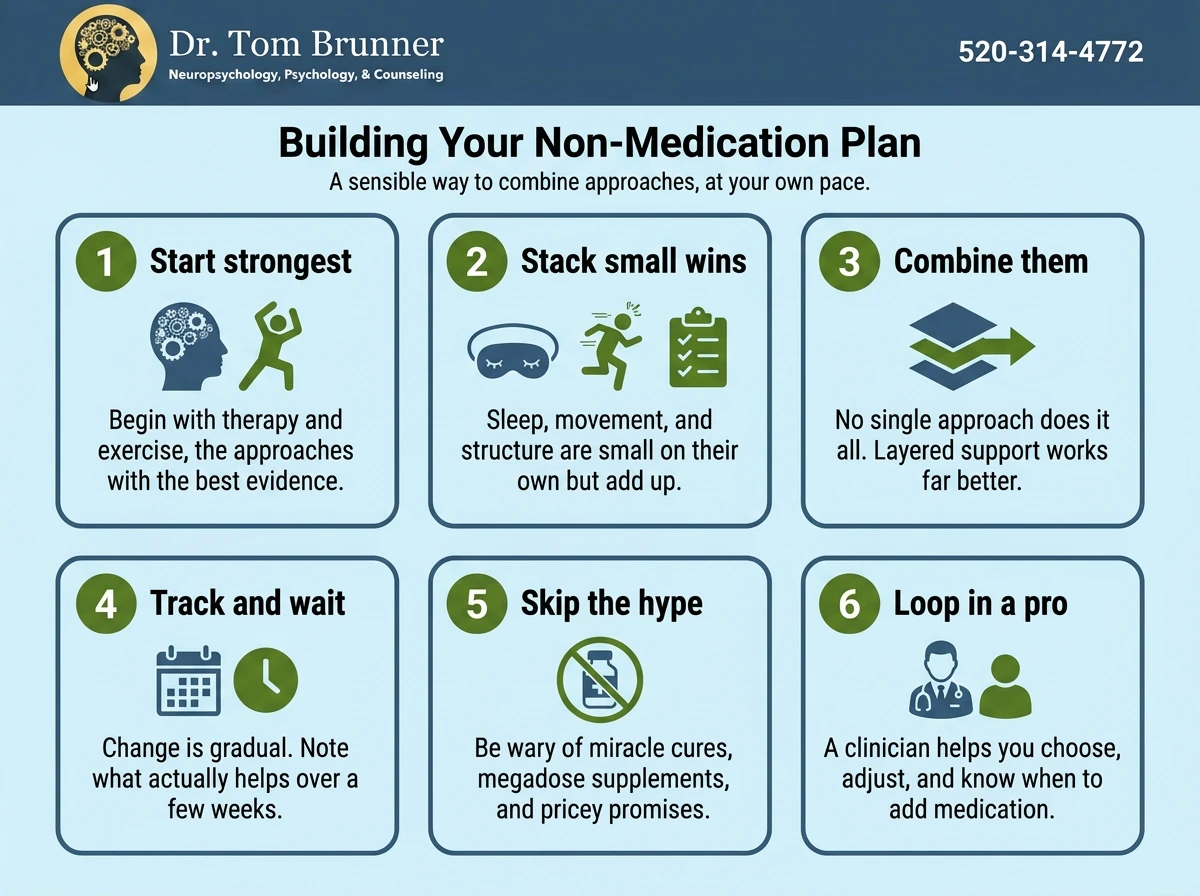
Start with the approaches that have the strongest evidence, therapy and exercise, then stack smaller wins like better sleep, structure, and focus tools. Combine several rather than relying on any single one, because layered support beats a lone silver bullet. Give changes a few weeks and track what genuinely helps, since progress is gradual. Steer clear of overhyped miracle fixes. And keep a professional in the loop, both to guide your choices and to help you recognize if and when adding medication would make everything else work better.
Frequently Asked Questions
Can ADHD be managed without medication?
For some people, yes, especially with mild symptoms, in young children (where behavior therapy is first-line), or when medication is not an option. But no non-medication approach matches medication for core symptoms, and the strongest plans often combine several strategies, sometimes including medication.
What is the best natural remedy for ADHD?
There is no single remedy, but the two with the best evidence are structured therapy (especially CBT) and regular exercise. Good sleep, routines, and, for some, omega-3 add further support. Be cautious of anything marketed as a natural cure.
What supplements actually help ADHD?
Omega-3 fatty acids have the most evidence, though the effect is modest. Minerals like magnesium, zinc, and iron help mainly if a blood test shows you are deficient. Talk to a doctor before starting any supplement, and be wary of unregulated “focus” products.
Does body doubling really work for ADHD?
Many people find it one of the most effective tools for getting started and staying on task. Working alongside someone else, in person or on video, provides gentle accountability that makes task initiation far easier. It is not a treatment, but it is a genuinely useful strategy.
Is neurofeedback worth it for ADHD?
The evidence is weak. When studies are properly blinded, neurofeedback’s benefits largely disappear, pointing to a placebo effect. It is safe but expensive and time-consuming, so approach it with realistic expectations and discuss it with a professional first.
Sources
The information in this article was drawn from the following authoritative sources. Each link goes to the original publication.
CHADD: New Research on Non-Medication Therapies. Reviews the long-term evidence for non-medication approaches to ADHD.
Children and Adults with Attention-Deficit/Hyperactivity Disorder (CHADD). National nonprofit with evidence-based ADHD resources.
Attention Deficit Disorder Association (ADDA). Nonprofit focused on adults with ADHD, including non-medication strategies.
National Institute of Mental Health (NIMH): ADHD. Federal research summary on ADHD treatment.
The Bottom Line
Managing ADHD without medication is genuinely possible for some people, and helpful for nearly everyone as part of a bigger plan. The tools that work best are the least glamorous: therapy, exercise, sleep, structure, and steady daily habits, supported by practical tricks like body doubling and a modest boost from good nutrition.
Set your expectations honestly. No natural remedy cures ADHD, and the flashiest, priciest options are often the least proven. Focus your energy on the approaches backed by evidence, combine several, and give them time to add up.
Most of all, keep this a partnership with a professional. Whether or not medication ends up being part of your plan, the goal is the same: to build a life that works with your ADHD brain. With the right mix of support, that is well within reach.