

Parenting a child with ADHD can feel like running a race where the finish line keeps moving. The mornings are chaotic, homework turns into a battle, and the advice that works for other kids does not seem to stick. If that sounds familiar, take a breath. Your child is not broken, and you are not failing. ADHD just means their brain works differently, and it responds to a different playbook.
The good news is that ADHD is one of the most treatable conditions in childhood. With the right mix of support, structure, and, when needed, treatment, kids with ADHD grow into capable, thriving adults. This guide walks through what actually helps, from early intervention and parent training to school support, teen treatment, and the truth about diet.
This article is for general education only. It is not a substitute for medical advice. If you think your child may have ADHD, talk to a pediatrician or licensed provider for a proper evaluation.
First Steps After an ADHD Diagnosis
A diagnosis can bring a wave of feelings, from relief to worry. Once the dust settles, a few first steps set you up well:
- Learn how ADHD shows up in your child. Every child is different. Knowing their specific challenges helps you target support.
- Build a team. Your pediatrician, your child’s teacher, and sometimes a therapist all play a role.
- Start with structure. Predictable routines help at every age and cost nothing.
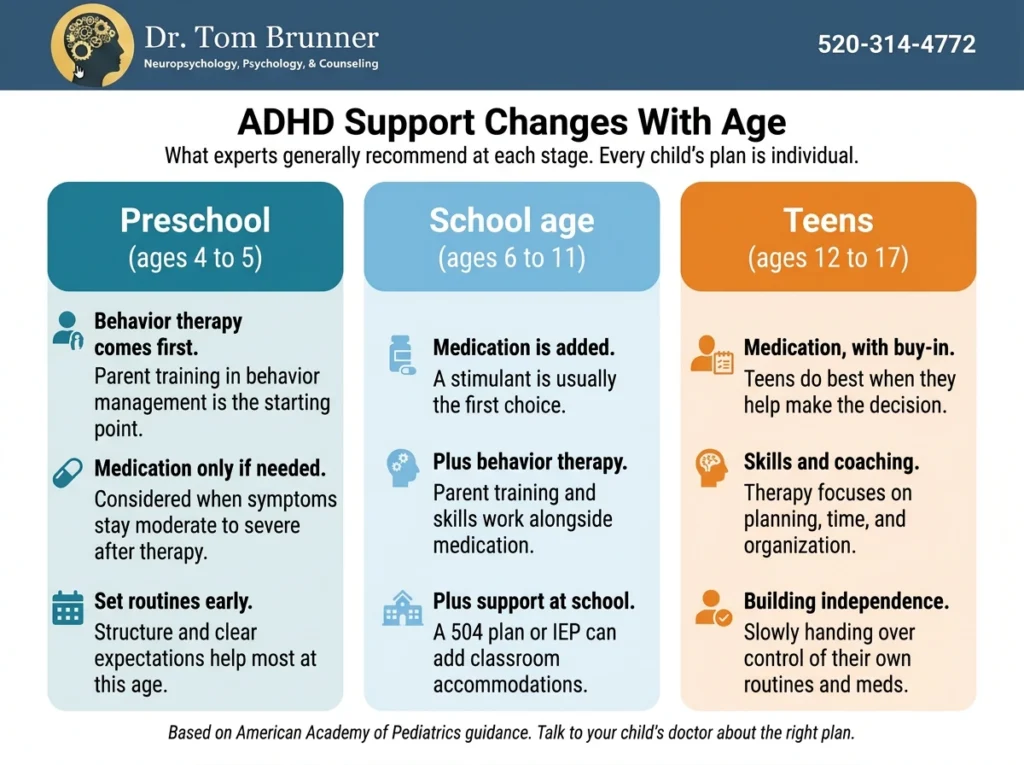
- Match treatment to age. What works for a preschooler is different from what works for a teen, as the guide below shows.
Early Intervention: Why Starting Young Matters
The earlier ADHD is spotted and supported, the better. The American Academy of Pediatrics recommends that doctors evaluate any child age 4 and up who shows attention or behavior problems, which means help can start well before grade school. Early support does not just ease symptoms now. It can prevent years of frustration, low self-esteem, and school struggles down the road.
In preschoolers, ADHD can look like constant motion, big emotions, trouble taking turns, or not listening. These behaviors are common in all young children, so the key is how often and how intensely they happen, and whether they get in the way of daily life. Some young children with ADHD also have delays in speech or coordination, which is worth mentioning to your pediatrician.
For children ages 4 and 5, the first step is not medication. It is behavior therapy, delivered mainly through the parents. That approach has the strongest evidence for this age group, which brings us to parent training.
Early support does not have to be complicated. It often looks like a steady daily routine, clear and simple rules, lots of praise for small wins, and a calm response when things go sideways. Preschool and daycare teachers can be partners too, using the same approach so your child gets a consistent message at home and away. The aim at this stage is to build good habits and protect your child’s confidence before school piles on new demands.
Behavioral Parent Training
Behavioral parent training, sometimes called parent training in behavior management, is exactly what it sounds like. A therapist teaches you, the parent, specific skills to encourage the behavior you want and reduce the behavior you do not. You become the main agent of change, since you are with your child far more than any therapist could be.
It is not about being stricter. It is about being clearer and more consistent. Parents learn to give effective instructions, use praise and rewards well, set up simple routines, and respond calmly to tough moments. Well-known programs include Parent-Child Interaction Therapy, the Incredible Years, and Triple P, among others. Your pediatrician can point you to one in your area.
Behavioral parent training is the first-line treatment for young children, and it stays useful right through the school years. It also tends to reduce parent stress, which helps the whole household.
Everyday Parenting Strategies That Help
You do not need a formal program to start using the same principles at home. These strategies come straight from behavior therapy and work for most kids with ADHD.
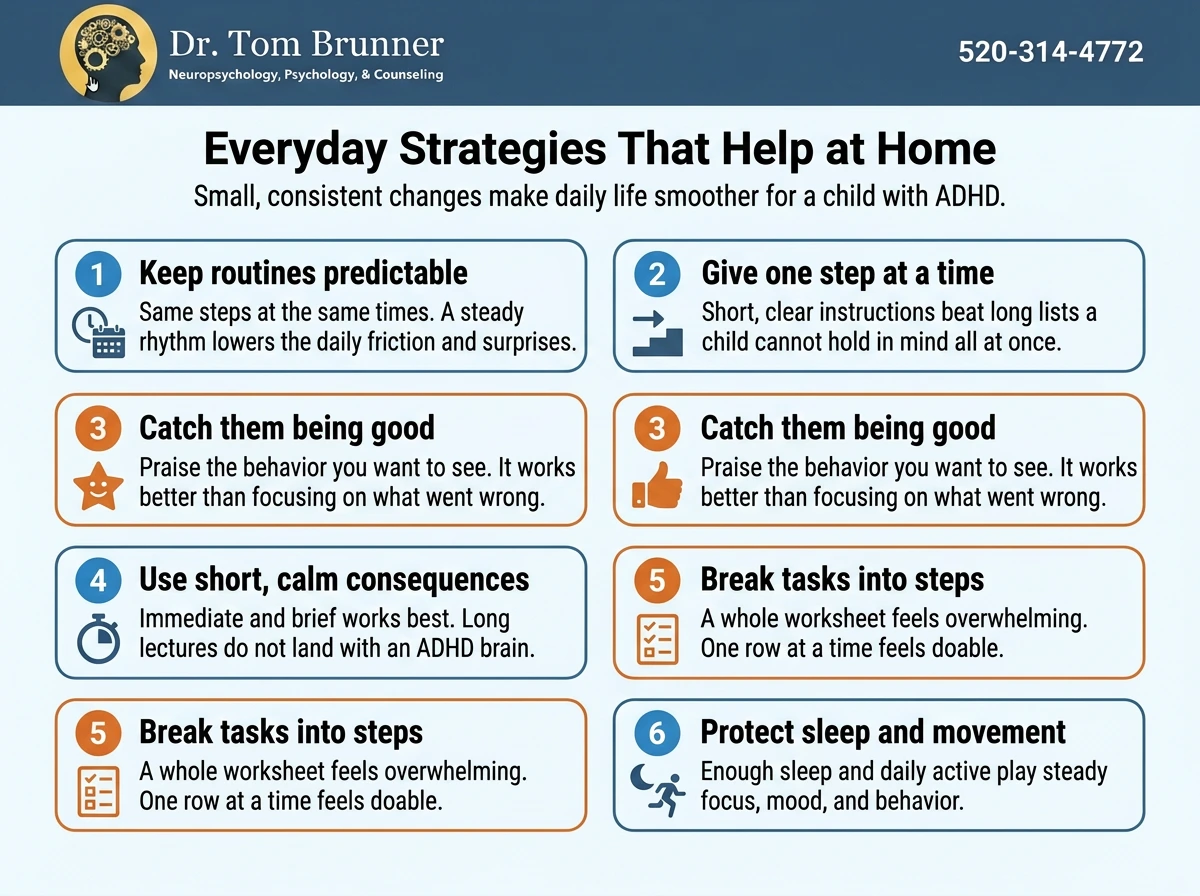
The thread running through all of these is consistency. Kids with ADHD do best when the world around them is steady and predictable, so their brain can spend less energy guessing what comes next. Progress is rarely a straight line, so celebrate small wins and keep going.
Here is what that looks like in practice. Take the morning rush, a classic ADHD flashpoint. Instead of calling out a string of tasks (“get dressed, brush your teeth, pack your bag, put on shoes”), you post a short picture checklist and ask for one thing at a time. You praise each step as it happens. You build in a couple of extra minutes so a slow start does not blow up into a fight. None of this is fancy. It just works with the ADHD brain instead of against it.
Support at School and in the Classroom
School is where ADHD often shows up most, because it asks kids to sit still, focus, and stay organized for hours. The good news is that children with ADHD have legal rights to support at school. Two kinds of plans can help, and it is worth knowing the difference.
|
Feature |
IEP |
504 Plan |
|---|---|---|
|
What it is |
A special education plan under federal law (IDEA) |
A plan to remove barriers under Section 504 |
|
Who it is for |
Students who need specialized instruction to learn |
Students who need a smaller degree of accommodations |
|
What it provides |
Specific services, goals, and specialized teaching |
Accommodations like extra time or a quiet workspace |
|
The process |
A formal evaluation and a written plan reviewed each year by the whole team |
Usually a simpler, faster process |
General overview. A school counselor or special education coordinator can explain which plan fits your child.
Whichever plan a child has, common classroom accommodations include:
- Extra time on tests and assignments
- A seat near the teacher and away from distractions
- Instructions given in writing as well as out loud
- Short movement breaks during long tasks
- Help breaking big projects into smaller steps
Treating ADHD in Teens
The teen years bring new challenges. Schoolwork gets harder and more independent, social life gets more complicated, and driving enters the picture. ADHD does not disappear at this age, but the way you support it shifts.
For teens, treatment usually combines medication with skills training that targets planning, time management, and organization. One big change is that teens need to be part of the decision. A teenager who feels forced onto medication often stops taking it, while one who understands why and helps choose is far more likely to stick with it. The goal across these years is to slowly hand over the reins, so your teen learns to manage their own routines, homework, and eventually medication.
One safety note worth flagging: teens with untreated ADHD have a higher risk of car crashes, and research suggests treatment lowers that risk. It is a good topic to raise with your teen’s doctor as they start driving.
The teen years also carry an emotional weight. After years of hearing what they did wrong, many teens with ADHD struggle with low self-esteem, and they face a higher risk of anxiety and depression. Watch for it, keep the conversation open, and get help early if you see warning signs. Reminding your teen that ADHD is a difference in how their brain works, not a character flaw, matters more than any single strategy.
Medication for Children and Teens
Medication is not the right choice for every child, but for many it is a major help. For school-age children and teens, the AAP recommends FDA-approved medication along with behavior therapy and school support. Stimulants are usually the first choice and have decades of research behind them. Nonstimulant options exist for children who do not respond well or have side effects.
Medication does not teach skills or fix everything on its own. It works best as one part of a plan that also includes structure at home, support at school, and behavior strategies. Finding the right medication and dose can take some trial and adjustment, so stay in close touch with your prescriber during the early weeks.
Diet Tips: Foods to Eat and Foods to Avoid
Parents often ask whether diet can help. The honest answer: food does not cause ADHD, and no diet cures it, but a healthy diet supports a child’s brain, mood, and energy. Research summarized by the Child Mind Institute and others points to a few reasonable steps.
|
Approach |
What the evidence says |
|---|---|
|
A balanced diet |
The foundation. Protein, whole grains, fruits, vegetables, and fish support steady focus and energy. |
|
Omega-3s (fish or supplements) |
May help a little for some children. The effect is small, and it is not a treatment on its own. |
|
Limiting artificial food dyes |
A subgroup of children seem sensitive. Cutting dyes may help those kids, though not all. |
|
Elimination diets |
Can help a small group, but they are restrictive. Do them only with a doctor or dietitian. |
|
Supplements (iron, zinc, and so on) |
Helpful mainly if a child is truly low. More is not better and can be harmful. |
|
Cutting sugar |
Sugar does not cause ADHD. A balanced diet still matters for energy and sleep. |
Nutrition can support treatment, but it does not replace it. Talk to your pediatrician before making big diet changes.
Frequently Asked Questions
How do you parent a child with ADHD?
With structure, clear one-step instructions, plenty of praise for good behavior, and calm, consistent consequences. Predictable routines and short, doable tasks help most. Behavioral parent training can teach these skills in depth.
What are the signs of ADHD in a 5-year-old?
Constant motion, trouble taking turns, big emotional reactions, not listening, and difficulty following simple directions. Many young children do these things sometimes. It points to ADHD when the behaviors are frequent, intense, and get in the way of daily life across different settings.
Is ADHD linked to speech delay?
Some children with ADHD also have delays in speech or language, though one does not cause the other. If your child is behind on talking, mention it to your pediatrician, who can arrange an evaluation and, if needed, speech therapy.
Can you get a service dog for a child with ADHD?
In some cases, yes. Service or emotional support animals can help certain children with focus, routine, and calming down, though they are not a standard treatment. Talk with your provider about whether it fits your child’s needs.
What is behavioral parent training?
It is a program where a therapist teaches parents specific skills to manage behavior, such as giving clear instructions and using praise and rewards well. It is the first-line treatment for young children with ADHD and helps at older ages too.
Why does my child with ADHD have such big meltdowns?
Strong emotions are part of ADHD. The same brain differences that affect focus also make it harder to hit the brakes on frustration, so feelings can boil over fast. Meltdowns are not manipulation or bad behavior. They ease with predictable routines, calm responses, and treatment that supports emotional regulation.
Will my child grow out of ADHD?
Not usually, but it often changes. Hyperactivity tends to fade with age, while attention and organization challenges frequently continue into adulthood. The skills, structure, and support your child builds now help them manage ADHD well for the long run, whether or not symptoms ease.
Sources
The information in this article was drawn from the following sources. Each link goes to the original publication.
American Academy of Pediatrics: ADHD Clinical Practice Guideline. Age-specific recommendations for evaluating and treating ADHD in children and teens.
Centers for Disease Control and Prevention (CDC): About ADHD. Overview of ADHD symptoms, diagnosis, and treatment, including behavior therapy.
Children and Adults with Attention-Deficit/Hyperactivity Disorder (CHADD). National nonprofit with parent and family resources, including parent training and school support.
Child Mind Institute: What We Know About ADHD and Food. Plain-language review of the evidence on diet, supplements, and ADHD.
National Institute of Mental Health (NIMH): ADHD. Federal research summary on ADHD across childhood and treatment options.
The Bottom Line
Parenting a child with ADHD is not about trying harder. It is about trying differently. The approaches with the best evidence are behavior therapy and parent training for young children, a combination of medication, therapy, and school support as kids get older, and a steadily larger role for teens in managing their own care.
A few practical moves make a real difference: keep routines predictable, give clear one-step instructions, catch your child being good, and get support at school through a 504 plan or an IEP. Diet can help around the edges, but it is a support, not a cure.
Most of all, remember that your child’s ADHD is not your fault, and it does not define their future. Kids with ADHD are often creative, energetic, and resilient. With the right support around them, those strengths are what people remember most.