

If you or your child has ADHD, one of the first questions is usually why. Did something cause it? Was it something a parent did, or did not do? Was it screens, sugar, or the way life is now? These are fair questions, and they deserve straight answers.
Here is the honest picture from decades of research: ADHD is mostly something people are born with. It runs in families, it shows up in the structure and chemistry of the brain, and it is not caused by lazy parenting or too much screen time. This guide walks through what the science actually says, from genes to dopamine to the parts of the brain involved, in plain language.
This article is for general education only. It is not a substitute for medical advice. If you think you or your child may have ADHD, talk to a licensed healthcare provider for a proper evaluation.
What Causes ADHD? The Short Answer
There is no single cause of ADHD, and no one thing you can point to and blame. Instead, ADHD comes from a mix of factors, with genes doing most of the heavy lifting. Here is the short version before we dig into each piece:
- Genes are the main driver. ADHD is one of the most inheritable conditions in mental health. It runs strongly in families.
- The brain develops and works a little differently. Certain areas mature later, and the brain’s chemical messengers are regulated in their own way.
- Some early-life factors can add risk. Things like being born very early or certain exposures during pregnancy can raise the odds, but they do not act alone.
- Everyday myths are not causes. Sugar, screen time, parenting style, and vaccines do not cause ADHD.

Is ADHD linked to Genetics?
Yes. Genetics is the single biggest reason a person has ADHD. It runs in families the way height or eye color does. If a parent has ADHD, their child is much more likely to have it too, and the same goes for brothers and sisters. Studies of twins, families, and adopted children all point the same direction. Research summarized in the peer-reviewed Genetics of ADHD review puts the heritability at around 74%, and some studies estimate it as high as 80%. That makes ADHD about as inheritable as height, and more inheritable than most other mental health conditions.
That does not mean there is one “ADHD gene” you can test for. ADHD is polygenic, which means many different genes each add a tiny bit of risk. No single one causes it on its own. It is the combination, inherited from both sides of the family, that shapes whether ADHD shows up and how strong it is. This is why ADHD can look a little different from one family member to the next.
How do researchers know it is so genetic? A lot of the proof comes from twin studies. Identical twins share all of their genes, while fraternal twins share about half. If one identical twin has ADHD, the other very often does too, far more often than with fraternal twins. That gap is what points to genes rather than upbringing, since twins usually grow up in the same home. Adoption studies point the same way: children tend to resemble their biological parents on ADHD more than the parents who raised them.
The ADHD Brain: What Is Different
ADHD is not a willpower problem. Brain imaging shows real differences in how certain areas of the brain develop and talk to each other. According to the National Institute of Mental Health, ADHD is a neurodevelopmental condition, which means it is tied to how the brain grows and is wired from an early age.
Much of the action centers on the prefrontal cortex, the area right behind your forehead. This is the brain’s control center. It handles focus, planning, decision-making, and impulse control, the same kinds of tasks a manager juggles at work. In ADHD, research shows this region tends to mature a few years later than usual, which helps explain why self-control and focus can lag behind.
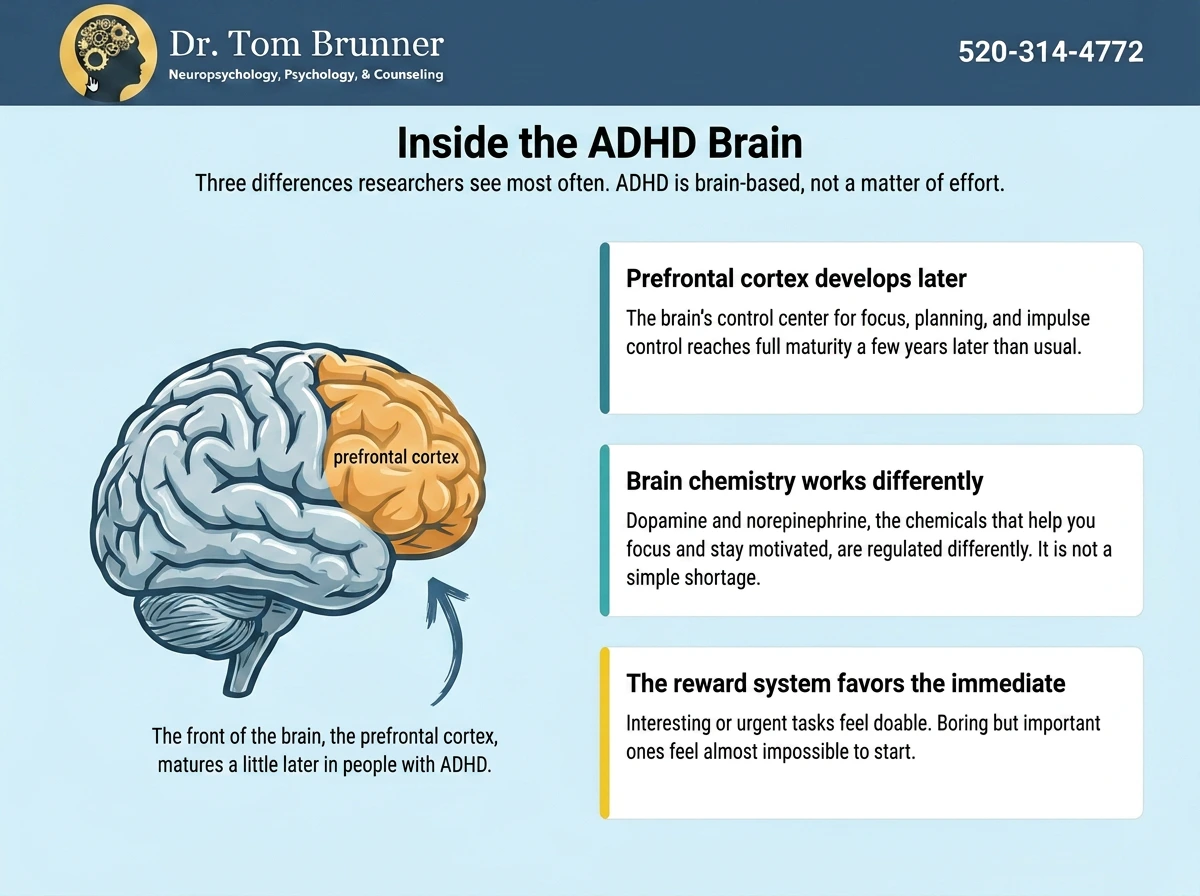
The prefrontal cortex does not work alone. It connects to deeper brain areas that handle movement, motivation, and reward. When the timing and strength of those connections run a little differently, the result can look like the everyday signs of ADHD: trouble starting tasks, forgetting steps, and acting before thinking.
Dopamine and Brain Chemistry
Brain cells talk to each other using chemical messengers called neurotransmitters. Two of them matter most in ADHD: dopamine and norepinephrine. Both help the brain focus, stay motivated, and manage reward. In ADHD, these chemicals are regulated differently. Here is what the main players do.
| Chemical messenger | What it does | Its role in ADHD |
|---|---|---|
| Dopamine | Drives motivation, reward, and the sense that something is worth doing | Regulated differently, so immediate rewards feel more urgent than long-term ones |
| Norepinephrine | Helps the brain stay alert and focused, especially in the prefrontal cortex | Signaling differences make it harder to sustain attention |
| GABA | Calms brain activity and helps filter out distractions | Less efficient signaling may add to restlessness and distractibility |
General summary of neurotransmitter research in ADHD. The science is still developing, and no single chemical explains the whole condition.
It is tempting to call ADHD a simple “chemical imbalance,” but that is not quite right. The issue is less about having too little of a chemical and more about how the brain uses and recycles it. Dopamine is closely tied to the brain’s reward system. When dopamine signaling runs differently, immediate rewards feel far more compelling than distant ones. That is why a person with ADHD can lose hours to something interesting but stall out on a boring task, even one they care about.
This also explains how ADHD medications work. Stimulant medications increase the amount of dopamine and norepinephrine available in the brain, which helps the focus and self-control systems do their job. It is not about adding energy. It is about helping the brain regulate the chemicals it already has.
Executive Function: How the Differences Show Up
All of this brain science shows up in daily life through something called executive function. Executive function is the set of mental skills the prefrontal cortex manages, the brain’s version of a project manager. It includes:
- Starting tasks, especially boring or hard ones
- Holding information in mind, known as working memory
- Planning ahead and managing time
- Controlling impulses and resisting distractions
- Managing emotions when they run high
When these skills work differently, doctors call it executive dysfunction. It is why a person with ADHD might be smart and capable yet still lose their keys, miss deadlines, or forget what someone just said. Short-term and working memory often take a hit, so details slip away even when the person is trying hard. None of this reflects a lack of intelligence. It reflects how the brain’s management system is running.
A few everyday examples make it concrete. Knowing you need to start a report but feeling frozen until the night before is a task-initiation problem. Walking into a room and forgetting why is a working-memory hiccup. Snapping at a small annoyance is emotional regulation running fast. These are not character flaws. They are the same brain differences showing up in ordinary moments.
Other Things That Can Raise the Risk
Genes and brain development explain most of ADHD, but a few other factors can add to the risk. These do not cause ADHD by themselves, and having one does not mean a child will develop it. They simply nudge the odds:
- Being born very early or very small. Premature birth and low birth weight are linked to a higher chance of ADHD.
- Certain exposures during pregnancy. Alcohol and tobacco use during pregnancy, and exposure to lead in early childhood, are associated with higher risk.
- Low iron stores. Some research links low iron, measured as ferritin, to ADHD symptoms, since iron helps the body make dopamine. The evidence is mixed, and low iron is seen as a possible contributor, not a proven cause. A provider may check iron levels as part of an evaluation.
It is worth repeating that these are pieces of a larger picture. In most cases, the strongest thread running through ADHD is the one a person is born with.
What Does Not Cause ADHD
A lot of popular beliefs about ADHD are simply wrong, and they can leave parents feeling blamed for something they did not cause. Here is what the research actually says about the most common myths.
| Common belief | What the research says |
|---|---|
| Too much sugar causes ADHD | Sugar can affect energy for a short time, but it does not cause ADHD. |
| Screen time causes ADHD | Screens can affect attention and sleep, but they do not create the condition. |
| Bad parenting causes ADHD | Parenting does not cause ADHD. Good parenting helps a child manage it, but it did not cause it. |
| Vaccines cause ADHD | There is no link between vaccines and ADHD. |
| ADHD is not real | ADHD is a well-studied, brain-based condition recognized by every major medical body. |
If you are a parent reading this, take a breath. ADHD is not something you did. It is a brain-based condition your child was most likely born with, and understanding that is the first step toward helping them.
Can You Develop ADHD Later in Life?
This is one of the most common questions, and the answer has a twist. ADHD is not something that appears out of nowhere in adulthood. To fit the diagnosis, the signs have to trace back to childhood, generally before age 12. The brain differences behind ADHD are present from early on.
So why are so many adults diagnosed for the first time later in life? Usually because their childhood symptoms were missed, especially in people who were quiet or high-achieving, or in girls and women whose signs looked different. The ADHD was there all along. Life just got harder to manage as demands piled up, which finally brought it to light. Researchers are still debating whether a true “adult-onset” form exists, but for now, a childhood history is part of the diagnosis.
Frequently Asked Questions
Is ADHD hereditary?
Yes. ADHD is highly hereditary. If a parent or sibling has ADHD, other family members are much more likely to have it. Heritability is estimated at around 74% to 80%, making it one of the most inheritable mental health conditions.
Where does ADHD come from?
Mostly from genes. ADHD is passed down through families and shows up in how the brain develops and uses chemicals like dopamine. Early-life factors can add some risk, but genetics is the main source.
Is ADHD a chemical imbalance?
Not exactly. That phrase is an oversimplification. ADHD involves how the brain regulates and uses dopamine and norepinephrine, not simply having too little of them. The difference is in the signaling, not just the amount.
Does ADHD affect IQ?
No. ADHD is not related to intelligence. People with ADHD span the full range of IQ, including very high. ADHD affects focus, memory, and self-control, which can make it harder to show what a person knows, but it does not lower intelligence.
Does ADHD cause memory problems?
It can affect working memory and short-term memory, the kind you use to hold information in mind for a moment. This is why details and instructions can slip away. It is a feature of how the ADHD brain manages information, not a sign of a failing memory overall.
Does taking Tylenol during pregnancy cause ADHD?
The research is mixed and the topic is debated. Some earlier studies suggested a small link, but the largest and most rigorous studies, which compared siblings to account for genetics and family factors, found no causal link. Guidance has shifted back and forth, so anyone who is pregnant should follow the advice of their own doctor. The American College of Obstetricians and Gynecologists has a current summary of the evidence.
Sources
The information in this article was drawn from the following authoritative sources. Each link goes to the original publication.
Centers for Disease Control and Prevention (CDC): About ADHD. Overview of ADHD, its symptoms, and known risk factors.
National Institute of Mental Health (NIMH): ADHD. Federal research summary on ADHD as a neurodevelopmental condition, including brain and genetic findings.
Genetics of Attention Deficit Hyperactivity Disorder (peer-reviewed review). Summary of twin, family, and genome studies, including heritability estimates.
Children and Adults with Attention-Deficit/Hyperactivity Disorder (CHADD). National nonprofit funded in part by the CDC, with family-facing resources on ADHD.
American College of Obstetricians and Gynecologists (ACOG): Acetaminophen Use in Pregnancy. Current review of the evidence on prenatal acetaminophen and neurodevelopmental outcomes.
The Bottom Line
ADHD is mostly something people are born with. Genes are the biggest cause, which is why it runs so strongly in families. On top of that, the ADHD brain develops and uses its chemistry a little differently, especially in the prefrontal cortex and in how it handles dopamine. A few early-life factors can add some risk, but they do not act alone.
Just as important is what does not cause ADHD. It is not sugar, screens, vaccines, or parenting. If you have been carrying guilt or confusion about where ADHD came from, the science offers some relief: it is a brain-based condition, not a personal failing.
Understanding the cause changes how you respond to it. When you know ADHD comes from how the brain is built, the goal shifts from trying harder to building the right supports. That is where real progress begins, for both kids and adults.